📖 Read more: Metaverse 2026: What Happened to the Big Promise
🏃 What Is Full Body Tracking?
Most VR headsets (Meta Quest 3, PSVR2, Valve Index) only track your head and hands — via the headset and controllers. Your legs, torso, and elbows remain “invisible” to the system. VR software uses Inverse Kinematics (IK) to “guess” their positions, but the results are far from perfect: feet slide through the floor, sitting looks unnatural, and dancing becomes comedic.
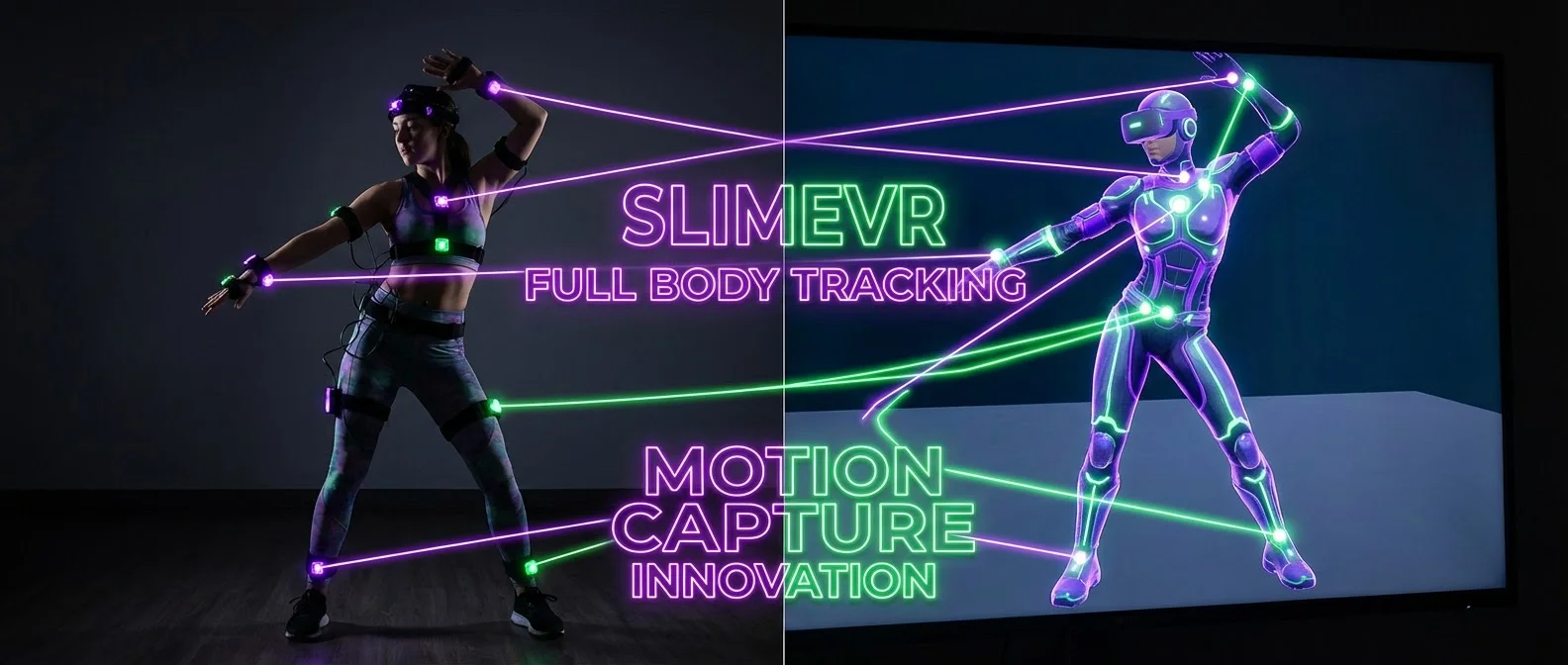
Full body tracking solves this by placing sensors (trackers) on additional body points: typically shins, waist, elbows, and feet. Each tracker provides 6 degrees of freedom (6DOF) — position (X, Y, Z) plus orientation (roll, pitch, yaw). With 3-8 extra trackers, your VR avatar replicates every step, dance move, or kick in real time.
⚙️ How It Works: FBT Technologies
There are three main approaches to body tracking for VR. Each one has its own advantages and drawbacks depending on your budget, available space, and the accuracy you need.
Optical (Outside-In)
External cameras or base stations (Lighthouse) track markers or IR LEDs on the body. Used by VIVE Trackers and professional mocap. Sub-millimeter accuracy (0.1mm), but requires line of sight and a permanent installation.
Inertial (IMU-Based)
Tiny sensors (accelerometer + gyroscope + magnetometer) strapped to limbs calculate orientation. The technology powering SlimeVR, HaritoraX, and Tundra Trackers. Affordable and portable, but subject to drift (cumulative error) over time.
AI Camera (Inside-Out)
Computer vision algorithms estimate body pose from a camera feed (e.g., Kinect, webcam, Quest 3 body tracking beta). No additional hardware needed, but accuracy depends on lighting, angle, and occlusion limitations.
Magnetic Systems
Calculate position via magnetic flux from three orthogonal coils in a transmitter-receiver pair. Provide 6DOF per marker without line of sight. Drawbacks: small capture volume, sensitivity to metal objects, and electromagnetic interference.
Mechanical Exoskeleton
Skeletal structures with potentiometers at joints directly track joint angles. Cost $25,000-$75,000, no occlusion or drift issues, but bulky and restrictive. Primarily used in industrial and research motion capture settings.
Stretch Sensors
Flexible silicone capacitors that measure stretch, bend, and pressure. Immune to magnetic interference and free from positional drift. However, low signal-to-noise ratio requires filtering or machine learning — increasing latency.
🎯 Top FBT Systems in 2026
The full body tracking market has matured significantly. From DIY open-source projects to premium commercial solutions, there's an option for every budget. Here's a comparison of the leading systems:
FBT Systems Comparison 2026
SlimeVR
The most popular community-driven FBT project. Open-source firmware, available as DIY or pre-built kits. Uses BMI270/BMI160 IMU sensors with wireless WiFi connectivity via ESP8266/ESP32. Starting at ~$75 for 5 trackers, ~$150 for a full 11-point set. Drift correction through sensor fusion algorithms (Mahony/Madgwick). The community continuously develops firmware updates.
VIVE Ultimate Trackers
HTC's newest generation of trackers. No Lighthouse base stations required — they use built-in cameras (inside-out tracking) combined with IMU. Compatible with Quest headsets via dongle. ~$200 per unit. Better accuracy than pure IMU, without the overhead of an optical setup. Ideal for VR social apps and dancing.
HaritoraX Wireless
Japanese-designed IMU trackers, hugely popular in the VRChat community. Bluetooth LE connection, 6 trackers (shins, knees, waist, chest). Sets priced at $220-$330. Outstanding battery life (~20 hours). Plug-and-play experience with no technical expertise required. Drift comparable to SlimeVR but with more refined factory calibration.
AI Pose Estimation (Quest 3)
Meta leverages the Quest 3's passthrough cameras for body tracking without external trackers. AI 3D pose estimation models recognize the body in real time. Still in beta, with limitations around occlusion (sitting, bending) and lower accuracy than dedicated trackers. Free software update — potentially a game changer down the road.
📖 Read more: VRChat: What It Is and How to Get Started
🎮 Full Body Tracking Applications
FBT isn't just a gimmick — it's used across multiple domains, from gaming to professional production:
VR Social & VRChat
The #1 use case for FBT. In VRChat, full body avatars dance, sit, do yoga, or hug. Social presence increases dramatically — your body speaks. Over 50% of “VRChat dancers” use FBT, primarily SlimeVR or HaritoraX.
Production Motion Capture
Indie animators and VTubers use consumer FBT as budget motion capture. Apps like VSeeFace, VMC Protocol, and Unreal Engine LiveLink stream motion data to 3D avatars. Animation that once cost $10,000+ can now be done with $150 in gear.
VR Fitness & Sports
Games like Beat Saber, Nock, and Les Mills BodyCombat leverage FBT for more accurate calorie tracking, proper exercise form, and full-body scorekeeping. Accuracy in kick/squat movements improves by ~40% with trackers vs. IK estimation.
Medical Rehabilitation
Motion capture in clinical settings: gait analysis, post-surgical recovery assessment, gamified physiotherapy exercises. Inertial mocap systems are ideal for home rehab without expensive camera setups.
Gaming
Blade & Sorcery, Boneworks/Bonelab, and Neos VR natively support FBT. Physical interactions (kicks, grabbing objects with feet) unlock gameplay possibilities that are impossible with hand-only tracking.
Enterprise & Training
Worker training in construction, enhanced industrial safety, workplace ergonomic assessments. Full body accuracy enables realistic simulators without risk of injury.
"Inertial motion capture systems capture the full six degrees of freedom body motion of a human in real-time. Benefits include: capturing in a variety of environments including tight spaces, no solving, portability, and large capture areas."
🔬 IMU Sensors: The Heart of Consumer FBT
The majority of consumer full body trackers (SlimeVR, HaritoraX, Sony Mocopi) rely on Inertial Measurement Units — tiny circuit boards combining:
- Accelerometer: Measures linear acceleration. Detects movement in any direction plus gravity — but doesn't know “where” it is, only “how it's moving.”
- Gyroscope: Measures angular velocity (rate of rotation). Extremely accurate in the short term, but accumulates drift over time — a stationary position slowly “slides” away.
- Magnetometer: Acts like a digital compass, measuring the magnetic field. Provides an absolute heading reference, but is affected by nearby metal objects, electrical wiring, and electronic devices.
The three sensors are combined through sensor fusion algorithms (Kalman filter, Madgwick, Mahony) for accurate 3D orientation. This combination is called a 9-DOF IMU (3-axis accelerometer + 3-axis gyro + 3-axis magnetometer). Despite this, IMU trackers don't know their position in space — only their orientation. Position is calculated through a biomechanical model: knowing each joint's angle and limb lengths, the software reconstructs the entire skeleton.
⚠️ Challenges & Limitations
Key FBT Challenges
🔮 The Future: AI & Markerless FBT
The major trend of 2026 is the gradual replacement of physical trackers with AI-based body tracking. Next-gen headsets (Quest 3, Apple Vision Pro, Quest 4 rumors) integrate cameras that “see” the body without any additional hardware.
3D pose estimation techniques using RGB-D cameras (depth + color) are evolving rapidly. Research institutions like Stanford, MIT, and the Max Planck Institute are developing markerless motion capture powered by deep learning. These models recognize human figures, break them down into joints, and reconstruct a full skeleton in real time.
Accuracy keeps improving year over year: machine learning techniques use lazy learning and Gaussian models to automatically clean up noisy Kinect-level data to a quality sufficient even for ergonomic assessments. The era where you'll wear nothing but a headset — and your avatar will mirror every movement — isn't far off.
Key Takeaways
- Full body tracking brings legs, torso, and elbows into VR — beyond just head + hands
- Three core technologies: optical (Lighthouse), IMU (SlimeVR/HaritoraX), AI camera (Quest 3)
- SlimeVR: most affordable open-source option ($75-$150), but IMU drift requires periodic resets
- VIVE Ultimate Trackers: inside-out with no base stations, ~$200/ea, standalone capable
- AI markerless tracking (Quest 3 beta): free, no hardware needed, but still in beta
- Top use cases: VRChat social, indie motion capture, VR fitness, medical rehabilitation
- #1 challenge: IMU drift — cumulative error every 15-30 min, requires recalibration
- The future: AI pose estimation + deep learning will eliminate the need for physical trackers