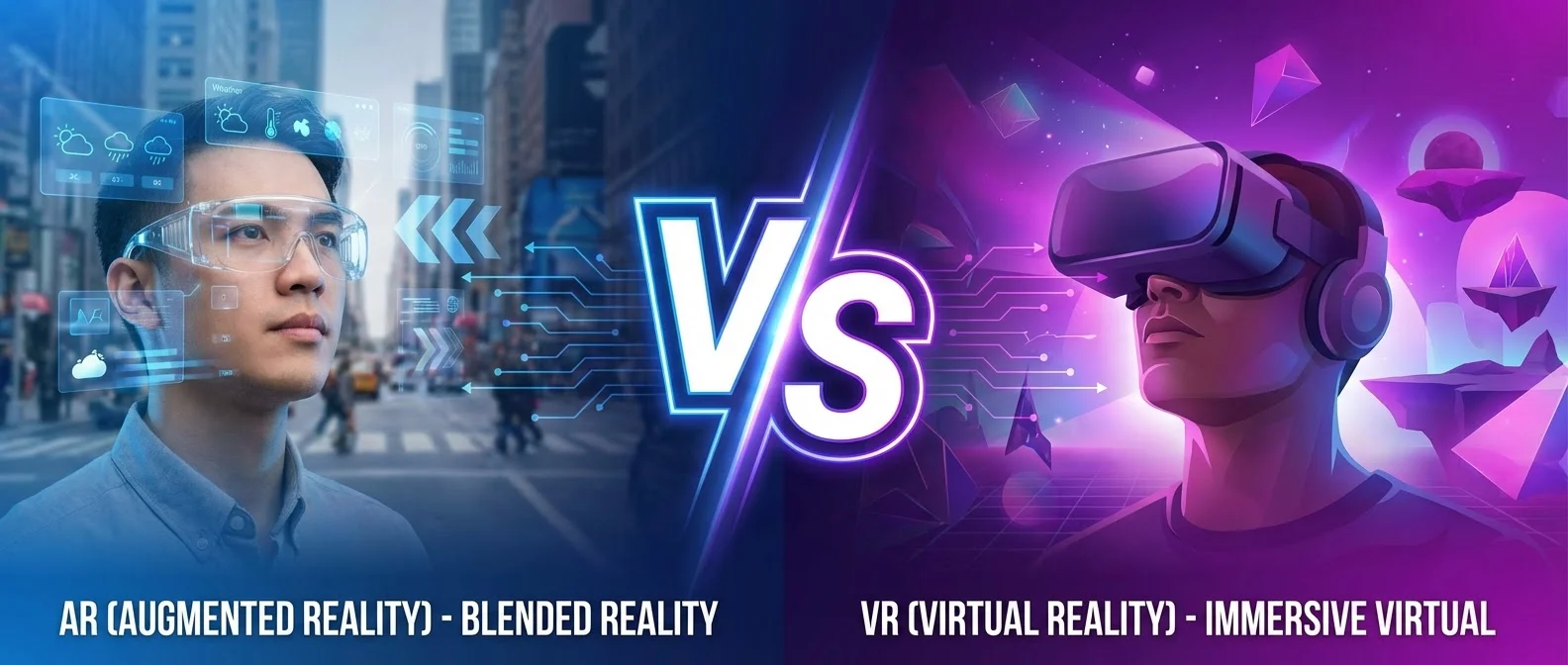
Augmented Reality (AR) and Virtual Reality (VR) were born around the same era, yet they followed radically different paths. In 2026, the two technologies stand at a point of convergence — and simultaneously in direct opposition. Which one will come to dominate our daily lives?
A Tale of Two Worlds
Virtual reality came first. Jaron Lanier coined the term “Virtual Reality” in the late 1980s through his company VPL Research. His firm built the first commercial VR gloves (DataGlove) and headsets (EyePhone). The idea was bold: an entire world inside a device, full immersion with no connection to the physical space.
Augmented reality followed shortly after. The term “Augmented Reality” is attributed to Thomas P. Caudell of Boeing, in 1990. Louis Rosenberg at the USAF's Armstrong Laboratory built the first functional AR system, Virtual Fixtures, in 1992. Rather than replacing the world, AR enriched it — digital objects superimposed on real space.
For two decades, both technologies remained mostly confined to military labs and universities. VR found application in flight simulators and medical training, while AR was used in fighter jet heads-up displays and industrial maintenance.
VR: A World Within a World
Virtual reality means full replacement of the visual field. The user wears a headset that completely covers their eyes and is transported into a digital environment. They see, hear, and ideally feel (through haptic feedback) an entirely artificial world.
Modern VR effectively began with the Oculus Rift Kickstarter in 2012. Palmer Luckey, just 19 at the time, designed a headset that reignited virtual reality dreams. Meta (then Facebook) acquired Oculus in 2014 for $3 billion — a move that signaled VR's transition from niche curiosity to mainstream ambition.
Today, in February 2026, the VR headset market is dominated by Meta. The Meta Quest 2 captured 80% of headset sales in 2021, and the Quest line remains the dominant force. The Meta Quest 3, released in October 2023, introduced mixed reality capabilities with high-resolution video passthrough, pancake lenses, and a wider field of view. The Quest 3S, a more affordable variant with Fresnel lenses, followed in October 2024 at a lower price point.
Sony's PlayStation VR2 (2023) offered eye-tracked foveated rendering, haptic feedback in the controllers, and OLED displays. Apple entered the market with the Vision Pro (2024) at $3,499, a device it insists on calling a “spatial computer” rather than a VR headset — a sign that even within VR, the line is blurring.
AR: The Digital World Inside the Real One
Augmented reality works in reverse. Instead of isolating the user, it enriches what they already see. Digital elements — text, 3D models, navigation data — appear on top of the real world through a phone camera or specialized smart glasses.
AR conquered smartphones first. Pokémon Go (2016) was the first massive AR hit with the general public, even though it used the most basic form — phone camera with digital overlays. Apple with ARKit and Google with ARCore built the foundations for millions of AR applications. Today, over 1 billion users engage with some form of mobile AR.
In the headset space, the story is more complex. Microsoft introduced HoloLens (2015) and HoloLens 2 (2019), but chose military and enterprise applications over consumer use. Magic Leap burned through billions before finding a (more modest) market in enterprise deployments. Meta unveiled the Orion AR glasses prototype in September 2024 — an impressive glimpse of the future, but still far from mass-market readiness.
However, the AR software market is already worth $13 billion (2024), driven primarily by mobile AR. AR advertising is valued at $5.2 billion, while AR glasses hardware reaches $6.3 billion. AR doesn't require expensive headsets — that's the big advantage.
The Great Comparison
AR vs VR: Detailed Comparison
Application Sectors: Where Each Excels
Gaming & Entertainment
VR dominates here. Titles like Beat Saber and Half-Life: Alyx showcase what full immersion can deliver. AR has Pokémon Go, but mobile games can't match the same depth of experience. Winner: VR.
Retail & Commerce
IKEA, Shopify, and dozens of brands use AR for virtual try-on and placing products in your space. No headset required. VR retail experiences remain niche. Winner: AR.
Medicine & Surgery
AR excels: overlaying CT scans on the patient, real-time surgical guidance. VR is used for surgeon training (LapSim) and PTSD therapy. It's a tie — each in a different domain.
Education
VR enables virtual field trips and 3D anatomy models. AR lets students see 3D objects on their desks. 85% of medical students find mixed reality equivalent to or better than in-person classes. Winner: Tie.
Military Use
AR is actively deployed: heads-up displays in fighter jets, SmartCam3D on drones, AR goggles designed for soldiers. VR serves training purposes (STE, VirTra). Winner: AR (field) / VR (training).
Industry & Maintenance
AR leads clearly: Boeing, BMW, and Volkswagen use AR on assembly lines, with digital guides overlaid on equipment parts for maintenance. Winner: AR by far.
The Convergence: Passthrough and Mixed Reality
The most interesting development of 2024–2025 isn't that AR and VR are competing — it's that they're converging. Video passthrough technology is changing everything. The Meta Quest 3 is technically a VR headset, but its passthrough cameras enable mixed reality experiences, delivering AR through VR hardware.
The Apple Vision Pro went even further. Apple refuses to call it a VR headset, branding it a “spatial computer.” It uses high-resolution passthrough so the user sees the real world with digital windows and applications floating in space. It doesn't even support standard VR controllers or OpenXR — it wants to be AR, dressed in VR hardware.
Google, for its part, announced Android XR in partnership with Samsung — a platform aimed squarely at the middle ground between AR and VR. Simultaneously, the platform will support both headsets (Project Moohan) and AR glasses. The line between AR and VR is becoming artificial — the same hardware can deliver both experiences.
"The question is no longer AR or VR. It's when we'll wear a device that does both, without even thinking about the difference."
The Obstacles Each Technology Faces
VR's Challenges
Motion sickness remains a significant problem. Between 25% and 40% of users report nausea, headaches, or discomfort, particularly during prolonged use. The vergence-accommodation conflict, where the eyes focus at one distance while the virtual object appears at another, is an inherent weakness of every HMD. Physical injuries were documented in a Wall Street Journal investigation in January 2022 — legs, hands, shoulders, even necks.
Social isolation is another challenge. VR by definition cuts the user off from the world around them. For children, this poses particular risks — studies show that children aged 6–18 report higher levels of “realness” in VR environments compared to adults, raising concerns about cognitive development. Only 26% of US teens own a VR headset (2022), and 48% rarely use it.
AR's Challenges
AR faces primarily technical barriers. AR glasses must be light and stylish enough to wear like regular glasses — something that hasn't been achieved at consumer scale yet. The HoloLens 2 weighs 566 grams, prohibitive for daily use. Even Meta's Orion prototype, while lighter, isn't ready for production.
Safety in public spaces is a concern. AR navigation can be distracting — a study on fatal accidents during Pokémon Go usage estimated costs of $2–7.3 billion in crashes over just a 5-month period. Privacy, especially with always-on cameras in smart glasses, remains an unresolved issue.
Numbers That Speak: The 2025–2030 Market
The combined AR and VR market is estimated to reach $215.2 billion by 2035 (Medium/MRFR, November 2025). The AR software B2C market is already worth $13 billion (2024), while the mobile AR market reaches $11.9 billion. In contrast, VR relies on hardware sales: Meta holds approximately 80% of the headset market, with Sony and Apple sharing the remainder.
The fundamental asymmetry is this: AR is already in the hands of a billion people via their smartphones. VR requires dedicated hardware, limiting its user base to tens of millions. This scale difference favors AR long-term, especially in sectors like retail, navigation, and everyday information.
2026 and Beyond: Which Future Wins?
The honest answer is that neither “wins” — but if we must speak in numbers, AR has a clear advantage of scale. Here's why:
AR will be everywhere. Every smartphone is already an AR device. Google, Apple, and Meta are working feverishly on AR glasses that will look like ordinary eyewear. Meta Ray-Ban, despite its limitations, sold 7 million units. Once true AR glasses with full displays ship, the market will explode.
VR will become a premium experience. VR isn't going to disappear — it will simply become the “IMAX” of the digital world. For gaming, training, therapy, and deep immersion, nothing replaces VR. But it will never be something we wear 8 hours a day.
Convergence will settle the debate. Already in 2026, mixed reality headsets do both. The real question shifts to: how light and stylish can a headset become so it can be worn like glasses? Apple, Meta, and Google are betting the answer is within the next 3–5 years.
The critical technology is optical see-through displays — displays thin enough to fit into normal glasses frames. Meta Orion already uses silicon carbide waveguides in prototype form. Samsung is working on micro-LED AR displays. The AR glasses market is expected to reach $6.4 billion by 2028.
Ultimately, the answer to “which future wins” isn't AR or VR. It's XR — Extended Reality. A synthesis that will let us move freely between the real and virtual worlds, depending on our needs. The technology won't ask — it will simply adapt.