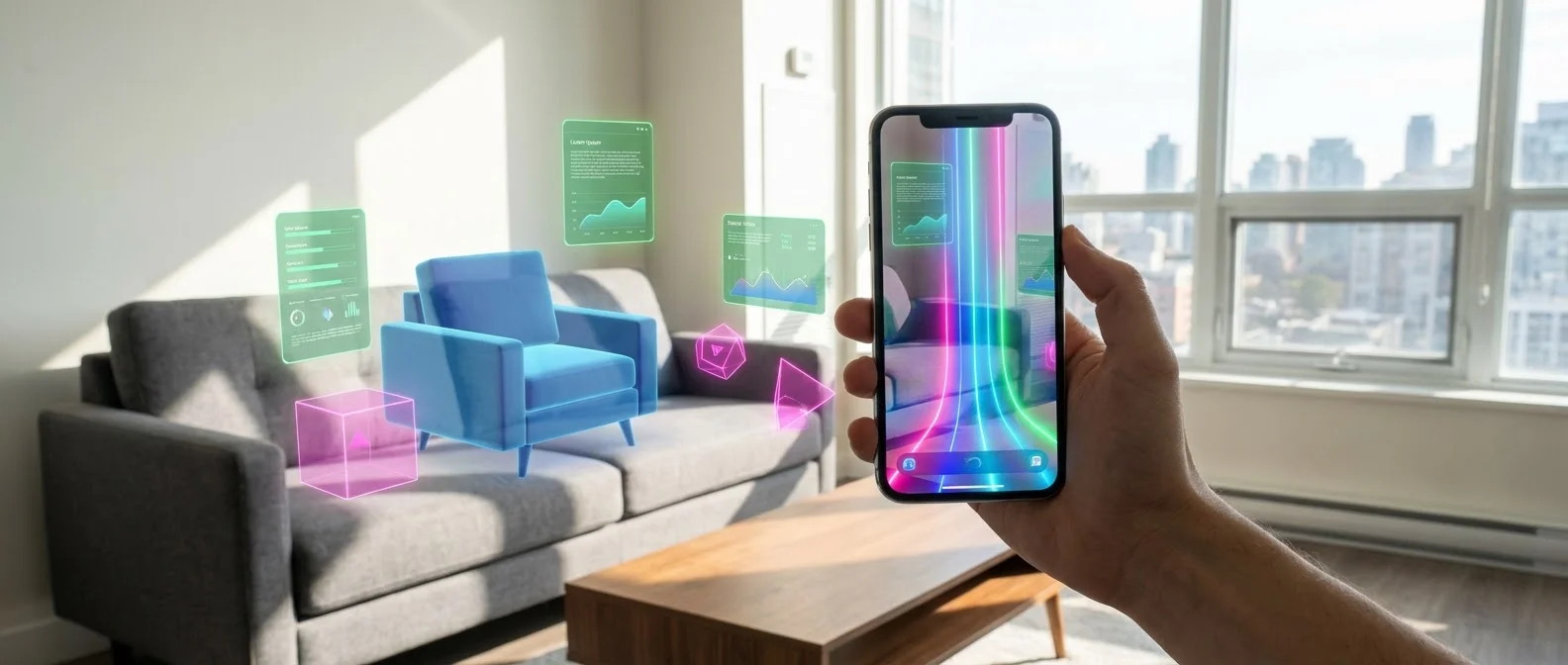
Augmented Reality (AR) is no longer sci-fi — it's part of our everyday lives. From object recognition to virtual try-ons, AR apps are transforming how we interact with the world around us. In 2026, the AR app market is expected to surpass $50 billion globally, with over 1.7 billion smartphone users having access to AR features. We've selected the 15 top apps you should download today.
📖 Read more: AR vs VR 2026: Which Technology Will Dominate Our Future?
AR technology is evolving rapidly thanks to Apple's ARKit and Google's ARCore frameworks, which enable millions of apps to place digital objects in the real world through your smartphone camera. It's worth exploring what these platforms offer, because AR in 2026 is nothing like the clunky filters you might remember. Let's dive into the 15 apps that stand out.
Recognition & Search
Our first category includes apps that turn your phone's camera into an AI-powered eye. Point your camera at anything — a plant, a building, text in a foreign language — and get instant information, translations, or search results. Visual search is gradually replacing typing as the primary way we find information.
1. Google Lens
Google Lens turns your camera into an AI search tool. It recognizes plants, animals, buildings, barcodes, QR codes, and text in real time. The Circle to Search feature (2024) lets you search by simply circling an object on your screen. First launched in 2017, it's now integrated into Android and iOS for free.
2. Apple Visual Intelligence
Apple's answer to Google Lens, built into iOS 18 and the new iPhone 16. It uses on-device AI for recognizing objects, restaurants, animals, and text. It works exclusively on Apple devices with the Neural Engine, offering exceptional privacy with no data sent to the cloud.
3. Pinterest Lens
Snap a photo of anything — an outfit, a room, a dish — and Pinterest Lens instantly finds similar pins and ideas. Perfect for DIY projects, cooking inspiration, and interior design. Over 600 million visual searches per month on the platform.
These three apps represent a radical shift in how we search for information. Instead of typing keywords, you simply point your camera. Visual search is expected to replace a significant percentage of traditional text searches by 2028, especially in shopping, travel, and food.
Shopping & Home
One of the most practical areas of AR is shopping. Imagine seeing how a new sofa would look in your living room before buying it, or trying on sunglasses without visiting a physical store. AR technology dramatically reduces online product returns.
4. IKEA Place
One of the first mainstream AR apps, it places over 2,000 IKEA products in your space at real scale. It uses ARKit and ARCore for 98% dimensional accuracy. Launched in 2017, it remains a global benchmark in AR commerce.
5. Amazon AR View
Try thousands of Amazon products — from furniture to electronics — in your space before hitting “Buy.” The app places 3D product models with correct proportions and lighting, helping reduce online returns by 25%.
6. Houzz
Interior design in AR — place furniture, lighting, and decorative items in your home through your camera. The “View in My Room 3D” feature supports over 300,000 products with photorealistic rendering that reproduces realistic shadows and reflections.
AR commerce isn't just about furniture. Brands like Sephora, Warby Parker, and Nike offer AR try-on experiences for makeup, glasses, and shoes respectively. Apple adopted the USDZ format (2018) so every iPhone user can view 3D products directly in Safari. The technology saves billions in the supply chain by dramatically reducing returns.
Gaming & Entertainment
Gaming was the sector that brought AR to the mainstream. From Snapchat filters to the Pokémon Go phenomenon, entertainment remains the most popular AR app category with hundreds of millions of daily active users.
7. Pokémon Go
The AR game that changed everything. With over 1 billion downloads, $6 billion in lifetime revenue, and 147 million monthly users at its peak, it remains the most successful AR app in history. In March 2025, Scopely acquired the game as part of a $3.5 billion deal.
8. Snapchat Lenses
Over 300 million users interact daily with AR Lenses on Snapchat. Sky Filters launched in September 2017, while Lens Studio lets creators build custom AR experiences. Over 3 million Lenses have been created to date.
📖 Read more: Meta Ray-Ban Display: Smart Glasses with a Built-In Screen
9. TikTok Effect House
TikTok's AR effect creation platform, launched in 2022. It lets creators build AR filters, face effects, and interactive experiences without code. With TikTok's algorithm power, a viral AR effect can reach millions of users in hours.
Top AR Platforms Compared
Notably, Meta shut down its Spark AR platform in January 2025, moving creators toward the Meta Horizon ecosystem. This means Snapchat and TikTok now dominate the social AR space, while YouTube followed in December 2024 with YouTube Effect Maker.
Navigation & Tools
AR isn't just about fun — it's incredibly useful in everyday life. The following apps solve real problems, from navigating unfamiliar streets to measuring a room or translating a menu in a foreign language.
10. Google Maps Live View
Real-time AR pedestrian navigation. Point your camera at the street and see arrows and directions placed on top of real-world buildings and intersections. It works in over 100 cities worldwide, using Visual Positioning System (VPS) for meter-level accuracy. Perfect for travelers.
11. Google Translate Camera
Point your camera at any text — a sign, a menu, instructions — and see the translation in AR, overlaid on the original text. It supports 100+ languages. The technology is based on Word Lens, which Google acquired in 2014.
12. Apple Measure
Measure distances, heights, and areas of objects using only your iPhone camera. The app leverages the LiDAR scanner on iPhone Pro models for millimeter-level accuracy. Pre-installed for free on every iPhone — no download needed.
Did You Know?
AR technology is already used in industry: Boeing, BMW, and Volkswagen integrate AR instructions into assembly lines, reducing errors by 90% and training time for new workers by 50%. In medicine, surgeons use HoloLens for AR guidance during procedures.
Creation & Education
Our final category covers apps that transform you from a viewer into an AR content creator, as well as educational tools that harness the power of AR for learning through experience.
13. Adobe Aero
The professional AR experience creation tool. Import 3D models, images, or animations and place them in real-world spaces without code. Ideal for designers, marketers, and educators. Fully integrates with Photoshop and Illustrator.
14. Star Walk 2
Point your phone at the sky and identify stars, constellations, planets, and satellites in real time. The AR astronomy app uses GPS, gyroscope, and camera to overlay names and information on the night sky. An amazing educational tool.
15. WebXR & A-Frame
AR directly in the browser, with zero installation. The WebXR API and open-source A-Frame library (MIT License, since 2015) enable AR experiences right on the web. Widely used for education, museums, and virtual tours with zero entry cost.
Education is a sector with enormous AR potential. A study at Case Western Reserve University showed that 85% of first-year medical students considered mixed reality teaching “equivalent or better” than in-person anatomy presentations. AR doesn't replace the teacher — it empowers them, giving students 3D models they can rotate, magnify, and explore through their phones.
"Augmented Reality doesn't replace the real world — it enriches it. That's why AR will become more important than VR in the long run."
Our list clearly shows that AR is no longer experimental technology. From Pokémon Go's $6 billion to Google Maps' free AR navigation, these 15 apps prove that Augmented Reality has already become part of our daily lives. All you need to do is pick up your phone and explore the world through a new lens.
Download at least 2-3 of these apps and experiment. You'll be amazed by how refined AR technology is in 2026 — and how natural it feels to use. The world becomes more interesting when every object, building, or product can reveal a layer of information, entertainment, or creativity on top of it.