📖 Read more: SSD NVMe for Gaming: Speed & Guide 2026
The Dawn of War Series Legacy
The first Warhammer 40,000: Dawn of War launched in September 2004 and transformed how we viewed Warhammer video games. Relic Entertainment, based in Vancouver, created an RTS that combined spectacular battles with innovative squad-based mechanics and a resource system built on strategic points rather than traditional resource gathering.
With a Metacritic score of 86/100 and three expansions (Winter Assault, Dark Crusade, and Soulstorm) that added 5 new factions to the original 4, Dawn of War became a benchmark for the genre. Dawn of War II (2009) took a more RPG-oriented direction with squad-based tactics, while Dawn of War III (2017) attempted to blend both styles but received mixed reviews due to MOBA elements that alienated the fanbase.
Dawn of War I (2004)
Classic RTS with base-building, 4+5 factions, strategic points and squad-based combat. Metacritic 86/100. Where the legend began.
Dawn of War II (2009)
RPG/tactical direction with hero units, loot and smaller scale. Introduction of Tyranids. Consistently beloved by fans.
Dawn of War III (2017)
Attempted fusion of I and II, but MOBA elements divided the fanbase. Mixed reviews, but valuable lessons for the future.
Definitive Edition (2025)
Remastered edition of the original with graphical improvements. A clear sign of life for the franchise.
Relic Entertainment: A New Era of Independence
Relic Entertainment was founded in 1997 in Vancouver and boasts one of the most impressive track records in the RTS genre, with series like Homeworld, Company of Heroes, and of course Dawn of War. After years under THQ (2004–2013) and Sega (2013–2024), in March 2024 Relic went independent with the help of an external investor.
This independence is crucial for Dawn of War's future. Free from the constraints of a major publisher, Relic can now focus on what they do best: creating epic real-time strategy experiences. The release of Dawn of War: Definitive Edition in August 2025 was the first signal that the franchise is alive and has a future.
Relic Independence (2024)
In March 2024, Relic Entertainment split from Sega with the help of an external investor, returning to independence after 20 years. This move gives them full creative control over their IPs, including Dawn of War.
What We Expect from Dawn of War IV
Based on the series' history and lessons learned from DoW III, Dawn of War IV is expected to return to its roots. The franchise's fans have clearly expressed what they want:
- Return to base-building: Base construction and resource management were the heart of DoW I
- More factions: The variety of 40K factions is immense — Necrons, T'au, Leagues of Votann
- Epic campaigns: Large, narrative campaigns in the style of DoW: Dark Crusade
- Large-scale battles: Hundreds of units on the battlefield, leveraging modern hardware
- Modding support: The DoW community has created amazing mods — this must continue
📖 Read more: Death Stranding 2: Kojima's New Creation
The Warhammer 40K Universe
Warhammer 40,000 is one of the richest sci-fi universes in the world. Created by Games Workshop, it presents a dystopian future where humanity is trapped in constant war against alien threats, demonic Chaos forces, and traitors from within the Imperium itself.
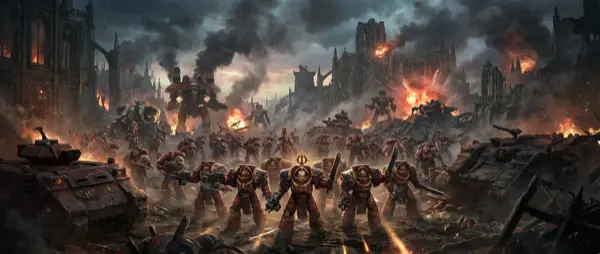
The Space Marines — the superhuman warriors of the Emperor — are the iconic face of the franchise. In Dawn of War's case, the Blood Ravens chapter has a direct connection to the series, with Captain Gabriel Angelos as the central hero of the original campaign on the planet Tartarus.
The rich 40K lore offers unlimited possibilities for campaigns: planetary Ork invasions, Tyranid hive fleets, Chaos incursions, Necron awakenings, Eldar stratagems, and much more. A Dawn of War IV could explore new sectors of the galaxy, new factions, and new narrative directions.
Technical Expectations
Relic is known for its Essence Engine — the custom engine that powers their Company of Heroes and Dawn of War titles. The engine has evolved through three generations (Essence 1.0, 2.0, 3.0) and offers HDR lighting, dynamic shadows, Havok physics, and advanced environment destruction.
A new Dawn of War would be expected to leverage Essence Engine 4.0 or something entirely new, delivering large-scale battles with hundreds of units, ray tracing, advanced AI, and the impressive sync-kill animations that made DoW II famous.
Essence Engine Legacy
Relic's Essence Engine evolved through 3 generations: 1.0 (Company of Heroes), 2.0 (Dawn of War II) and 3.0 (Company of Heroes 2). Each version added HDR, dynamic lighting, TrueSight visibility and ColdTech weather simulation. Essence 4.0 could bring Dawn of War into a new era.
The Lesson of Dawn of War III
The failure of Dawn of War III wasn't due to production quality but rather design choices. The attempt to combine DoW I's macro-gameplay with DoW II's hero-focused gameplay, while adding MOBA-style elements, resulted in a game that satisfied neither DoW I fans nor DoW II fans.
The lesson is clear: Dawn of War IV needs to pick one direction and execute it brilliantly. Either go full-scale RTS in the style of DoW I, or tactical RPG in the style of DoW II — but not both at once. The community has spoken, and Relic, now an independent studio, has every incentive to listen.
Conclusion
Warhammer 40,000: Dawn of War IV is perhaps the most anticipated comeback in the RTS space. With a Relic that has reclaimed its independence, a universe of infinite richness, and a community waiting eagerly, all the elements converge. All Relic needs to do is listen to the fans and return to the roots that made the series legendary.
For the Emperor!