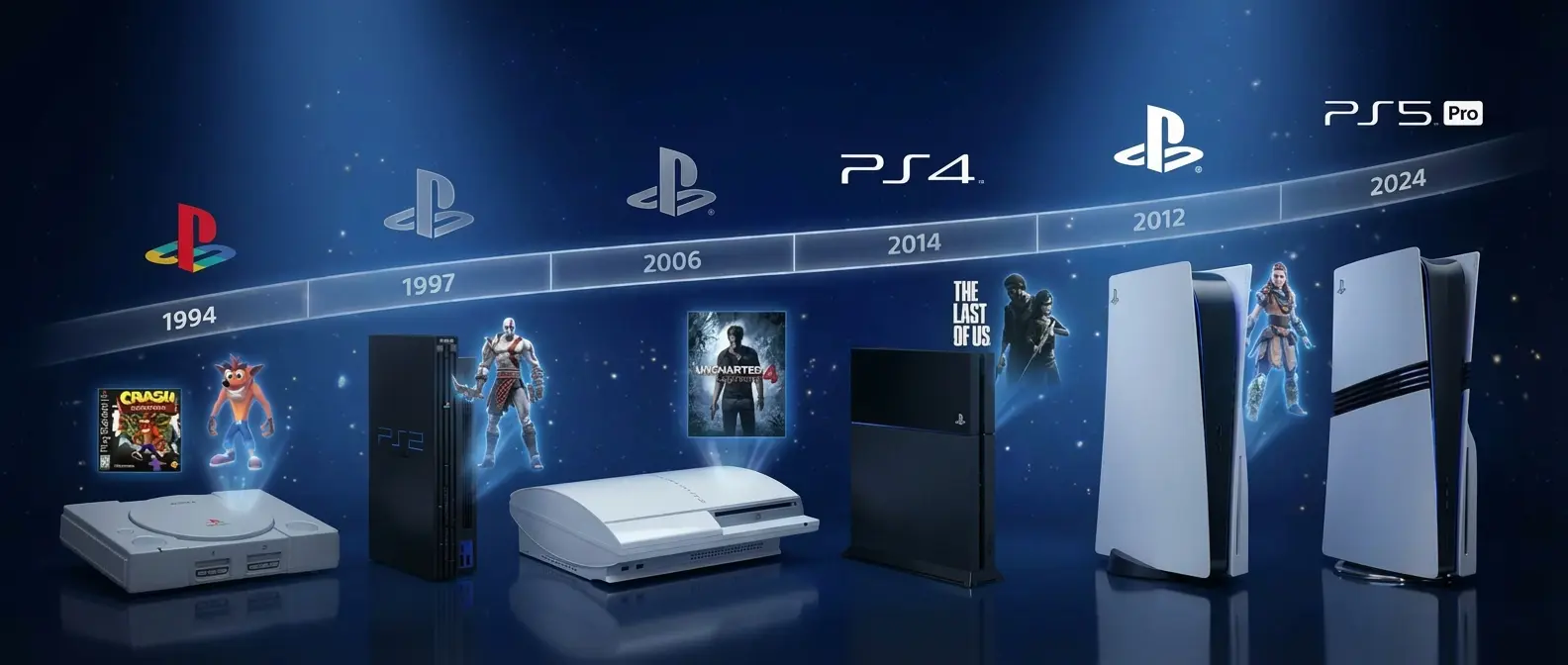
Table of Contents
How It All Began
The irony of history: Nintendo's decision to reject Sony led to the creation of its greatest competitor. Ken Kutaragi, known as the “father of PlayStation,” turned humiliation into motivation. Sony didn't just want to enter the market — it wanted to dominate it.
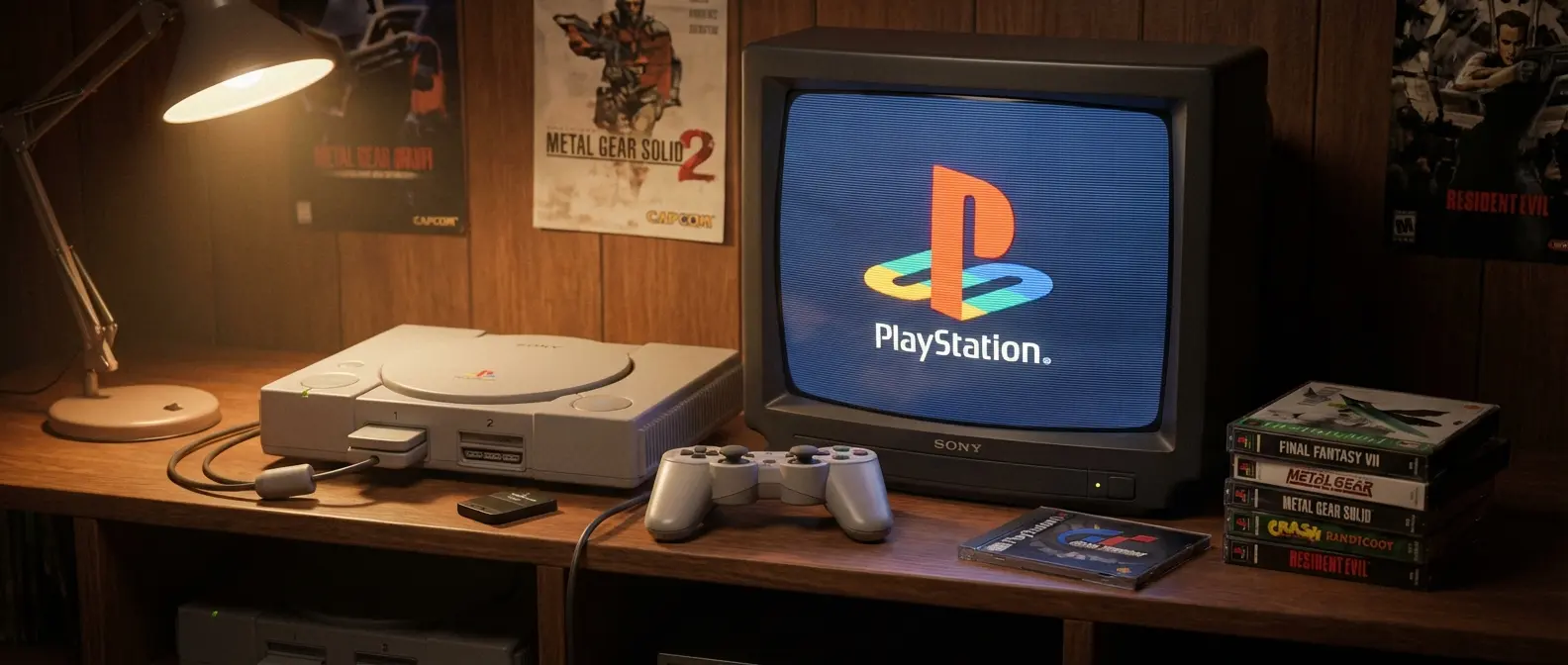
PlayStation 1
The 3D Gaming Revolution
The original PlayStation wasn't just a new console — it was a statement of intent. With its iconic gray design, the CD-ROM drive that allowed games far larger than cartridges, and its focus on 3D gaming, Sony laid the groundwork for a new era.
Sony's marketing was equally revolutionary. Instead of targeting only children like Nintendo, PlayStation appealed to young adults. The clubs, the music events, the edgy commercials — PlayStation was “cool,” and that branding endures to this day.
🎮 The Games That Defined an Era
⚙️ Technical Specifications
| CPU | MIPS R3000A @ 33.8688 MHz |
|---|---|
| RAM | 2 MB (+ 1 MB VRAM) |
| Graphics | GPU with 360,000 polygons/sec |
| Storage | CD-ROM (650 MB) |
| Audio | 24 channels, 44.1 kHz |
The PS1 won the 5th generation console war decisively. With 102 million units sold, it defeated the Nintendo 64 (33M) and the Sega Saturn (9M). Sony was here to stay.
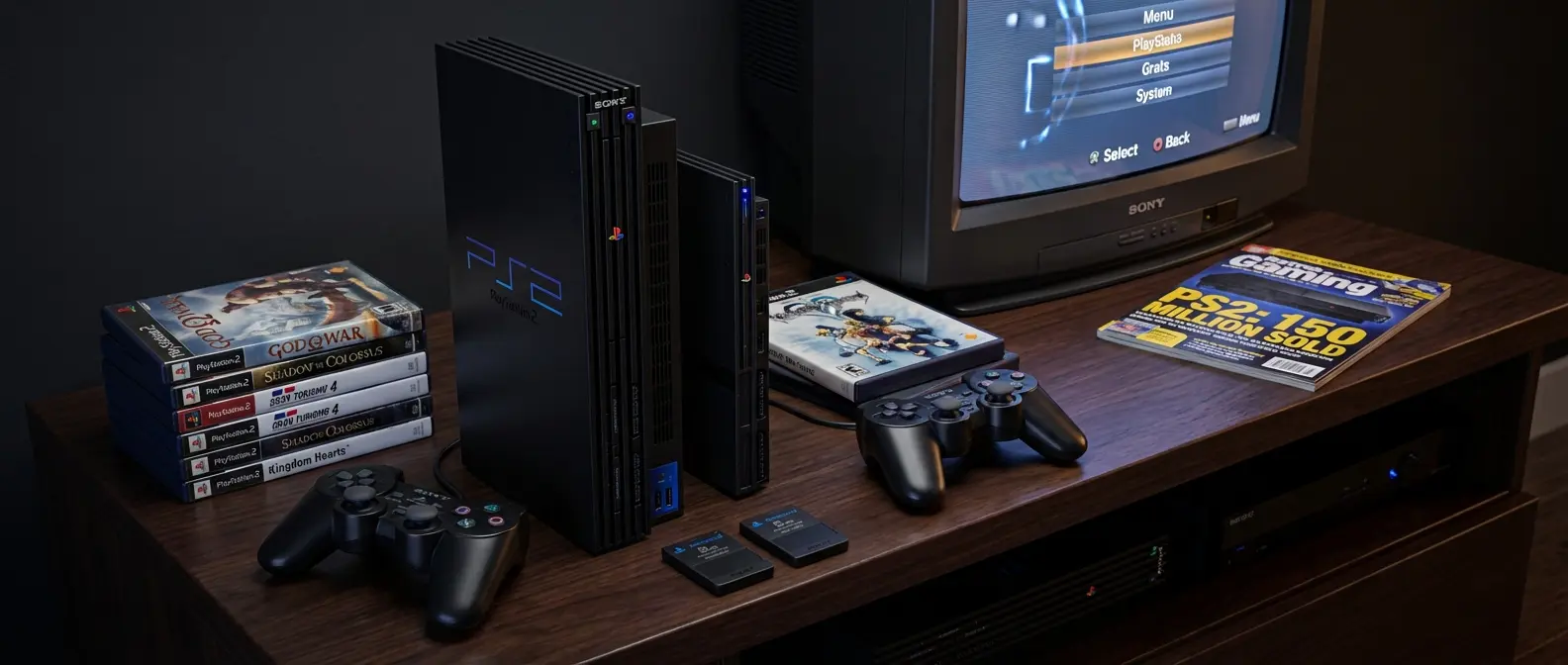
PlayStation 2
The Best-Selling Console of All Time
On March 4, 2000, Sony released the PlayStation 2 in Japan — and dominance began. With 155 million units sold, the PS2 remains the best-selling console in gaming history, a record that will likely never be broken.
What made the PS2 so successful? The combination. It was a DVD player — something that cost $300+ on its own at the time. It had backward compatibility with PS1 games. And it had a game library that covered virtually every genre and franchise imaginable.
🎮 The Legendary Exclusives
📺 The DVD Revolution
Many people bought the PS2 solely as a DVD player — and then discovered the games. This “Trojan horse” strategy brought millions of new gamers into Sony's ecosystem. The PS2 helped establish DVD as a format, just as the PS3 would later do with Blu-ray.
The PS2 was so successful that Sony continued producing games for it until 2013 — 13 years after its launch. The last game was "Pro Evolution Soccer 2014″ in Brazil.
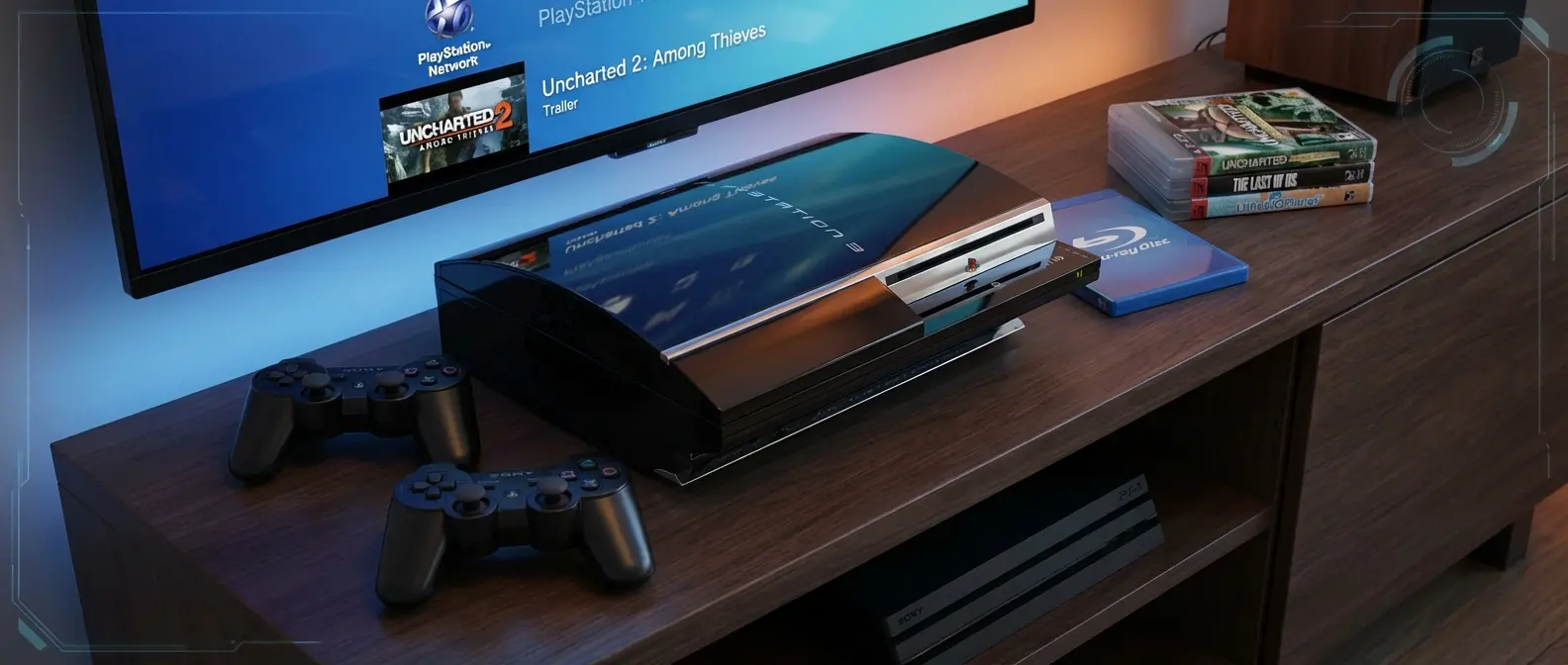
PlayStation 3
The Difficult but Memorable Generation
The PS3 was the most difficult moment in PlayStation's history. With a launch price of $599 (the infamous phrase “Five hundred ninety-nine US dollars”), the complex Cell architecture that frustrated developers, and an Xbox 360 with a one-year head start, Sony found itself on the ropes.
But Sony fought back. It cut prices, improved PlayStation Network, and — most importantly — invested in first-party studios that created some of the generation's best games. The PS3 eventually matched the Xbox 360 in sales.
🎮 The Games That Saved the PS3
💿 Blu-ray & PlayStation Network
The PS3 was the cheapest Blu-ray player on the market at launch — and it helped the format win the war against HD DVD. Meanwhile, PlayStation Network evolved into a full online ecosystem, despite suffering the notorious 2011 hack that kept the network offline for 23 days.
The PS3 also gave us PlayStation Plus (2010), trophies (2008), and the ability to remote play with PSP. It laid the foundation for all modern PlayStation features.
PlayStation 4
The Return to the Top
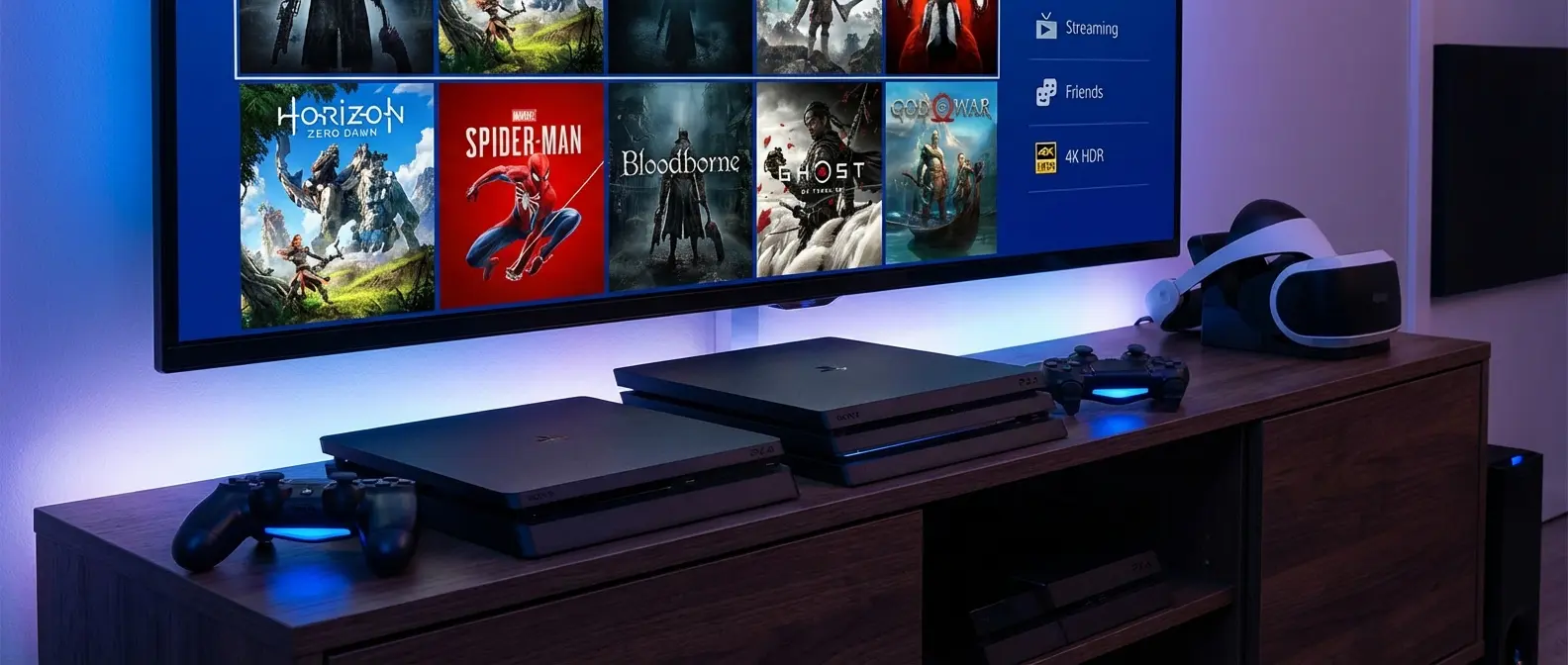
Sony learned from the PS3's mistakes. The PS4 had developer-friendly architecture (x86 like PCs), a competitive price ($399 vs $499 for the Xbox One), and a clear focus: games, not gimmicks.
While Microsoft tried to make the Xbox One an “all-in-one entertainment center” with always-online requirements and Kinect, Sony simply said: “This is for the players.” That message won the war before it even started.
🎮 The Golden Age of Exclusives
🥽 PlayStation VR & PS4 Pro
In 2016, Sony made a bold move: it released PlayStation VR, bringing virtual reality to the masses at $399. It was the first successful VR console — with over 5 million units sold.
That same year came the PS4 Pro — the first mid-generation console upgrade. With 4K gaming (upscaled) and HDR support, it gave gamers the choice without fragmenting the ecosystem.
PlayStation 5
The Next Generation of Gaming
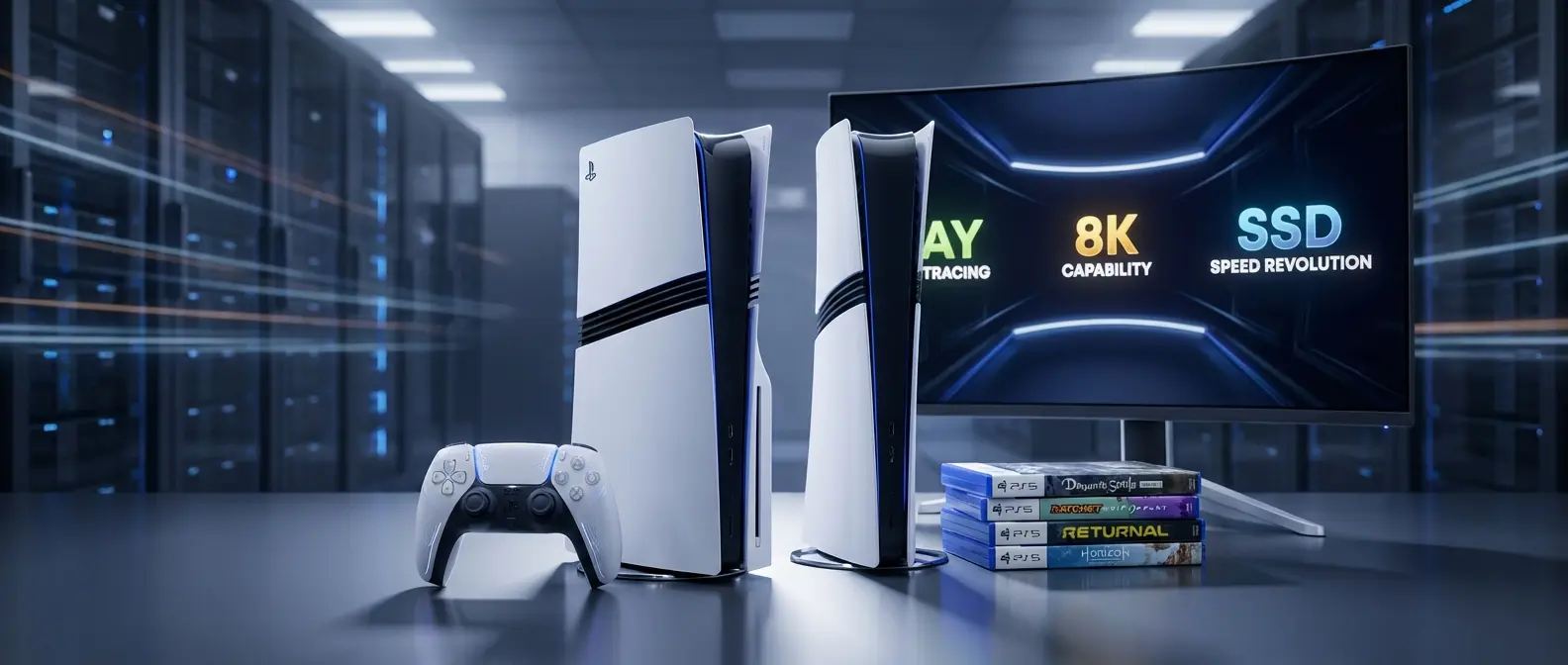
On November 12, 2020, in the midst of the COVID-19 pandemic, Sony released the PlayStation 5. The futuristic black-and-white design was the most radical aesthetic change in the console's history — but the real revolution was on the inside.
Sony's custom SSD loaded games almost instantly — not in seconds, but in milliseconds. The DualSense controller with haptic feedback and adaptive triggers offered immersion never seen before. Ray tracing support brought photorealistic lighting to consoles.
🎮 Launch & Beyond
🚀 PS5 Pro (2024)
In November 2024, Sony released the PS5 Pro at $699 — the most expensive PlayStation console ever. With a 67% more powerful GPU, advanced ray tracing, and PlayStation Spectral Super Resolution (PSSR) AI upscaling, it delivers true 4K/60fps gaming.
The price drew criticism, but for enthusiast gamers, the PS5 Pro is the ultimate console gaming experience of 2025.
PlayStation 6: The Future
A hypothetical scenario based on trends and technological developments
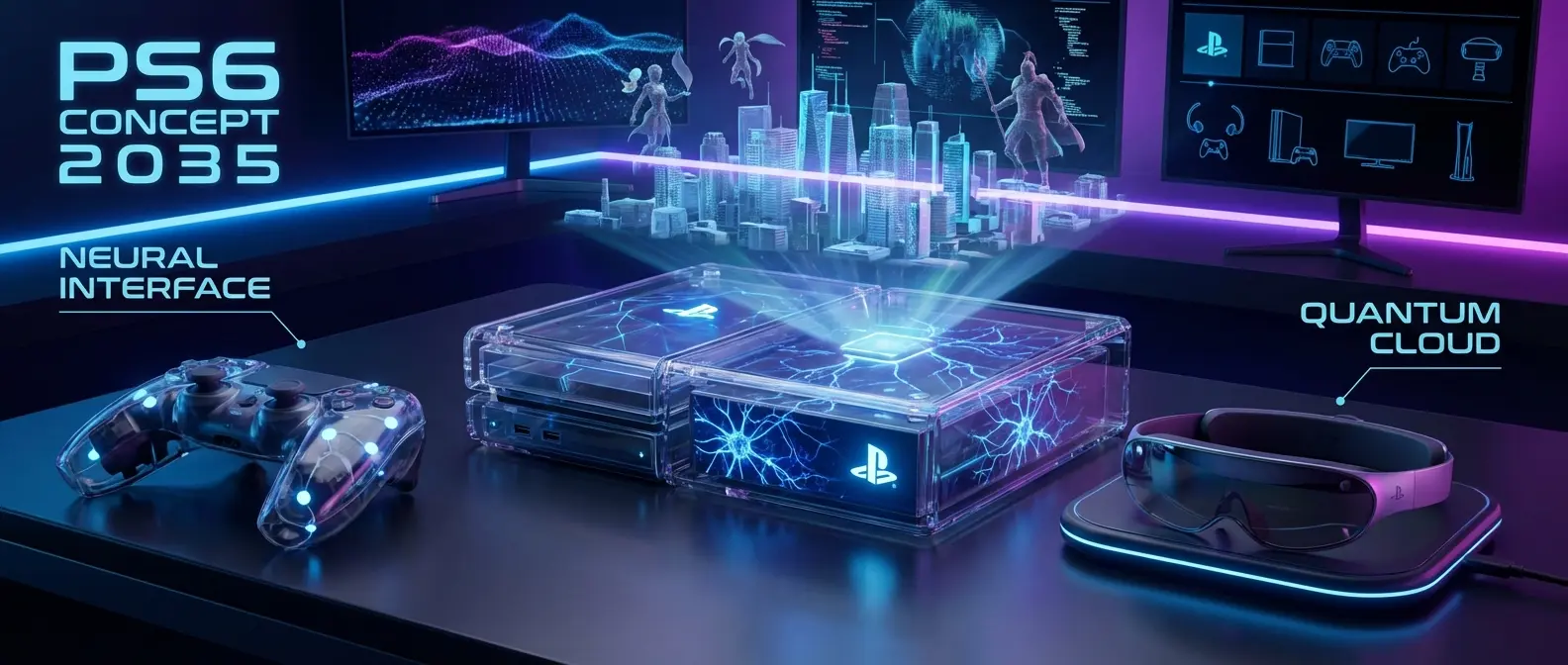
What can we expect from the PlayStation 6? Based on Sony's patterns, technological trends, and market leaks, here is our prediction for the next generation.
🗓️ When Will It Launch?
Based on Sony's historical timeline:
- PS1 → PS2: 6 years
- PS2 → PS3: 6 years
- PS3 → PS4: 7 years
- PS4 → PS5: 7 years
Prediction: The PS6 will launch between 2027 (earliest) and 2029 (latest). The most likely date is late 2028, giving the PS5 an ~8-year lifecycle.
⚙️ Technology & Specs (Speculation)
AI-Enhanced Everything
Dedicated AI cores for PSSR 2.0, smart NPCs, real-time content generation, and personalized gaming experiences.
Cloud-Local Hybrid
Seamless switching between local and cloud gaming. Stream AAA games with no downloads, with AI prediction for zero latency.
VR/AR Integration
PSVR3 integrated into the ecosystem. Mixed reality gaming with passthrough cameras. Holographic displays?
All-Digital Option
Possibly a digital-only edition, or disc drive as an optional accessory. Physical media in decline.
Modular Design
Upgradeable components; Extra storage, better cooling, VR modules — customize your console.
DualSense 2.0
Temperature feedback, scent modules (?), advanced biometrics. Full-body haptics with wearables.
💰 Price (Prediction)
With the PS5 Pro at $699 and inflation, the PS6 will likely be priced around:
- Digital Edition: $549-599
- Standard Edition: $649-699
- Pro/Premium Edition: $799-899
🎮 Potential Launch Titles
All Generations Compared
| Feature | PS1 | PS2 | PS3 | PS4 | PS5 |
|---|---|---|---|---|---|
| Release | 1994 | 2000 | 2006 | 2013 | 2020 |
| Launch Price (US) | $299 | $299 | $599 | $399 | $499 |
| Sales (M) | 102.49 | 155.00 | 87.40 | 117.20 | 60+ |
| CPU | 33 MHz | 294 MHz | 3.2 GHz Cell | 1.6 GHz x86 | 3.5 GHz Zen 2 |
| RAM | 2 MB | 32 MB | 256 MB | 8 GB | 16 GB |
| Storage Media | CD-ROM | DVD | Blu-ray | Blu-ray/HDD | SSD/Blu-ray |
| Max Resolution | 480i | 480p | 1080p | 4K (Pro) | 8K (upscale) |
| Online Service | — | Network Adapter | PSN Free | PS Plus | PS Plus |
🏆 The Legacy of PlayStation
30 years after the first PlayStation, Sony has sold over 600 million consoles in total. But the numbers don't tell the whole story.
PlayStation transformed gaming from a “children's hobby” into mainstream entertainment. It brought CDs, DVDs, and Blu-rays into millions of homes. It created franchises that are now cultural icons — from Kratos to Nathan Drake, from Aloy to Ellie and Joel.
Most importantly? PlayStation proved that games can be art. Titles like Journey, The Last of Us, Shadow of the Colossus — these aren't just products. They are experiences that stay with you.
And the story continues. The PS6 is coming. New technologies — AI, VR, cloud — will bring experiences we can't even imagine today. But one thing is certain: as long as PlayStation exists, the magic of gaming will endure.
Play Has No Limits. 🎮