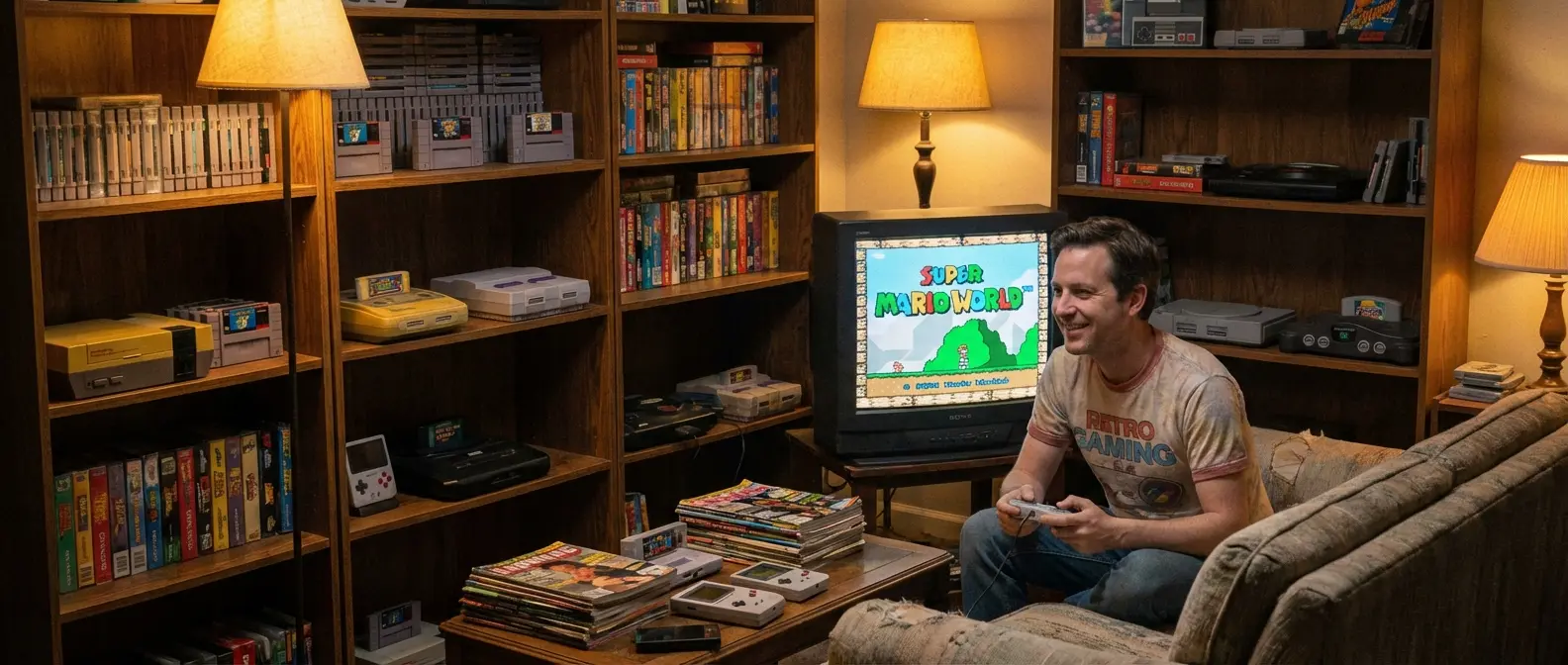
In an era where video games feature photorealistic graphics, ray tracing, and artificial intelligence that generates endless content, a curious phenomenon is gaining ground: more and more gamers are returning to the classic games of the '80s, '90s, and 2000s. Retro gaming isn't just a passing trend — it's a cultural movement that reflects our deep need for authenticity, simplicity, and a connection to our gaming roots.
This comprehensive guide explores every aspect of retro gaming: from the nostalgia that draws us back to the past, to the modern technological solutions that make classic gaming more accessible than ever. We'll examine emulators, mini consoles, retro handhelds, collecting, and the renaissance of pixel art in modern indie games.
🧠 The Psychology of Nostalgia: Why We Crave the Past
Nostalgia is a powerful emotion that activates the same brain centers associated with pleasure and reward. When a gamer in their 30s or 40s sees the startup screen of Super Mario Bros or hears the music from The Legend of Zelda, they don't just remember a game — they relive entire periods of their life.
🎮 Why Do Retro Games Make Us Feel So Good?
Neuroscience shows that nostalgia increases dopamine levels, reduces stress, and enhances the sense of social connection. Retro games are tied to memories of carefree summer vacations, multiplayer sessions with friends in the living room, and the adrenaline rush of beating a boss after endless attempts.
Unlike modern games that require dozens of hours to complete and constant online connectivity, classic games offer something rare: a sense of completion. You can finish Super Mario Bros in one hour, turn off the console, and feel satisfied. This simplicity is refreshing in a world full of endless updates, live services, and FOMO.
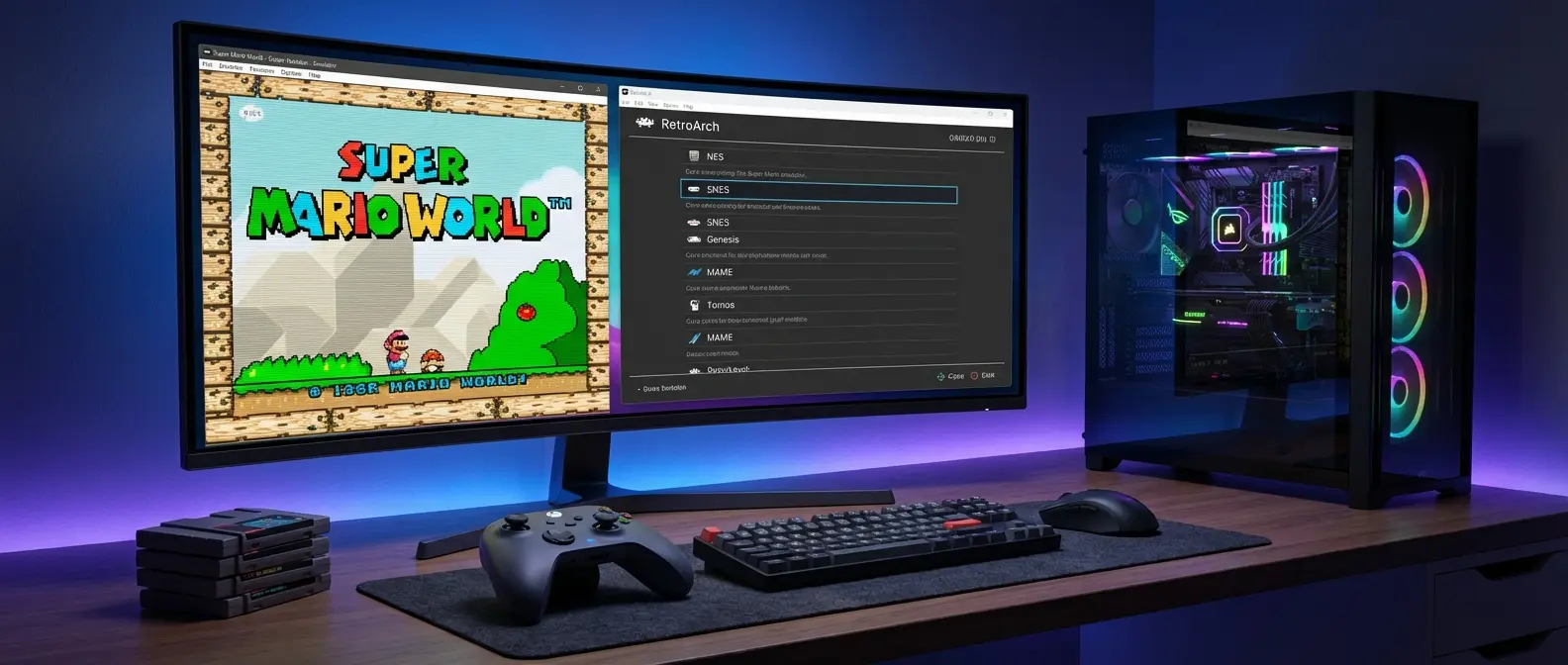
Modern emulation setup: High-end PC with RetroArch, wireless controller and RGB lighting for the ultimate retro experience
💻 Emulators: The Digital Preservation of Gaming
Emulators are perhaps the most accessible way to experience retro gaming in the modern era. They are software that “mimics” the hardware of older consoles, allowing you to play games on a PC, smartphone, or even on modern consoles.
What Is an Emulator and How Does It Work
An emulator is essentially a program that “pretends” to be another device. When you run an NES emulator on your computer, the software reads ROM files (digital copies of the cartridges) and executes them as if it were the original hardware. This requires tremendous computing power — which is why only in recent years have we been able to reliably run emulators for modern consoles.
🔥 Popular Emulators by Platform
- RetroArch: All-in-one frontend for dozens of platforms
- Dolphin: GameCube and Wii emulation in 4K
- PCSX2: PlayStation 2 with upscaling
- RPCS3: PlayStation 3 emulation
- Cemu/Yuzu/Ryujinx: Nintendo Wii U and Switch
- MAME: Arcade games preservation
- DeSmuME/melonDS: Nintendo DS
- PPSSPP: PlayStation Portable
RetroArch: The Ultimate Emulation Frontend
RetroArch has become the de facto standard for retro gaming on PC. Instead of installing dozens of different emulators, RetroArch uses a “cores” system — small plugins that represent each console. A unified interface lets you browse your entire library, from Atari 2600 to Nintendo 64, with consistent controls and settings.
Some of RetroArch's advanced features include:
- Shaders: Recreating the look of CRT televisions with scanlines and phosphor glow
- Netplay: Online multiplayer for games that never originally supported it
- Rewind: Turn back time if you make a mistake
- Save states: Save anywhere, independent of the original save system
- Achievement systems: RetroAchievements integration to earn trophies in classic games
The Legal Side of Emulation
A common question concerns the legality of emulators. The short answer: emulators are legal. ROM files, however, are intellectual property. Legally, you can create backup copies of cartridges you own, but downloading ROMs from the internet remains a gray area.
The gaming community argues that emulation is a vitally important tool for preserving gaming history. Thousands of games are at risk of being lost as cartridges deteriorate and companies stop selling them. Organizations like the Internet Archive and the Video Game History Foundation are working toward the legal preservation of this cultural heritage.
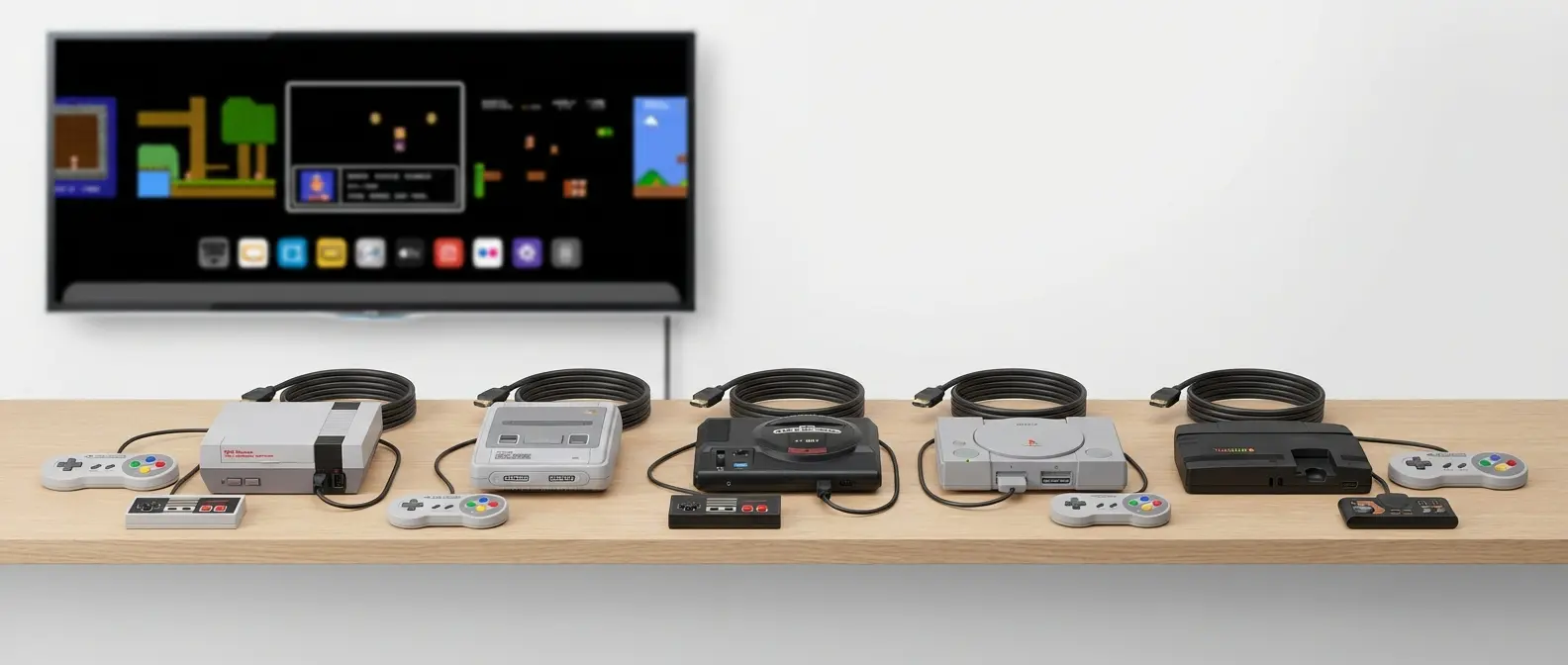
Mini Consoles: NES Classic, SNES Mini, Genesis Mini and PS Classic - miniatures next to originals with plug-and-play convenience
🎮 Mini Consoles: The Official Answer to Nostalgia
Nintendo changed the retro gaming landscape in 2016 when it released the NES Classic Edition. A tiny version of the classic NES with 30 pre-installed games, HDMI output, and a price tag under $60. The result? It sold out almost immediately and created an entirely new product category.
The Evolution of Mini Consoles
Nintendo launches the mini console trend. 30 games, 2.3 million units sold in 6 months.
21 games including the never-before-released Star Fox 2. An absolute must-have.
Sony responds with 20 PS1 games. Mixed reviews due to game selection and emulation issues.
42 games, excellent emulation by M2. Considered the best mini console ever.
60+ games including Sega CD titles. Premium retro experience.
Arcade classics in a tabletop format with a built-in screen.
Why Mini Consoles Succeeded
The success of mini consoles rests on three pillars: convenience, legitimacy, and aesthetics. Instead of hunting for ROMs and configuring emulators, you simply plug the console into your TV and play. The companies have official licenses for the games, so there's no ethical dilemma. And the miniature version of your favorite console looks perfect on your shelf.
🔴 NES Classic
30 games, 2 controllers, official Nintendo quality. Games: Super Mario Bros 1-3, Zelda, Metroid, Mega Man 2
🟣 SNES Classic
21 games + unreleased Star Fox 2. Games: Super Mario World, A Link to the Past, Super Metroid, EarthBound
⚫ Genesis Mini
42 games, M2 emulation excellence. Games: Sonic 1-2, Streets of Rage 2, Gunstar Heroes, Castlevania
⚪ PlayStation Classic
20 games, PAL versions controversy. Games: Final Fantasy VII, Metal Gear Solid, Tekken 3, Resident Evil
Modding: Unlocking the Full Potential
The modding community has transformed mini consoles into full-fledged retro gaming machines. With custom firmware like Hakchi2 for Nintendo or Project Lunar for Genesis Mini, you can add hundreds of additional games, improve emulation quality, and add support for other platforms.
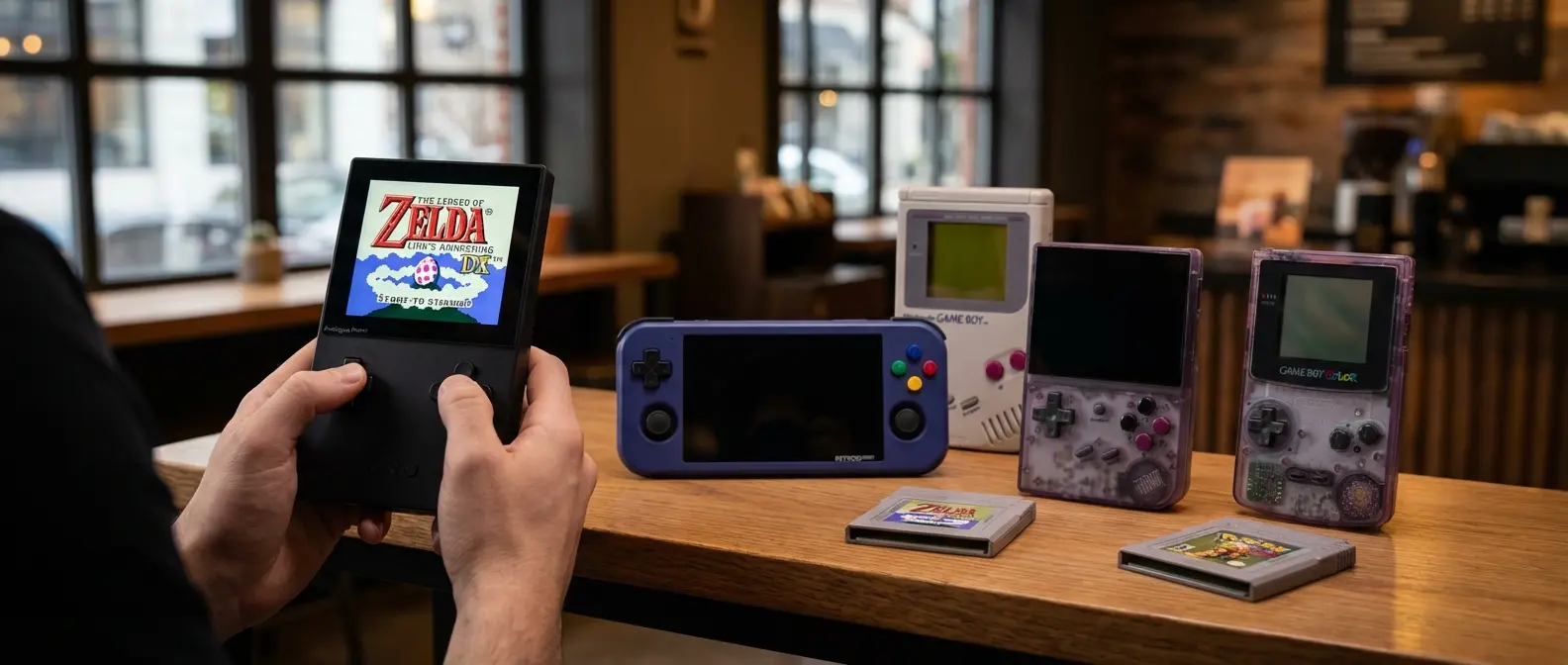
The new generation of retro handhelds: Analogue Pocket, Retroid Pocket, Anbernic - high-quality screens with perfect pixel art for portable retro gaming
📱 Retro Handhelds: The Renaissance of Portable Gaming
If mini consoles brought retro gaming to the living room, retro handhelds took it everywhere. In recent years, an explosion of Chinese manufacturers and premium brands has created an entire device category: portable consoles designed exclusively for retro gaming.
Categories of Retro Handhelds
Budget Options ($30-$60)
Devices like the Anbernic RG35XX and the Miyoo Mini Plus offer incredible value. With compact designs, quality screens, and support for 8-bit and 16-bit consoles, they're the perfect introduction to retro handheld gaming. Most run custom Linux firmware that makes setup easy even for beginners.
Mid-Range ($60-$150)
The Retroid Pocket 3+ and the Anbernic RG505 use Android for greater flexibility. They can run anything up to PSP, Nintendo DS, and some Dreamcast/N64 games with satisfactory performance. The larger screen and better controls make them ideal for extended sessions.
Premium ($200+)
The Analogue Pocket is the holy grail of retro handheld gaming. Instead of emulation, it uses FPGA technology for bit-perfect reproduction of the original hardware. It accepts genuine Game Boy, Game Boy Color, and Game Boy Advance cartridges, while adapters allow Game Gear, Neo Geo Pocket, and Lynx games. With a gorgeous 1600x1440 OLED screen, it's the definition of the premium retro experience.
🏆 Top 5 Retro Handhelds for 2026
- Analogue Pocket: FPGA excellence, genuine cartridges, $220
- Steam Deck: Runs everything, full PC power, $399+
- Retroid Pocket 4 Pro: Android versatility, PS2 capable, $150
- Anbernic RG35XX Plus: Best budget option, perfect for 16-bit, $55
- Miyoo Mini Plus: Ultra-portable, pocketable design, $45
FPGA vs Emulation: What's the Difference?
The big debate in the retro gaming community is FPGA versus software emulation. Emulators run on conventional CPUs and “translate” the original hardware's instructions in real time. This requires overhead and can introduce latency or inaccuracies.
FPGA (Field Programmable Gate Array) works differently: instead of simulating the hardware, the chip reconfigures itself to BE the hardware. The result is cycle-accurate reproduction with no input lag. For purists, this is the only acceptable solution apart from original hardware.
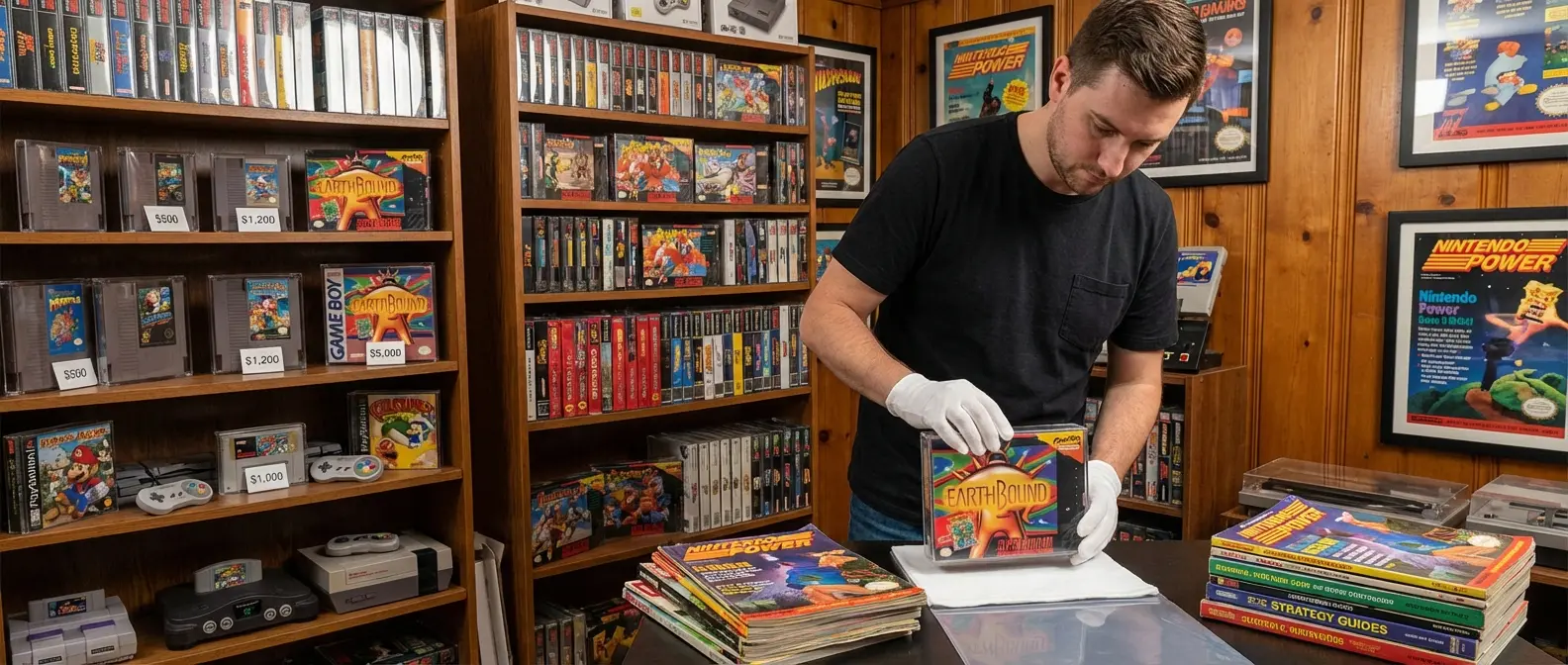
The art of retro game collecting: Mint condition boxes, rare cartridges, limited editions and growing investment value
📦 Retro Game Collecting: Passion, Investment, or Obsession?
Retro game collecting has evolved from a hobby into a serious investment. Sealed copies of classic games sell for millions of dollars at auctions, while even loose cartridges of popular titles have tripled in value over the last decade.
The Retro Collecting Market
| Title | Condition | Price 2015 | Price 2025 |
|---|---|---|---|
| Super Mario Bros (NES) | Sealed | $500 | $50,000+ |
| EarthBound (SNES) | CIB | $200 | $800 |
| Chrono Trigger (SNES) | CIB | $150 | $400 |
| Pokemon Red (GB) | CIB | $50 | $250 |
| Little Samson (NES) | Loose | $400 | $1,500 |
Tips for Beginner Collectors
If you want to start collecting retro games, follow these basic principles:
- Collect what you love: Don't chase expensive rarities if you're not interested in the games. The joy is in playing, not just owning.
- Authenticity checks: The market is flooded with reproductions and fakes. Learn to identify authentic cartridges before spending serious money.
- Caring for your collection: Store away from moisture and direct sunlight. Cartridges can last decades with proper storage.
- Local markets: Flea markets, garage sales, and pawn shops can hide treasures at low prices.
- Patience: The best deals come to those who wait. Don't buy at the first price you see.
Game Grading: Is It Worth It?
Companies like WATA Games and CGC offer professional grading for sealed games, rating their condition on a 1-10 scale. A game graded 9.8 A++ can be worth ten times more than an ungraded copy. However, the practice has faced criticism for market manipulation and for turning games into speculation assets rather than playable media.
🕹️ The Immortal Arcade Classics: Where It All Began
Before home consoles, arcade cabinets were the only way to play video games. The neighborhood arcades, the halls filled with lights and sounds, remain unforgettable memories for entire generations of gamers.
👾 The Iconic Arcade Games That Defined Gaming
- Pac-Man (1980): The yellow hero who chased ghosts - one of the most recognizable video game characters of all time
- Donkey Kong (1981): Mario's first appearance (then called “Jumpman”) - Nintendo burst onto the scene
- Space Invaders (1978): The space shooter that created the shoot 'em up genre
- Galaga (1981): The evolution of space shooters with challenging gameplay and bonus stages
- Bomb Jack (1984): The acrobat who collected bombs - a favorite in every arcade
- Bubble Bobble (1986): The dragons Bub and Bob who trapped enemies in bubbles - the ultimate co-op experience
- Asteroids (1979): Destroying asteroids with missiles - minimalist yet incredibly addictive
- Galaxian (1979): Aliens descended in formations - precursor to Galaga
- Frogger (1981): The frog trying to cross the road - simple concept, endless fun
- Street Fighter II (1991): The fighting genre revolution - Ryu, Ken, Hadouken!
🇬🇷 Arcades in '80s and '90s Culture
Who doesn't remember the neighborhood arcades? The coins dropping into machines, the lines to play Street Fighter II, the noise from the games echoing down the street. Bomb Jack was everywhere - perhaps the most popular arcade game of the era. And Pac-Man? It became synonymous with video gaming for an entire generation.
🎮 Classic Consoles: A Historical Retrospective
To fully understand retro gaming, we need to know the consoles that shaped the industry. Each generation brought innovations that changed the way we play.
🕹️ Third Generation (1983-1992): The Renaissance
After the video game crash of 1983, Nintendo saved the industry with the NES (Famicom in Japan). With iconic titles like Super Mario Bros, The Legend of Zelda, and Metroid, it laid the foundations of modern gaming. Sega responded with the Master System, but Nintendo dominated in the US.
- Nintendo Entertainment System (NES): 62 million sales, 1,000+ games
- Sega Master System: 13 million sales, popular in Europe and Brazil
- Atari 7800: Backwards compatible with 2600, but too late to market
⚔️ Fourth Generation (1987-1996): The Console Wars
The era of 16-bit warfare. “Genesis does what Nintendon't” was Sega's slogan that sparked one of the most intense rivalries in gaming history. Both consoles had legendary libraries.
- Super Nintendo (SNES): 49 million sales, Mode 7 graphics, iconic RPGs
- Sega Genesis/Mega Drive: 31 million sales, blast processing, Sonic dominance
- Neo Geo AES: Arcade-perfect gaming for those who could afford it ($650 launch price)
- TurboGrafx-16: Underrated gem with an excellent shmup library
🌟 Fifth Generation (1993-2002): The 3D Revolution
The transition to 3D graphics changed everything. Sony entered the market with the PlayStation and managed to dominate, while Nintendo laid the foundations of modern 3D gameplay with the Nintendo 64.
- Sony PlayStation: 102 million sales, CD-ROM revolution, Final Fantasy VII
- Nintendo 64: 33 million sales, 4 controller ports, Super Mario 64 changed everything
- Sega Saturn: 9 million sales, 2D powerhouse, beloved in Japan
- Atari Jaguar: “Do the math” - 64-bit marketing, 250K sales
💿 Sixth Generation (1998-2006): The Golden Age
For many, this is the last “retro” generation. The Dreamcast was ahead of its time with online gaming, the PS2 became the best-selling console of all time, and Microsoft entered the market with the Xbox.
- PlayStation 2: 155 million sales, DVD player, massive library
- Xbox: 24 million sales, Xbox Live, Halo phenomenon
- GameCube: 22 million sales, underrated gem, handle for portability
- Dreamcast: 10 million sales, died too young, online pioneer
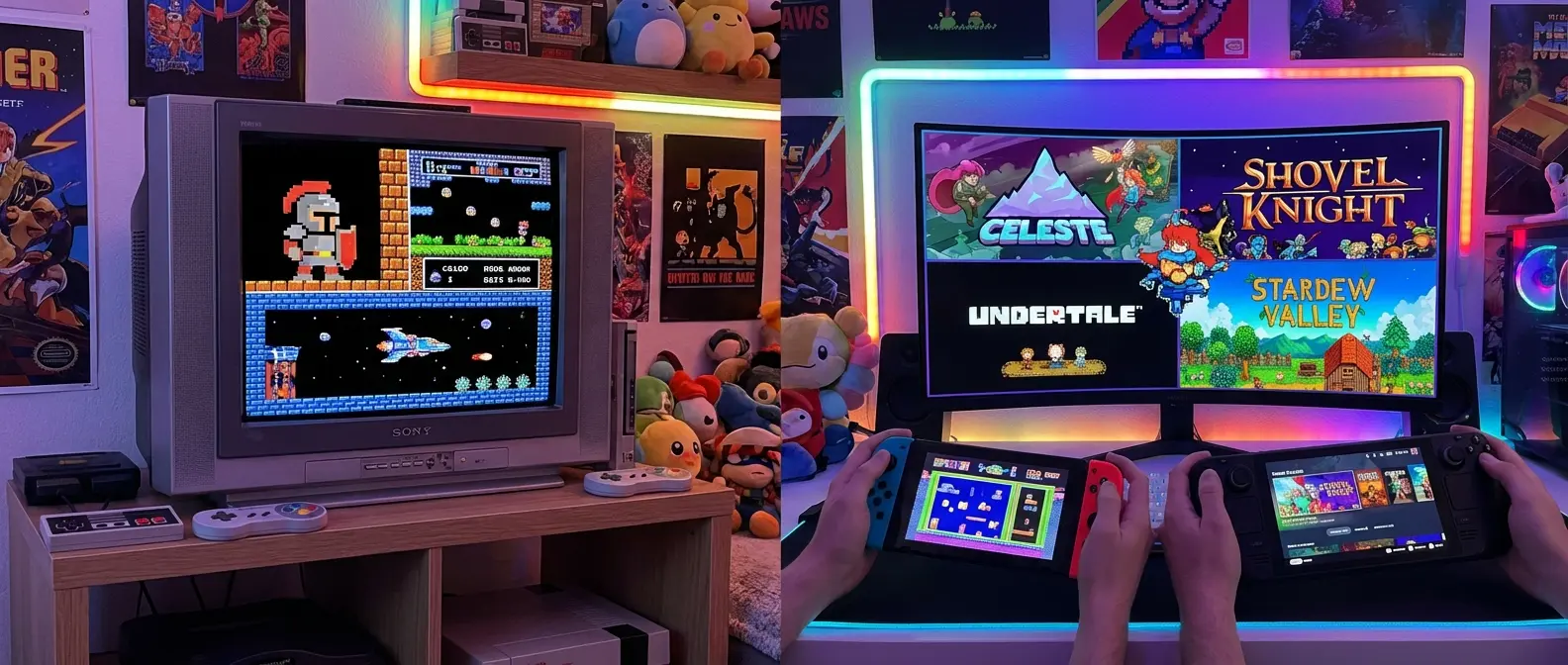
Retro Renaissance: Celeste, Shovel Knight, Undertale, Stardew Valley - modern indie games that honor timeless pixel art
🎨 The Pixel Art Renaissance: Retro Aesthetics in New Games
The retro gaming influence isn't limited to playing old games — it has deeply influenced modern game development. Pixel art indie games have become a massive category, combining the aesthetics of the past with modern game design.
Why Developers Choose Pixel Art
Choosing pixel art isn't just nostalgic — it's practical and artistic. A solo developer can create beautiful pixel art without a team of 3D artists and animators. The style also allows a focus on gameplay over graphics fidelity, and the timeless aesthetic means games don't “age” visually.
✨ Must-Play Modern Pixel Art Games
- Celeste: Precision platformer with incredible music and a story about mental health
- Shovel Knight: NES-style perfection with modern quality-of-life features
- Undertale: Revolutionary RPG that subverts genre expectations
- Stardew Valley: Farming sim that surpassed Harvest Moon
- Hollow Knight: Metroidvania masterpiece with atmospheric world
- Dead Cells: Roguelike action with butter-smooth combat
- Hyper Light Drifter: Wordless storytelling, Zelda meets Dark Souls
- Katana Zero: Stylish action with time manipulation
- CrossCode: Action RPG set in an MMO, massive content
- Blasphemous: Dark, gothic action with stunning art
The Technology Behind Modern Retro
Modern pixel art games aren't simply “old games on new hardware.” They use modern techniques that were impossible on classic consoles:
- Parallax scrolling: Multiple background layers for depth
- Dynamic lighting: Real-time shadows and lighting
- Particle effects: Explosions, sparks, magical effects
- Smooth animations: Far more frames than the originals
- High resolutions: Pixel art on 1080p or 4K displays
- Advanced physics: Realistic movement and interactions
🔮 The Future of Retro Gaming
Retro gaming shows no signs of slowing down — on the contrary, it continues to evolve and adapt to new technologies.
Trends That Will Shape the Future
- Cloud Retro Gaming: Services like Antstream Arcade offer streaming access to thousands of retro games
- VR Nostalgia: Imagine “stepping inside” a 1985 arcade
- AI Upscaling: Technologies like ESRGAN upgrade pixel art to HD
- FPGA Evolution: Even more accurate hardware reproduction
- Legal Preservation: Push for legal preservation of the gaming heritage
- NFTs & Digital Ownership: Controversial, but could potentially change collecting
Why Retro Gaming Will Always Exist
There's something timeless about classic games that modern ones can't replicate. The simplicity of a platformer you learn in seconds but need years to master. The sense of completion when you beat a boss without difficulty settings or assists. The social experience of couch co-op that online games can't replace.
As modern games become increasingly complex, time-consuming, and service-based, retro games offer a refuge. They are complete products that don't require updates, subscriptions, or an always-online connection. They are what you bought, nothing less, nothing more.
📝 Conclusion: The Timeless Allure of Classic Gaming
Retro gaming is much more than a simple trend — it's a movement that reflects our relationship with technology, art, and our memories. Whether you choose emulators on your computer, mini consoles on your TV, retro handhelds for gaming on the go, or start collecting authentic cartridges, there's a retro gaming path for every budget and lifestyle.
The beauty of retro gaming is that there's no “right” way to do it. You can be a purist who plays only on original hardware with a CRT television, or a casual fan who enjoys games on your smartphone. You can invest thousands in sealed collectibles or explore free ROMs. What matters is the joy and connection you find in classic games.
Because in the end, great games are timeless. Super Mario Bros is just as fun today as it was in 1985. Chrono Trigger still moves with its story. Tetris is still perfectly designed. Technology may evolve, but good design never ages.
So pick up the controller, pop in a cartridge, and let nostalgia take you back to the golden years of gaming. Because sometimes, the past is the best way to enjoy the present.