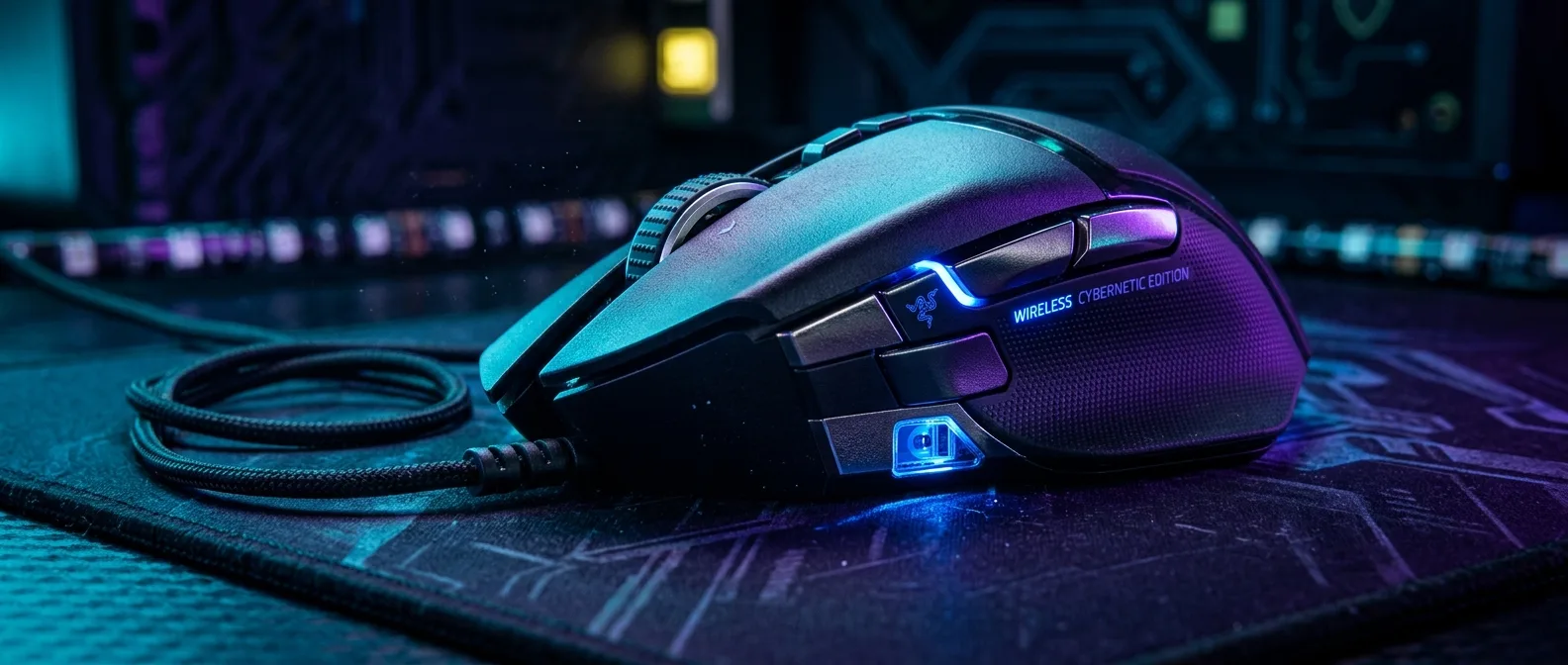
Six hours of battery life at 8000Hz? Those days just ended. Razer's FrameSync technology promises to double gaming mouse battery life — and the Viper V4 Pro is just the beginning.
📖 Read more: US Gaming Sales 2026: Resident Evil Requiem Dominates +60%
🔋 FrameSync: The Revolution We Didn't See Coming
When did your gaming mouse accuracy last bother you? Almost never, I'd guess. Sensors have reached the point where even budget mice deliver flawless performance. But battery life? That still hurts. Razer gets this better than most. The new FrameSync technology in the Viper V4 Pro isn't just another marketing buzzword — it's a smart solution to a real problem. Instead of hammering the sensor with thousands of snapshots every second, FrameSync syncs image capture with your computer's polling cycle. The result? The Viper V4 Pro hits 180 hours of battery life at 1000Hz. Nearly double the previous model.Previously, the mouse sensor took snapshots constantly — even when they weren't needed. Like having a camera that shoots 8000 photos per second, but you only use 1000 of them.
How Does It Work in Practice?
The process happens in three stages: the sensor captures the image, the MCU (microcontroller) processes it, then sends it to your computer when requested. The traditional approach had the sensor working non-stop, regardless of when the next data request would come. FrameSync changes this pattern. It synchronizes the sensor with the MCU and polling rate, so images are only captured when they're about to be requested. Think G-Sync for monitors — but for mice.⚡ Viper V4 Pro: When Numbers Tell the Story
The new Viper isn't just better battery life. It's a complete upgrade that shows how far we've come with gaming peripherals.49g Weight (black model)
50,000 DPI Focus Pro Gen-3
930 IPS tracking speed
180h Battery at 1000Hz
Optical Scroll Wheel: The End of Problems
One of the most annoying features of gaming mice is scroll wheels that skip steps. Razer answered with an optical scroll wheel that's 3.3 times more reliable than mechanical designs. Might not sound impressive, but anyone who's lost a clutch round because their wheel double-scrolled during weapon switch understands the value.📖 Read more: MSI Jacks Gaming Hardware Prices 30%: \
🎯 The Comparison Everyone's Waiting For
The Viper V4 Pro costs €160 — exactly what the V3 Pro cost at launch. But how does it stack up against the competition?Vs. Logitech G Pro X2 Superstrike
The Logitech costs more (around €180) but offers haptic feedback and analog switches. Razer plays the battery life and weight game.
Vs. Corsair Sabre V2 Pro Ultralight
The Corsair is lighter (36g), but Razer has better sensor technology and significantly more battery life.
Build Quality and Construction
The Gen-4 optical switches promise 100 million clicks and zero debounce delay. If that means something to you, you're probably in this mouse's target group. If not — just know the clicks will outlast the rest of the mouse. The lower weight (49g in black, 50g in white) is achieved without noticeable loss in build quality. The honeycomb design isn't as exposed as other ultralight mice.🔧 FrameSync Beyond Razer
The interesting question is whether we'll see this technology from other companies. The idea of synchronized sensing isn't patented by Razer — it's a logical evolution anyone could adopt. Logitech has already shown innovation with Superstrike technology. Corsair has the ultralight approach. Now Razer brings battery efficiency to the forefront.The gaming ecosystem is becoming increasingly wireless. Keyboards, headsets, mice — everything's moving toward wireless. And in that environment, battery becomes the critical factor."After years of sensors being generally equally good, it's hard to get excited about new technologies. But FrameSync changes something we actually care about — battery life."
Jacob Fox, PC Gamer
Does the Bigger Dongle Mean Something?
Razer replaced the V3 Pro's tiny dongle with a larger hemispherical design. Supposedly it improves connection stability — and something tells me this isn't marketing speak. Wireless gaming peripherals have a hidden enemy: interference. A larger dongle with better antenna design can make the difference between flawless connection and occasional hiccups.💰 Is the Upgrade Worth It in 2026?
Here comes the tough question. If you already have a good gaming mouse — say the V3 Pro or G Pro Wireless — why change? The answer depends on how much charging bothers you. The V3 Pro had about 95 hours of battery at 1000Hz. That means charging every 3-4 weeks for the average user. The V4 Pro makes it every 6-7 weeks. Is that significant? For some yes, for others no. If you play competitively and every gram counts, the 5 grams less weight might interest you. If you use high polling rates (4000Hz+), the improved efficiency becomes more noticeable.At 8000Hz, the V4 Pro promises 45 hours of battery life. That's pretty impressive for such high polling frequency, but there's one thought: how many people actually need 8000Hz?
Razer is betting that 2026 will be the year gaming mice finally become "set and forget." Charge, play for months, recharge. Without thinking about battery level every time I shut down my computer. If that becomes reality, FrameSync technology will be one of the reasons it succeeded. And who knows — maybe in two years we'll wonder how we lived without it.