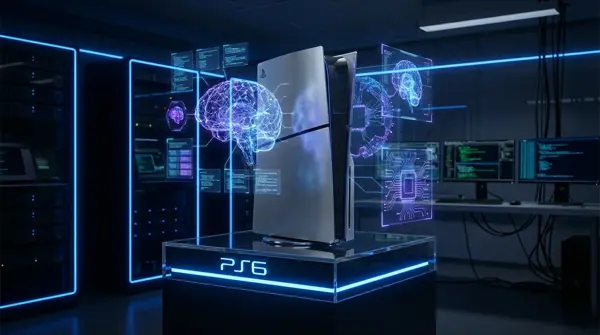
The Chip Crisis: AI vs Gaming
In October 2025, Mark Cerny — the architect behind every PlayStation since the PS4 — confirmed that the next PlayStation console is in “early development” and that its release will come “in a few years' time.” This statement, combined with rapid developments in the AI industry, reveals a serious underlying problem.
TSMC (Taiwan Semiconductor Manufacturing Company) is the only manufacturer in the world capable of producing chips using sub-5nm technology — precisely what Sony needs for the PS6. But TSMC's production capacity isn't infinite, and demand has skyrocketed due to AI.
Nvidia, the world's largest AI chip company, has secured a massive share of TSMC's production for its own data center GPUs. Companies like Microsoft, Google, Meta, and Amazon are spending billions on AI infrastructure, and they all need TSMC chips. This means less capacity — and higher costs — for gaming clients like Sony and AMD.
2027 or 2028-2029? The Release Dilemma
Reliable leaks paint two possible scenarios. Well-known AMD leaker KeplerL2 on NeoGaf claims that a 2027 launch is “not just on the table — it's the plan, unless any unexpected delays happen.” The same source reports that specs for both the PS6 and the next Xbox have already been finalized.
On the other hand, many analysts believe AI chip demand pressure will push Sony to delay until 2028 or even 2029. Launching a new console requires millions of chips — an extremely difficult proposition when TSMC can't even fulfill existing AI orders.
PlayStation Release History
If Sony follows the historical 7-year pattern between generations, 2027 is the target. But the pandemic showed how fragile the supply chain can be — PS5 consoles were nearly impossible to find until mid-2022. The AI chip crisis could create similar, if not worse, problems.
AI Inside the PS6: From Problem to Advantage
Paradoxically, the same AI technology causing delays will be the PS6's biggest selling point. Sony is already showing its direction with the PS5 Pro, which uses AI upscaling technology called PSSR (PlayStation Spectral Super Resolution) — Sony's answer to Nvidia's DLSS.
Cerny revealed that Sony is collaborating with AMD to use their new Radience Cores in the PS6's GPU, which will better support real-time ray tracing and AI upscaling. This means the PS6's chip will be more complex — and harder to manufacture than a straightforward gaming chip.
Expected AI Technologies in PS6
- Advanced PSSR 2.0 — Next-gen AI upscaling for native-quality 4K/8K imagery
- AI-enhanced Ray Tracing — AMD's Radience Cores for full path tracing
- Machine Learning NPCs — Characters with dynamic AI-driven behavior
- AI Audio Processing — Realistic 3D audio with machine learning
- Smart Asset Generation — Faster texture loading via AI decompression
Expected Specifications
According to the most reliable leaks (primarily from Moore's Law is Dead and KeplerL2), the PS6 will represent a significant upgrade in every aspect. YouTuber Moore's Law is Dead claims with “100% certainty” that Sony will continue its partnership with AMD, with a chip based on the RDNA 5 GPU and Zen 6 CPU.
PS5 Pro vs PS6 (Estimated)
An interesting detail: according to KeplerL2, the PS6 will have fewer Compute Units than the PS5 Pro, but thanks to the RDNA 5 architecture, each unit will be utilized far more efficiently. This could mean lower manufacturing costs — a crucial factor in the age of AI chip scarcity.
Games in Development
While Sony hasn't officially announced any PS6 games, we can identify several titles almost certainly targeting the next generation:
- Physint (Kojima Productions) — Hideo Kojima announced a “next-generation action espionage game” at State of Play 2024. The use of “next-generation” strongly hints at a PS6 exclusive.
- The Witcher 4 (CD Projekt Red) — Under codename “Polaris,” expected to arrive years from now.
- Cyberpunk 2077 Sequel (CD Projekt Red) — Codenamed “Orion,” likely cross-gen or PS6 exclusive.
- Hogwarts Legacy 2 — In “early development” according to Variety.
- Bloodborne Remake — Every PlayStation fan's dream. FromSoftware delivered a Demon's Souls remake at PS5 launch.
The Price: Will Gamers Pay More?
The era of affordable consoles appears to be ending. The PS5 launched at $499, was raised to $549 citing a “challenging economic environment,” and the PS5 Pro arrived at $699 — a price recently increased to $749.
In this climate, analysts estimate the PS6 will launch between $599 and $649. A $700+ price tag for the base model would be a tough sell. However, if chip manufacturing costs continue rising due to AI demand, Sony may face difficult decisions.
An intriguing rumor suggests Sony is considering a “PS6S” model — a cheaper, less powerful variant similar to the Xbox Series S. This would be unprecedented for Sony, which has never released a “light” console. If realized, it could offset higher prices and make next-gen gaming more accessible.
Sony vs Microsoft: The Strategic Game
The next-gen race doesn't concern Sony alone. According to the same sources, the next Xbox is being developed in parallel and may also launch in 2027. In fact, KeplerL2 reports that Microsoft will have a raw specs advantage — more CPU cores, higher GPU frequency, more cache, and greater bandwidth.
This doesn't necessarily translate to a real-world advantage. History has shown (PS3 vs Xbox 360, PS4 vs Xbox One) that specs don't decide the winner — exclusive games, pricing, and the services ecosystem make the difference. With 92.2 million PS5s sold through January 2026, Sony has an enormous installed base to leverage.
What Does This All Mean for Gamers?
For the average gamer, the situation is fairly clear: the PS5 will remain the primary gaming platform for at least another 1-2 years. Sony positions the PS5 in “the latter stage of its lifecycle,” but this doesn't mean abandonment — it means the biggest games (GTA 6, Marvel's Wolverine) will still release on PS5.
The truth is that AI brings both challenges and opportunities. Yes, it may delay the PS6 by 1-2 years. But when it eventually launches, it will incorporate AI technologies that will fundamentally change how we play games. From photorealistic graphics without framerate sacrifices to NPCs that react like real humans — the next generation is worth the wait.
Key Takeaways
- Scenario 1: PS6 launches late 2027 (if TSMC production goes smoothly)
- Scenario 2: Delayed to 2028-2029 (more likely due to AI chip demand)
- Price: Expected at $599-$649, potentially higher if TSMC raises prices
- Backward compatibility with PS5 and PS4 games is likely
- AI will be a core selling point — PSSR 2.0, path tracing, ML NPCs
- Competition with the next Xbox will determine final pricing