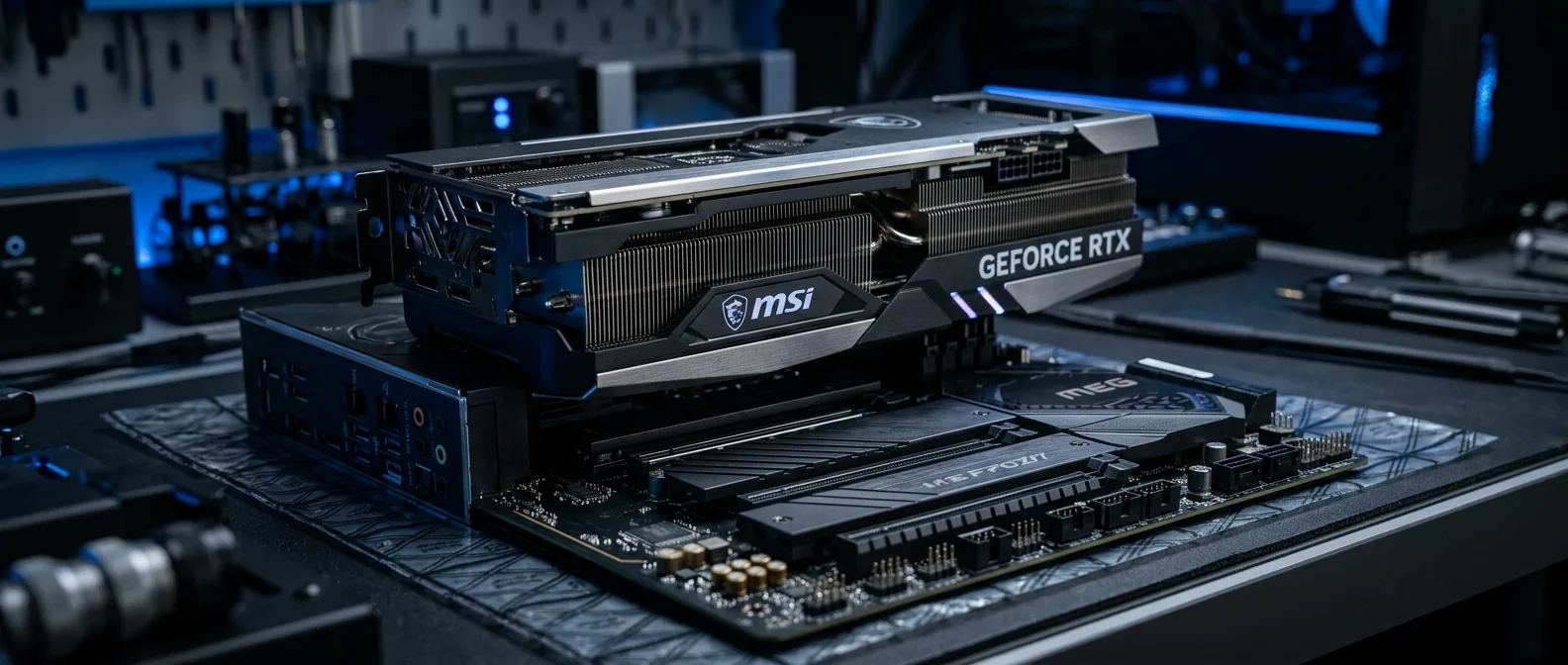
DRAM costs five times more than last year. That's just the beginning, says MSI. The Taiwanese company warns of gaming hardware price hikes up to 30% in 2026 — even as its co-founder calls this "the toughest year in company history." What's really driving these brutal numbers?
⚡ The Perfect Storm of 2026
The message was crystal clear at MSI's March 13 investor meeting. General manager Huang Jinqing didn't try to sugarcoat the news. Prices will jump 15-30% across the entire gaming lineup. And no, this isn't temporary.
"This year is the most severe since the company's founding," he told investors. MSI launched in 1986. That means four decades of weathering market crises — from the dot-com bubble to the pandemic. But something different is happening now.
The problem isn't one-dimensional. DRAM and NVIDIA GPU shortages collide while artificial intelligence devours every available memory chip it can find. When a 16GB module that cost around $40 last year now hits $170-180, the math gets ugly for everyone.
🎮 Death of Budget Gaming Builds
Here's where MSI's bet gets interesting. Instead of trying to keep prices low, they're cutting entry-level products entirely. No discounts — immediate discontinuation.
Budget gaming systems that made up 30% of the portfolio will vanish. In their place? More mid-range and high-end products, including RTX 5060 and RTX 5070 systems. Fewer units, higher prices, same revenue — at least in theory.
"Customers, anticipating further price increases, already show willingness to pay more"
Huang Jinqing, General Manager MSI
That's market psychology in action. When you expect prices to rise, you buy now — even if it's already expensive. But does this work long-term?
The "DDR4 Renaissance" Strategy
Something even more striking: MSI completely reverses its DDR5 to DDR4 motherboard ratio. From 8:2 favoring DDR5, they're going 2:8 favoring DDR4. Yes, you read that right — back to older tech.
With DDR4 costing $110-120 for 16GB versus $170-180 for DDR5, the logic is simple. Even DDR4 has spiked dramatically, but it remains more accessible. The company already released new B550 AM4 motherboards for exactly this reason.
🔬 AI "Eats" All the Memory
Behind the numbers sits an unexpected shift. Global DRAM production has pivoted to AI applications. Datacenters, training servers, inference hardware — everything wants massive amounts of high-bandwidth memory.
Consumer gaming hardware gets the scraps. And while AI demand shows no signs of slowing, fabrication plants can't add capacity overnight. You build fabs over years, not months.
Why not build more fabs? They cost billions and DRAM is historically a cyclical market. Companies fear that once capacity is built, demand will crash and they'll be stuck with massive overcapacity.
But it's not just DRAM. MSI estimates a 20% shortage in Nvidia GPUs. GeForce production takes backseat to datacenter cards. An H100 sells for thousands — an RTX 5070 for hundreds. The choice for Nvidia is easy.
📊 What Changes for Gamers
2026 won't be the year for budget gaming builds. If you wanted to enter PC gaming with $600-800, good luck. Entry prices are climbing dramatically.
But there's a weird side effect. With such limited inventory and high prices, we might see better quality control. When you make fewer pieces but sell them for more, you have more budget for testing and R&D.
The New Gaming Hierarchy
Entry-level gaming moves to consoles. Mid-range becomes the new entry-level for PC. High-end becomes an exotic hobby for enthusiasts with deep pockets. This structure will stick for the next two years, minimum.
Budget Gaming (disappearing)
RTX 4060/5060 builds under $1,000 become impossible with new pricing
Mid-Range (new entry)
RTX 5070 builds start at $1,400-1,600, become the new "affordable" option
High-End (luxury)
RTX 5080/5090 builds start at $2,500+, for hardcore enthusiasts only
🎯 Survival Strategies for Gamers
What does a gamer do in this environment? Play the cards smart.
**First:** If you have a decent gaming PC, don't upgrade this year. That RTX 4070 you own will handle 1440p gaming for another 2-3 years. No point paying premium for marginal improvement.
**Second:** If you absolutely need a new PC, check the used market. Gamers who already have solid systems but wanted upgrades might now change their minds. Good opportunities on second-hand RTX 4080, RTX 4090.
**Third:** Explore DDR4 builds. Instead of chasing the latest DDR5 setup, a solid DDR4 system with Ryzen 5800X3D or 5900X will give you 90% of the performance at 60% of the cost.
The "Wait and See" Trap
Many gamers play the waiting game. "I'll wait for prices to drop." Bad news: they won't drop soon. Whatever companies survive 2026 will have learned they can sell fewer pieces at higher prices and make the same money.
MSI said it clearly: "Fewer units at higher average prices." This becomes the new normal in the gaming industry. Companies discovered they don't need volume — they need margin.
🔮 Future Predictions
Where do we go from here? Tough news for those expecting cheap PC gaming. 2027 might be slightly better, but don't expect a comeback to 2024 prices.
Consoles become even more attractive. A PlayStation 6 or next Xbox will offer fast gaming without PC hardware's fire prices. Sony and Microsoft know this — expect aggressive pricing on upcoming consoles.
But maybe higher prices aren't entirely negative. PC gaming had pushed constant upgrades every 2 years. Now gamers will be forced to keep their systems longer — meaning better optimization from developers and longer lifespan for each hardware generation.
Only nobody asked gamers if they wanted this "evolution." Money decided for us.