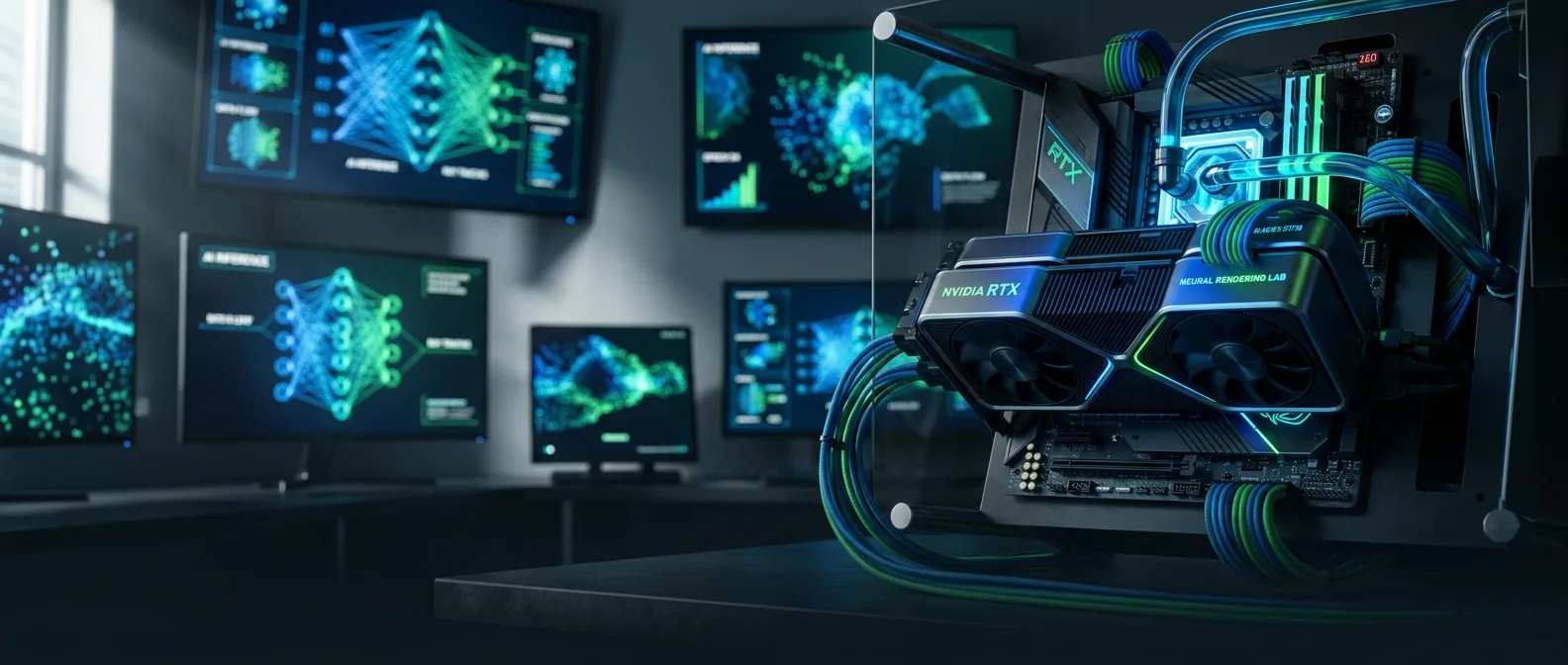
Two RTX 5090s running one demo. That was the reality behind Nvidia's DLSS 5 showcase at GTC 2026. The company unveiled the next generation of Deep Learning Super Sampling that promises to transform gaming with AI neural rendering. But the result looks more like an AI filter than next-gen graphics.
Jensen Huang took the stage at GTC talking about "reinventing game graphics." What did we actually see? A technology that converts games into photorealistic environments, but needs two flagship GPUs to work in the demo.
DLSS 5 arrives this fall 2026 with a radical philosophy shift. Instead of upscaling, we're talking about complete frame reconstruction through artificial intelligence. Nvidia calls it a "real-time neural rendering model" that "infuses pixels with photorealistic lighting and materials."
⚡ How DLSS 5 Neural Rendering Works
The heart of DLSS 5 is an AI model trained "end-to-end" to understand scene details. Hair, fabric, skin — the AI recognizes everything and reconstructs it with photorealism.
According to the company, DLSS 5 takes the color buffer and motion vectors from each frame as input. The AI model then "infuses the scene with photorealistic lighting and materials that are anchored to the original 3D content." The result? Frame consistency maintained over time.
Technical Details: DLSS 5 isn't simple upscaling. It analyzes a frame and extrapolates information across the entire scene, creating new geometry data and lighting information that didn't exist in the original render.
But here's where concerns begin. What happens to developers' artistic vision? Nvidia knows this and promises control options.
🎮 DLSS 5 Games and Hardware Requirements
The games supporting DLSS 5 are impressive names. Bethesda, Capcom, Ubisoft, Warner Bros. Games — everyone's jumping in.
The list includes:
- Assassin's Creed Shadows
- Starfield
- The Elder Scrolls IV: Oblivion Remastered
- Hogwarts Legacy
- Resident Evil Requiem
- NARAKA: Bladepoint
Interesting that older games can get DLSS 5 updates. Starfield — let's face it, not the prettiest gaming example — could become photorealistic.
Hardware Reality Check
Here come the hard truths. Digital Foundry visited Nvidia's labs and revealed a shocking detail: the demo used two RTX 5090s running in parallel.
One card for path tracing, one for DLSS 5. Total cost? Around $7,600. Not exactly mainstream gaming.
Sure, Nvidia claims they already have DLSS 5 running on single GPU in the labs. The question is: which GPU and at what performance?
🧬 AI Artifacts and Creative Control
This raises deeper questions. DLSS 5 doesn't just improve graphics — it fundamentally changes them.
What we see in demos looks like AI-generated video. Beautiful, photorealistic, but... synthetic. This raises questions about artistic integrity.
"DLSS 5 is the GPT moment for graphics — combining hand-crafted rendering with generative AI for dramatic visual realism increases, while maintaining the control artists need for creative expression."
Jensen Huang, CEO Nvidia
In theory, Nvidia provides "detailed controls for intensity, color grading and masking." Developers can determine where and how AI enhancements apply. Theoretically.
The AI Homogenization Problem
A major risk is all characters ending up looking like AI-generated faces. The neural network trained on specific datasets — what if it imposes its own "vision" of how humans should look?
The gaming community has already reacted negatively. Many fear games turning into "AI slop." Rightfully so?
📊 DLSS 5 Performance and Compatibility
DLSS 5 promises to run at 4K resolution with smooth, interactive gameplay. But without concrete benchmarks, we're stuck with promises.
RTX 50 Series
Exclusive support — at least initially
Real-Time Processing
Promises live rendering without frame drops
Developer Controls
Fine-tuning tools for artistic vision
Interesting detail: DLSS 5 uses the same Nvidia Streamline framework as DLSS 4 and Nvidia Reflex. So integration for developers should be relatively easy.
But what about backward compatibility? Will it support RTX 40 series, RTX 30 series? Nvidia hasn't answered.
🎯 Market Impact and Competition
DLSS 5's timing is odd. Usually major version jumps accompany new card generations. Now Nvidia breaks the pattern, possibly due to current hardware market conditions.
AMD is preparing its own response with FSR 5, but Intel with Arc doesn't seem to be entering the neural rendering game — yet.
Developer and Publisher Adoption
Major publishers (Bethesda, Ubisoft) supporting the technology is significant. It means DLSS 5 will have a serious content library from day one.
But there's also vendor lock-in risk. The more games become "DLSS 5 optimized," the harder choosing non-Nvidia hardware becomes.
🚀 The Future of Gaming Graphics
DLSS 5 isn't just the next step — it's a major shift toward AI-driven graphics.
If it succeeds, it will change how we think about game development. Why invest in expensive 3D artists when AI can do photorealistic lighting? Why optimize shaders when the neural network creates them automatically?
But if it fails — if games become homogenous AI soup — the backlash could set the technology back years.
What We're Waiting For: The first DLSS 5 games this fall 2026 will be the real test. Not controlled demos, but real-world usage on mainstream hardware.
🎯 Frequently Asked Questions
Which graphics cards will support DLSS 5?
Officially, only the RTX 50 series. Nvidia hasn't announced backward compatibility for RTX 40 or older generations, which seems unlikely due to neural rendering's high computational requirements.
Can I disable DLSS 5 in a game?
Yes, like previous DLSS versions, developers will provide on/off options and different quality levels. Nvidia promises granular controls for fine-tuning AI output.
How much will an RTX 50 series card with DLSS 5 cost?
Prices haven't been announced, but if the RTX 5090 reaches $3,800, expect the RTX 5080 around $2,200-2,500 and RTX 5070 at $1,200-1,500. Everything depends on availability and AMD competition.
Sources: