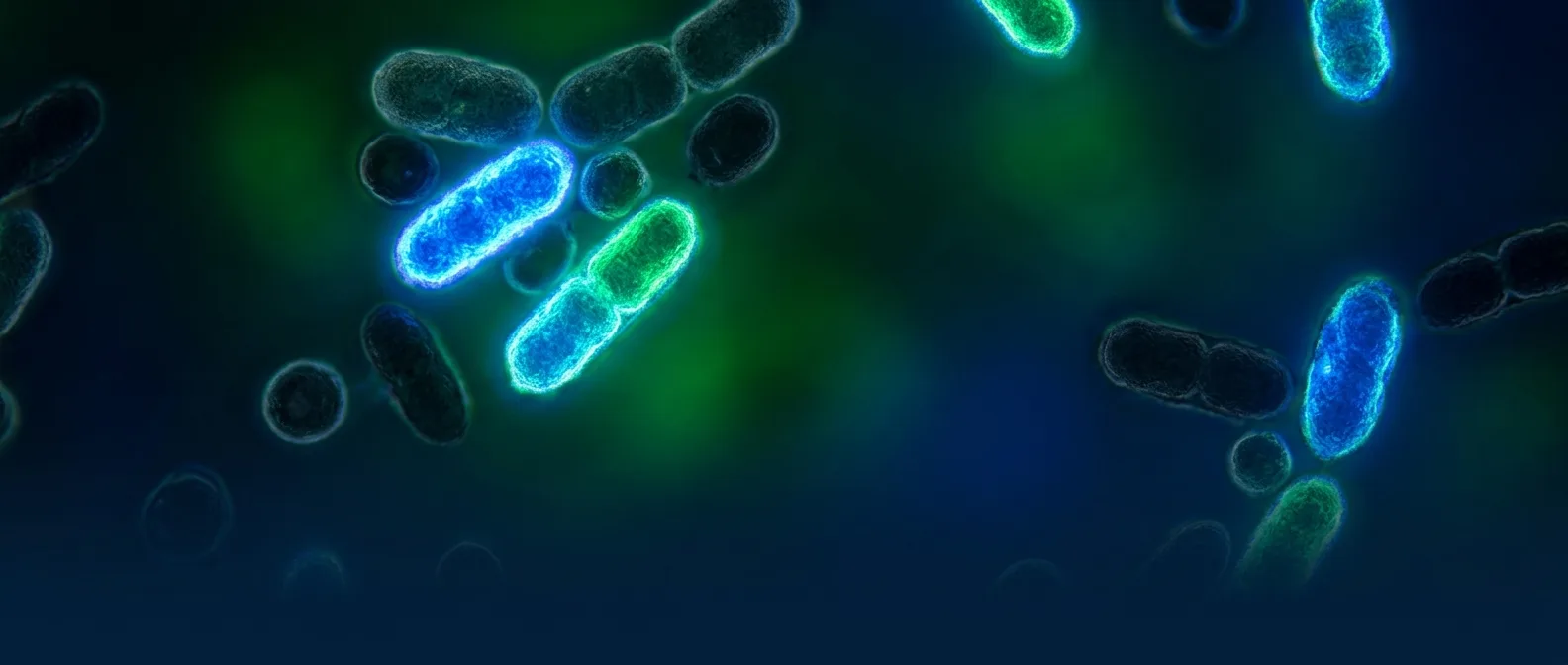
Dead bacteria don't come back to life. That's biology 101. But in March 2026, researchers at the J. Craig Venter Institute in California shattered that rule by creating the first zombie cells — microorganisms killed with chemotherapy drugs, then resurrected with synthetic genomes from entirely different species. This isn't just another synthetic biology milestone. This is programmable life from death.
Here's what happened: Scientists took bacteria, destroyed their DNA completely with mitomycin C (the same chemical used in cancer treatment), then injected synthetic genomes from different bacterial species. Some of the dead cells came back to life. They started growing, dividing, functioning — but with entirely artificial genetic instructions.
📖 Read more: AI Protein Design: The Food Revolution
🧬 How to Build a Zombie Cell
John Glass's team targeted Mycoplasma capricolum bacteria with mitomycin C, a DNA-shredding compound that left the cells "functionally dead" — unable to reproduce or perform basic life functions. Think of it as biological murder with a chemical weapon.
Why call them "zombie cells"? Zumra Seidel from JCVI explains: "We take a cell without a genome and it's functionally dead. But by adding a new genome, the cell resurrects."
Next came the resurrection. The team injected synthetic genomes from Mycoplasma mycoides — a completely different bacterial species — into the dead cells. Some of the corpses started growing again. Genetic testing confirmed these reborn cells carried only the synthetic genome.
Why Hasn't This Been Done Before?
Previous attempts failed because bacteria naturally absorb genetic material from their environment through horizontal gene transfer. Scientists couldn't tell if their synthetic organisms were running on artificial genomes or a mixture of old and new DNA.
By killing the host cell first, Glass's team eliminated this contamination problem. No original genome exists to interfere. Only synthetic instructions remain.
⚡ Meet Syn61: The Virus-Proof Bacteria
Meanwhile, at Cambridge, Jason Chin's team achieved something equally stunning with Syn61 — the first fully synthetic bacteria that can produce materials completely unknown to nature.
These aren't just modified bacteria — they're redesigned from scratch. Chin's team rewrote not only their DNA but the entire cellular machinery that translates genes into proteins. The result? Microorganisms that produce artificial amino acids, novel proteins, and polymers that exist nowhere else in nature.
How Do They Become Virus-Proof?
The antiviral protection works through redesigned cellular machinery. Viruses typically hijack a bacterium's cellular machinery to reproduce. In Syn61, that machinery no longer exists in a form viruses recognize. It's like trying to run Windows 95 software on Linux — the operating system is fundamentally incompatible.
When researchers infected both synthetic and natural bacteria with viruses, the natural ones died while Syn61 kept growing normally.
🏭 Programmable Life Factories
The applications are immediate. Imagine bacteria you can program to produce drugs, biofuels, or biodegradable plastics on demand. Microscopic factories that run on sugar and manufacture whatever you need.
"These bacteria can be converted into renewable and programmable factories, producing a wide range of new molecules with innovative properties."
Dr. Jason Chin, University of Cambridge
Chin's team plans to use Syn61 to create "long synthetic polymers that fold into structures and can form new categories of materials and drugs."
Why Does Virus Resistance Matter?
In pharmaceutical manufacturing, viral contamination can destroy entire drug production runs. If your bacterial factories are completely virus-proof, production becomes more reliable and cheaper. You can also maintain long-term cultures without worrying about contamination.
📖 Read more: CRISPR: End of Hereditary Diseases
🔬 Redefining Life and Death
Kate Adamala from the University of Minnesota calls this a "technical leap." These experiments challenge traditional definitions of life itself.
Traditional Life
Metabolism + reproduction + adaptation
Zombie Cells
Synthetic metabolism + programmed reproduction
"What are really the characteristics of life?" Adamala asks. "The recipient [cell] in this case does very little residual metabolism and certainly doesn't reproduce. What constitutes the real characteristic of life then?"
Where Do We Go From Here?
So far, the technique has only been tested on Mycoplasma — one of the simplest bacteria. Glass is optimistic it will work on more complex organisms like E.coli or yeast. The challenge? These have cell walls and much larger genomes.
"If it works for one type of organism, it's likely to work for another," Glass says. His lab is already exploring ways to remove and replace cell walls.
📊 Numbers and Prospects
In 2026, synthetic biology is worth over $35 billion globally. With breakthroughs like these, the market is expected to reach $85 billion by 2030.
Safety concerns exist. The Mycoplasma used in the research are pathogenic to goats and cattle. However, as Akos Nyerges from Harvard Medical School notes, none of the modifications are expected to increase their infectivity.
🎯 Frequently Asked Questions
Are zombie cells safe?
Current experiments follow best laboratory safety practices and pose no increased risk of pathogen escape. The synthetic genomes aren't designed to enhance infectivity.
When will we see practical applications?
Researchers estimate first commercial applications could appear in 5-10 years, initially in specialized drugs and biofuels. Large-scale production of complex materials may take longer.
How do they differ from regular genetically modified bacteria?
While conventional GMOs modify a few genes, zombie cells and Syn61 have completely redesigned genomes that enable them to do things impossible for natural organisms.
These developments force us to confront a new reality: the creation of life that never existed in nature, programmed for specific purposes. Perhaps the most important question isn't whether we can do this — but what it means for our understanding of life itself.