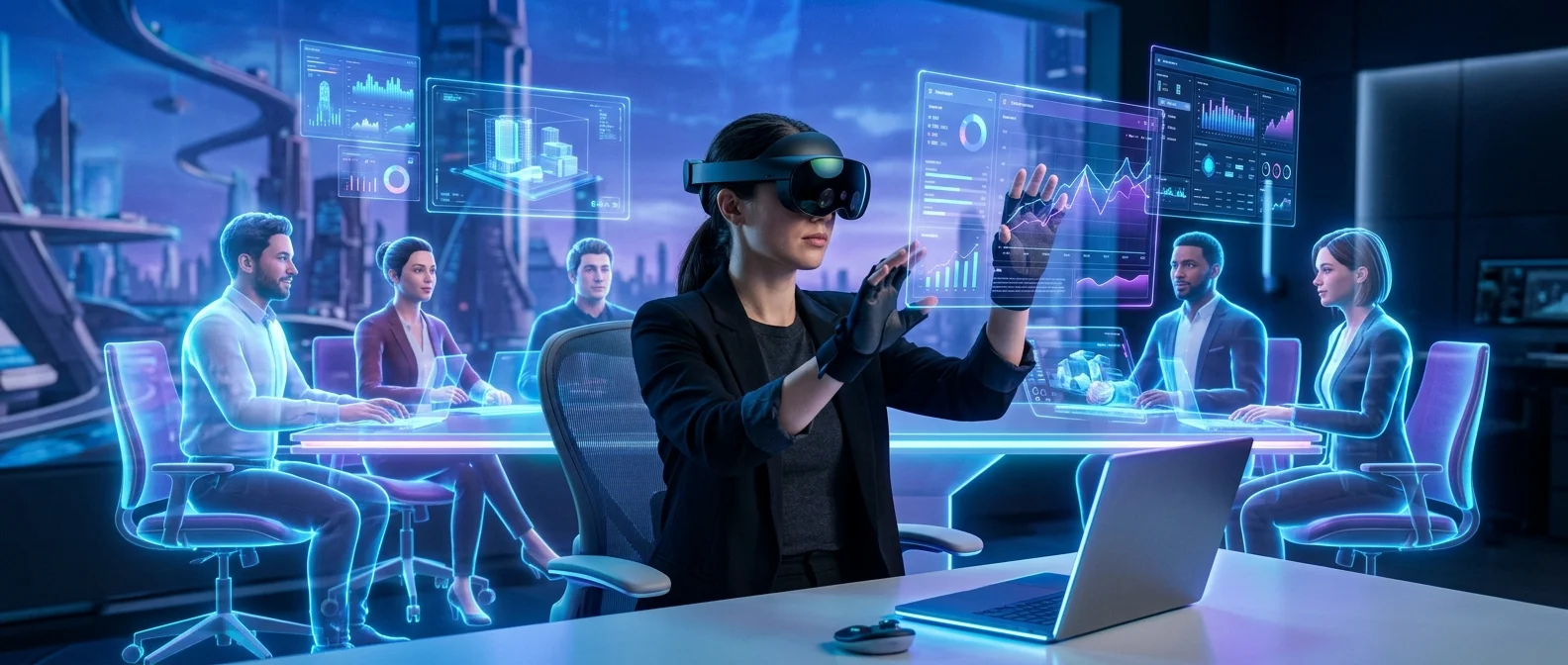
In 2021, Mark Zuckerberg renamed Facebook to Meta and promised we'd work in virtual offices wearing VR headsets. Four years and over $50 billion later, the vision has changed radically. The metaverse as a daily workspace didn't become reality — but the idea isn't dead. It's evolving.
📖 Read more: Humanoid Robots in Factories: The H1 Era 2030
From Snow Crash to VR Offices
The term “metaverse” was coined by author Neal Stephenson in the novel Snow Crash (1992) — a virtual world where people interacted as avatars in three-dimensional space. For decades it stayed science fiction. Second Life (2003), VRChat, and Roblox offered glimpses, but none replaced the office.
Everything changed when the pandemic showed that remote work isn't just feasible — it's preferred by millions. And while Zoom works, “Zoom fatigue” became a phenomenon, and tech companies saw an opportunity. Meta, Microsoft, Apple — all jumped into the race for the virtual office.
The Major Players
Meta: From Horizon Workrooms to AI Pivot
Meta invested more than anyone else. In 2021 alone, Reality Labs lost over $10 billion. Horizon Workrooms — Meta's VR office — let teams meet as avatars around virtual conference tables, write on virtual whiteboards, and collaborate in real time. The numbers told a different story. Horizon Worlds had minimal users — Decentraland, a self-proclaimed “metaverse” platform, was recorded with just 38 active daily users.
In February 2023, Zuckerberg announced a pivot toward artificial intelligence. In January 2026, Meta laid off over 1,000 employees at Reality Labs and shut down VR studios. The metaverse as workspace was no longer the priority.
Microsoft Mesh: Opened and Closed
Microsoft followed a different strategy. It acquired AltspaceVR in 2017 and developed Microsoft Mesh — a platform for mixed reality collaboration through Teams. Announced in 2021 at Ignite, officially launched in January 2024, tested by companies like Accenture and Takeda — and shut down in December 2025. The Register described the closure as “the end of an era”, as Microsoft turned fully toward AI.
Apple Vision Pro: A Different Approach
Apple said it wasn't building a VR headset but a "spatial computer". Vision Pro launched in February 2024 in the US and gradually expanded globally. At $3,499, with dual micro-OLED 4K displays, eye tracking, hand tracking and visionOS, it's the most advanced headset on the market. In October 2025, Apple announced the M5 version: 120 Hz, better resolution, and a new Dual Knit Band for improved comfort.
Apple's difference: It doesn't aim for virtual worlds filled with avatars. visionOS displays app windows in the user's real space — passthrough cameras show the real world with digital elements overlaid on top. It's mixed reality, not virtual reality.
📖 Read more: Work 2040: How We'll Work in the Future
Why the VR Office Fails
The problem isn't only technological. It's human. Few people want to wear a 600-800 gram headset for 8 hours a day. The challenges are specific:
- Comfort: even Vision Pro causes eye fatigue and facial pressure after prolonged use
- Cost: headsets range from $300 to $3,499 — multiples of a good laptop
- Isolation: VR disconnects users from physical space, which is undesirable in a family environment
- Computing power: a 1,000x increase in performance is needed for truly immersive experiences, according to Intel
- Killer app: there's still no application that's significantly better in VR than what we already do on screens
What Already Works
But VR isn't completely dead at work. Nvidia uses Omniverse for industrial digital twins — virtual replicas of factories for design and simulation. In medicine, surgeons are already using Vision Pro in the operating room. In education, immersive environments allow practicing dangerous situations without risk.
VR won't replace offices. But it works where flat screens fail: 3D design, simulation, training, medicine.
The Future: AR Glasses, Not Headsets
Most analysts agree: the VR headset is a transitional technology. The real future is lightweight AR glasses — glasses that look normal and overlay digital information on the visual field. Apple has admitted as much — Vision Pro is a “bridge” to future AR glasses that aren't yet technically feasible.
When AR glasses become light, affordable, and comfortable, then the virtual office could become reality. Not as a metaverse with avatars in virtual worlds, but as a layer on top of reality — windows, tools, colleagues “projected” into your living room while you drink coffee.
Today's reality is more mundane than Snow Crash. We don't live in virtual worlds — but slowly, the tools we need to work without an office are getting better. And that might be enough.