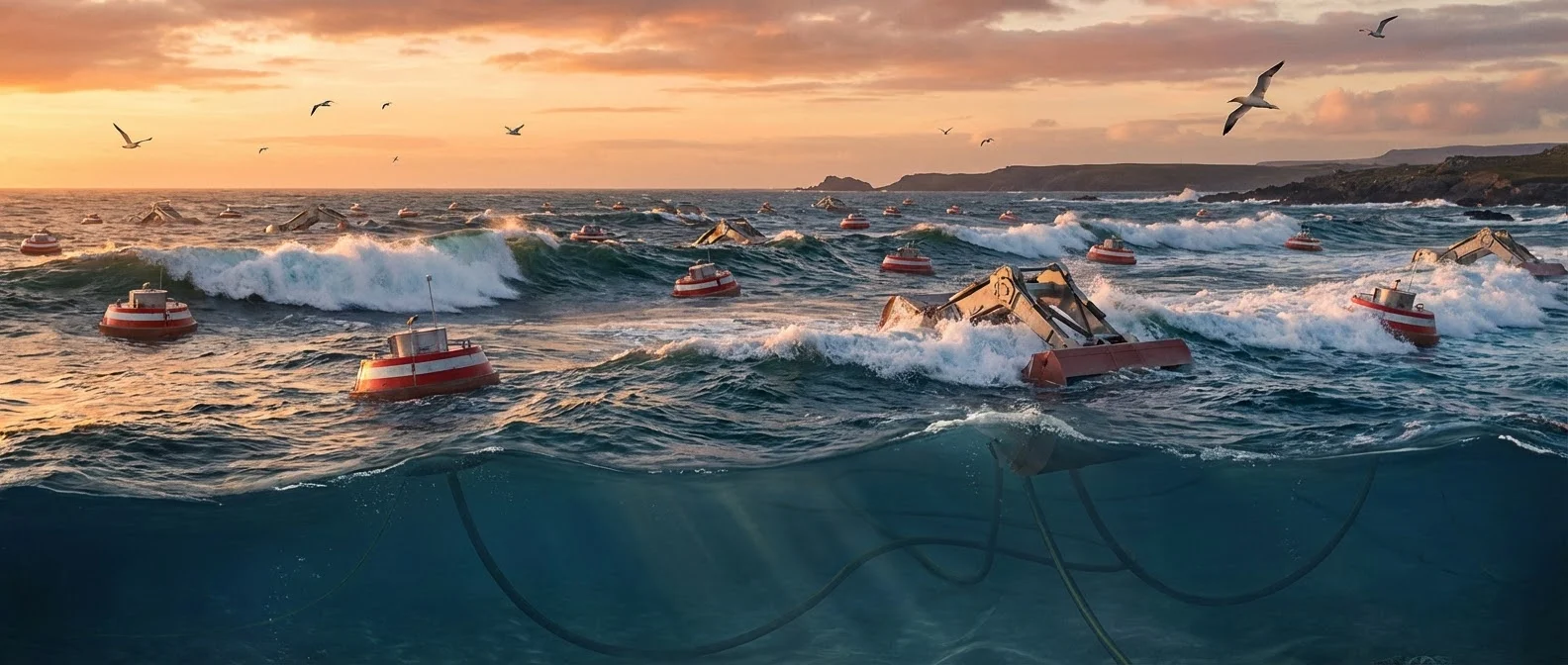
Every second, trillions of tons of seawater rise and fall in relentless cycles. Ocean waves carry enormous amounts of energy — five times denser than wind and ten to thirty times denser than solar. Wave energy represents one of the most untapped renewable sources on the planet — and the technology is finally beginning to mature.
📖 Read more: Solar Roads: Roads That Generate Electricity
🌊 What Is Wave Energy?
Wave energy is the capture of the kinetic and potential energy of ocean waves for electricity generation, desalination, or water pumping. Waves are primarily created by wind blowing across the sea surface — air pressure differences and surface friction transfer energy to the water, forming wave motions that can travel hundreds or thousands of kilometers.
In deep water, wave power is proportional to the square of the wave height and the wave period. A moderate swell of 3 meters with a period of 8 seconds produces roughly 36 kW per meter of wave front. In major storms, 15-meter waves carry up to 1.7 MW per meter — enough energy to power over 1,000 households for every meter of wavefront.
💡 Why Are Waves So Energy-Rich?
The ocean acts as a natural energy “accumulator.” Wind (a secondary form of solar energy) transfers energy to water, but since water density is ~800 times greater than air, energy density increases dramatically. Waves can travel across entire oceans with minimal loss, arriving at coastlines thousands of kilometers from their point of origin.
📜 Historical Timeline
The idea of harnessing wave energy is far from new. Since 1799, inventors and engineers have sought ways to tap this inexhaustible source.
📖 Read more: Hydrogen: The Fuel That Changes Everything
⚙️ Types of Wave Energy Converters (WEC)
Engineers have developed six distinct approaches to capture wave energy. Each converter type exploits a different aspect of wave motion.
| WEC Type | Operating Principle | Examples |
|---|---|---|
| Point Absorber | Floating buoy rises and falls — linear generators or hydraulic pumps produce electricity | CorPower C4, Seabased, OPT PowerBuoy |
| Surface Attenuator | Multiple articulated segments perpendicular to waves — flexing drives hydraulic pumps | Pelamis WEC (now defunct) |
| Oscillating Water Column | Waves compress air in a chamber — air drives a turbine to generate electricity | Islay LIMPET, Wave Swell Energy |
| Overtopping Device | Waves fill a reservoir above sea level — low-head turbines exploit gravity | Wave Dragon |
| Oscillating Wave Surge Converter | Flaps or membranes oscillate from surge motion — one end fixed, the other free | Aquamarine Oyster, WaveRoller |
| Submerged Pressure Differential | Flexible underwater membranes exploit pressure differences beneath waves | Bombora mWave, CalWave |
🌍 Global Potential
The theoretical potential of wave energy exceeds 2 TW (terawatts) — enough to cover a significant share of global consumption. The National Renewable Energy Laboratory (NREL) estimates that the United States alone has a theoretical potential of 1,170 TWh per year, equivalent to nearly one-third of the nation's electricity consumption. Alaska accounts for approximately 50% of that potential.
The best locations are found in the temperate zones — the western seaboard of Europe, the northern coast of the UK, the Pacific coastlines of North and South America, Southern Africa, Australia, and New Zealand. Prevailing westerly winds in these zones blow strongest in winter, providing reliable seasonal generation.
🌐 Global Impact: The International Race
Nations worldwide are investing in wave energy research. The European Marine Energy Centre (EMEC) in Scotland has supported more wave and tidal energy device deployments than any other single site. The UK has invested over £200 million over 15 years in wave energy development. The EU, US, and UK each allocate $5-50 million annually in R&D funding. Combined with private investment, this has led to dozens of ongoing wave energy projects across the globe. Island nations and coastal communities stand to benefit most — wave energy could complement solar and wind, providing electricity even during calm, dark nights.
📖 Read more: Self-Sufficient Cities 2050: Zero Waste
🔧 Technical Challenges
Despite its enormous potential, wave energy faces serious technical hurdles that explain why it hasn't yet been widely commercialized.
🌊 Marine Survivability
Devices must withstand saltwater corrosion, extreme storm waves, harsh weather conditions, and the immense forces exerted during each wave cycle. Wear in the marine environment is far greater than for onshore installations — biofouling, metal electrolysis, and even ship collisions are everyday hazards.
⚓ Mooring & Maintenance
Developing reliable mooring systems for the seabed is critical. Maintaining floating devices requires specialized vessels and favorable weather, significantly increasing operational costs. Seabased Industries AB in Sweden was liquidated in 2019 due to “extensive practical and financial challenges” — a cautionary tale for the industry.
🔌 Grid Connection
Transmitting electricity from open sea to shore requires high-voltage subsea cables — expensive, sensitive, and difficult to maintain. Electromagnetic fields from cables can also affect marine organisms. The UK invested over £200 million over 15 years without achieving “market-ready” technology, according to a 2017 Strathclyde/Imperial College study.
📖 Read more: Solar Paint: Buildings That Generate Power
🌱 Environmental Impact & Benefits
Unlike fossil fuels, wave energy produces no greenhouse gas emissions during operation. However, environmental concerns exist: electromagnetic fields from subsea cables, turbine noise, changes to sediment transport, and potential entrapment of marine organisms.
A remarkably positive finding: wave farms significantly reduce coastal erosion on nearby beaches. This synergy between coastal protection and energy production substantially enhances economic viability. Near lagoons, wave farms can provide effective coastal protection during maritime spatial planning.
🔭 What Does the Future Hold?
The technology stands at a critical inflection point. Recent developments offer reasons for optimism:
🚀 Recent Breakthroughs & Innovations
CorPower Ocean achieved a 300% power increase (600 kW) through negative spring technology and phase control — the buoy rises with a slight delay from the wave, extracting more energy. A UK company developed the Waveline Magnet, which reportedly achieves a levelized cost of electricity of just £0.01/kWh — if verified, it would be the cheapest clean energy in history. In Spain (2024), the first fully submerged wave energy converter was approved — invisible from the surface and protected from storms.
| Feature | Wave Energy | Offshore Wind | Solar |
|---|---|---|---|
| Energy Density | Very High (5× wind) | Moderate | Low |
| Predictability | Moderate (72-hour accuracy) | Moderate | High (daily) |
| Nighttime Operation | Yes — 24/7 | Yes | No |
| Technology Readiness | Early (TRL 5-7) | Mature (TRL 9) | Mature (TRL 9) |
| Cost (LCOE) | High (>$200/MWh) | ~$50-100/MWh | ~$30-60/MWh |
| Seasonal Complementarity | Winter (stronger winds = bigger waves) | Winter | Summer |
Wave energy is at the stage where offshore wind was in the late 1990s — promising but still expensive. If the cost reduction curve follows a similar trajectory, the 2030-2040 decade could mark the turn toward commercial viability. The waves will never stop — the question is whether we'll stop ignoring them.