📖 Read more: AI Gondolas: Autonomous Boats on Water
📖 Read more: Solar Satellites: Energy from Space
The Von Neumann Probe Concept That Changed Space Exploration
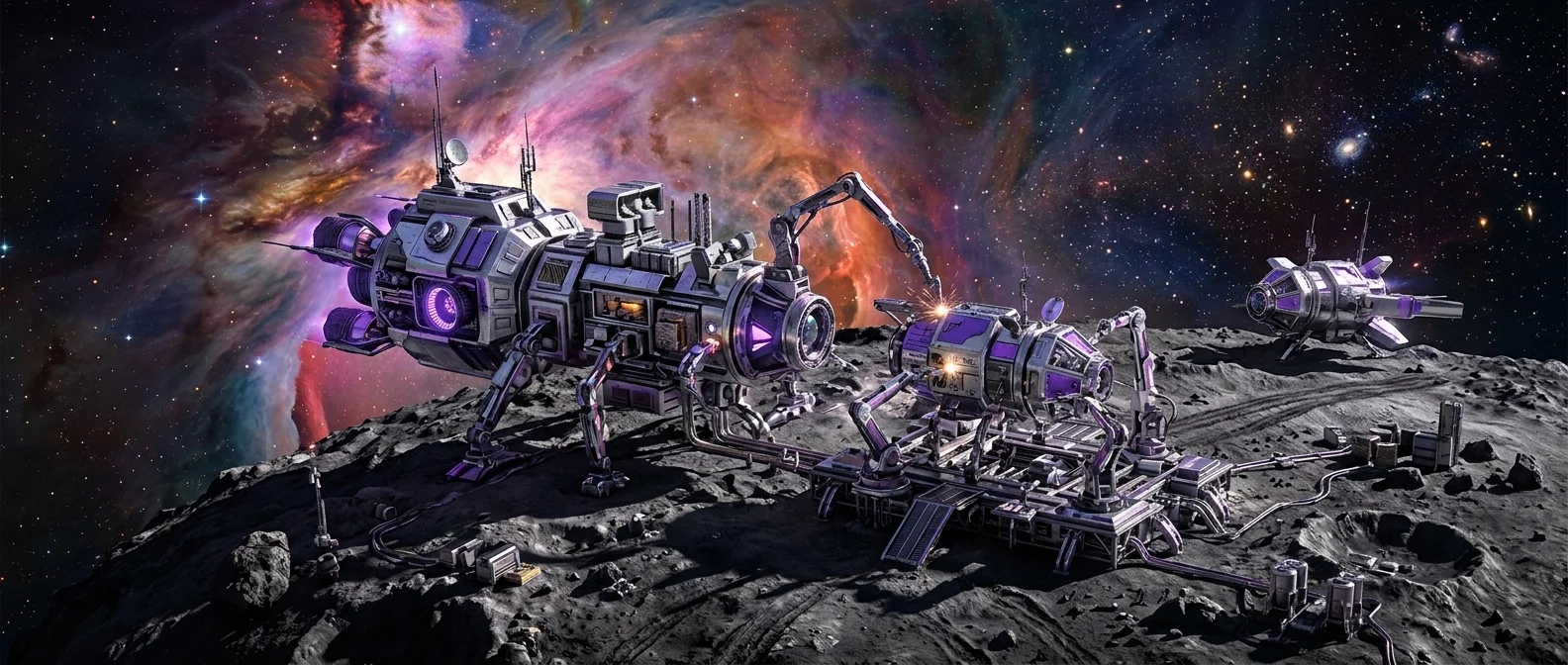
A spacecraft lands on a distant asteroid, harvests raw materials, and builds perfect copies of itself. These new probes travel to other worlds, repeat the process, and gradually spread across the entire galaxy. This isn't science fiction anymore — Von Neumann probes represent one of the most serious research frontiers that could redefine how we explore the universe.
Named after mathematician John von Neumann, who first described theoretical machines capable of self-replication, these spacecraft would turn a single mission into an entire fleet. One probe becomes two. Two become four. Within a few million years, they could visit every star system in the Milky Way.
Core Technology: Von Neumann probes combine advanced artificial intelligence, robotic manufacturing, and space propulsion to create autonomous exploration systems that can reproduce without human intervention.
How Self-Replicating Spacecraft Actually Work
Building a machine that can clone itself in space requires four critical systems working in perfect harmony. First, the probe needs advanced sensors and analysis equipment to identify suitable raw materials on asteroids or planets. Think spectrometers that can detect iron, silicon, and rare earth elements from orbit.
Second comes the mining and processing gear. The probe must extract these materials and refine them into usable components — essentially carrying a miniature smelter and chemical plant. Third, it needs a complete manufacturing facility capable of producing everything from microprocessors to rocket engines. Finally, the system requires sophisticated AI that can coordinate all these operations and make autonomous decisions about exploration and replication.
📖 Read more: Space Junk Crisis: 36,000+ Objects Threaten Earth's Orbit
Engineering Challenges and Breakthrough Solutions
The technical hurdles are staggering. How do you fit an entire industrial civilization into a spacecraft? Current approaches focus on molecular assemblers — machines that can build complex structures atom by atom. These would be paired with advanced 3D printing systems capable of producing electronics, mechanical parts, and even other manufacturing equipment.
The AI challenge might be even harder. The probe's brain must operate autonomously for decades or centuries without human oversight. It needs to handle unexpected situations, repair itself when things break, and evolve its capabilities over time. We're talking about artificial intelligence that surpasses human problem-solving in engineering, chemistry, and physics.
Current Progress in Self-Replication Technology
Despite the challenges, several breakthroughs are bringing Von Neumann probes closer to reality. Robotics has advanced to systems that can autonomously assemble complex structures. Meanwhile, nanotechnology developments allow for microscopic factories that can produce electronic components from basic raw materials.
Artificial intelligence has also made impressive strides in autonomous decision-making and adaptability. Modern systems can learn from their environment and improve performance without external guidance. These capabilities are crucial for spacecraft operating in remote environments for extended periods.
Advanced Robotics
Autonomous assembly of complex systems without human intervention
Nanotechnology
Microscopic factories for producing electronic components
Adaptive AI
Systems that learn and evolve autonomously
📖 Read more: Anti-Aging: Will We Live to 150?
Galactic Exploration Applications
Von Neumann probes could revolutionize how we explore the universe. Instead of sending one spacecraft to each interesting destination, we could launch a single self-replicating probe that would create an entire exploration fleet. This would enable simultaneous study of hundreds or thousands of worlds.
The technology could also build infrastructure in space before humans arrive. Self-replicating robots could construct space stations, telescopes, or even colonies on other planets. This would dramatically reduce the cost and risk of space exploration while accelerating our expansion into the solar system and beyond.
Traditional vs Self-Replicating Exploration
| Feature | Traditional Method | Von Neumann Probes |
|---|---|---|
| Number of Targets | One per mission | Hundreds simultaneously |
| Cost | High per target | Low after initial investment |
| Exploration Time | Decades per target | Parallel exploration |
The Grey Goo Problem and Ethical Concerns
Self-replicating spacecraft raise serious safety and ethical questions. The biggest risk is creating systems that could escape human control and reproduce uncontrollably. This could lead to the destruction of ecosystems or entire planets — the so-called "grey goo" scenario where self-replicating machines consume everything in their path.
There are also questions about property rights in space. If a self-replicating probe builds infrastructure on an asteroid or planet, who owns it? These issues require new international protocols and agreements for space exploration. We need robust control systems and fail-safes built into every Von Neumann probe design.
Warning: Developing Von Neumann probes requires strict control and safety systems to prevent uncontrolled replication that could have catastrophic consequences.
Development Timeline and Milestones
Experts estimate the first Von Neumann probe prototypes could be developed within the next 2-3 decades. These would be simple systems capable of reproducing only basic components of themselves. Full self-replication would likely require another 20-30 years of development.
The key to success will be gradual technology development. Initially, spacecraft will be able to manufacture simple tools and components. Gradually, their capabilities will expand until they can reproduce entire systems. This approach will allow for risk control and technology improvement at each stage.
Projected Evolution
- 2030-2040: First prototypes with limited replication
- 2040-2050: Systems that reproduce basic components
- 2050-2070: Fully self-replicating spacecraft
- 2070+: Mass exploration of the galaxy
Von Neumann probes represent one of the most ambitious technological concepts of our time. Despite the technical and ethical challenges, the possibility of self-replicating universe exploration could open new horizons for humanity. Their successful development would mark the beginning of a new era in space exploration, where the limits of the possible extend beyond any previous imagination.
Sources: