📖 Read more: Ammonia Ships: Zero Emissions in Shipping 2035
The Vacuum Train Revolution
Picture this: Athens to Thessaloniki in under 30 minutes. Not by plane, but by a train screaming through a vacuum tube at over 1,000 kilometers per hour. This isn't science fiction anymore — vacuum trains are breaking the sound barrier of ground transport.
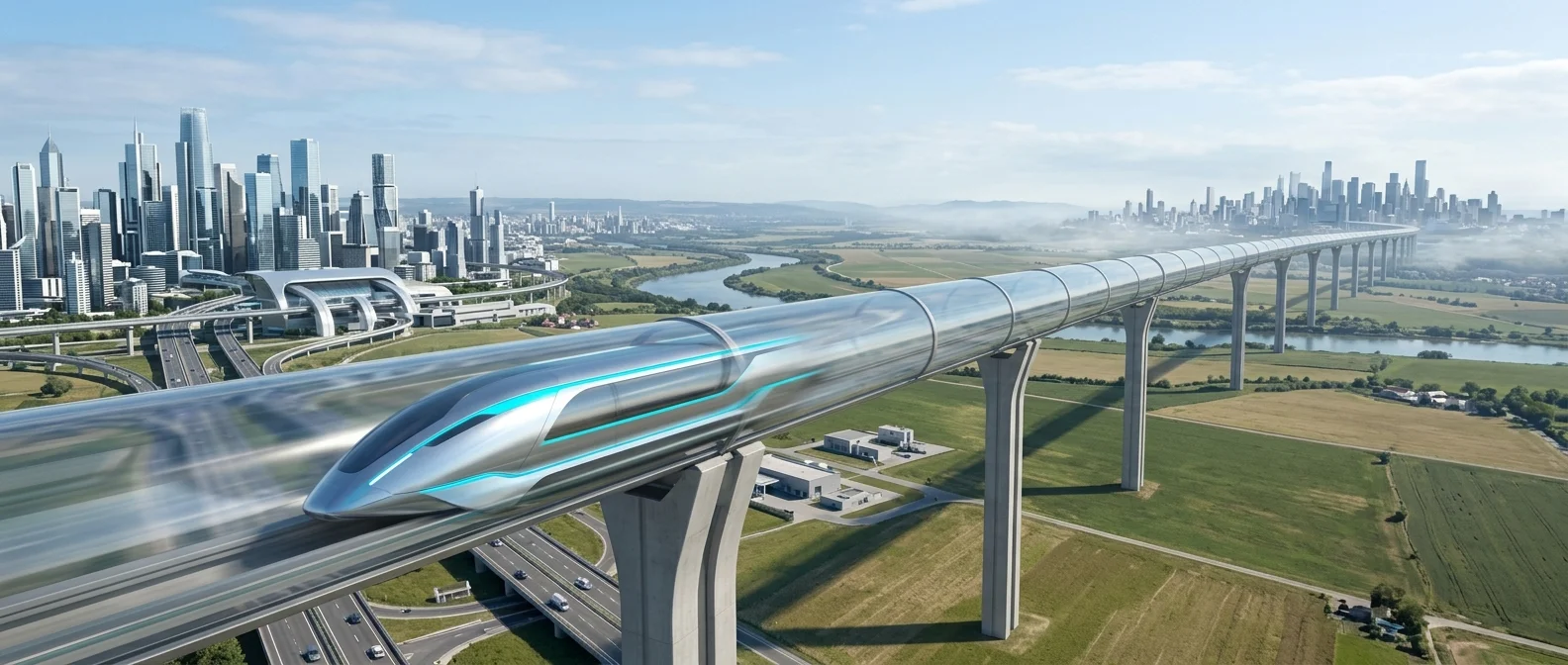
Hyperloop technology strips away everything that slows down traditional transport. No air resistance. No friction. Just pure speed in a near-vacuum environment that lets pods float on magnetic fields while racing through sealed tubes. The physics are elegant, the engineering is brutal, and the potential is staggering.
The Physics Behind Hyperloop Speed
Air is the enemy of speed. At highway speeds, your car fights through air thick as molasses. At 1,000 km/h, that resistance becomes a brick wall. Vacuum trains solve this by removing 99% of the air from their tubes, creating an environment where vehicles can slice through near-nothingness.
Magnetic levitation keeps the pods floating millimeters above the track, eliminating wheel friction entirely. Linear motors provide thrust without mechanical contact. The result? A transport system that can theoretically approach aircraft speeds while using a fraction of the energy.
Environmental Benefits and Sustainability
Vacuum trains don't just move fast — they move clean. Without air resistance and friction eating energy, hyperloop systems need dramatically less power to maintain speed. A pod cruising at 800 km/h consumes less energy per passenger than a car stuck in traffic.
Solar panels mounted along the tube infrastructure can generate enough electricity to power the entire system. Unlike jets that burn massive amounts of fuel fighting air resistance at altitude, hyperloop pods glide through their vacuum environment with minimal energy input once they reach cruising speed.
CO₂ Emissions Comparison
| Transport Mode | CO₂ Emissions (g/passenger/km) | Energy Consumption |
|---|---|---|
| Aircraft | 285 | High |
| Car | 120 | Medium |
| Train | 45 | Low |
| Vacuum Train | 0-15 | Very Low |
Engineering Challenges and Solutions
Building a vacuum train isn't just about removing air from a tube. You're creating hundreds of kilometers of near-perfect vacuum while maintaining structural integrity against atmospheric pressure trying to crush the tube from outside. Every seal, every joint, every access point becomes a potential failure point.
Magnetic levitation systems must work flawlessly in vacuum conditions. Control systems need split-second precision to keep pods stable at supersonic speeds. Emergency protocols must handle scenarios from power failures to tube breaches without compromising passenger safety.
Vacuum System
Advanced pumps maintain pressure below 1% of atmospheric levels
Magnetic Levitation
Superconducting magnetic systems for frictionless suspension
Speed Control
Linear motors provide precise acceleration and deceleration
Safety Systems
Multiple backup systems for emergency response scenarios
Global Projects and Development
Virgin Hyperloop has moved beyond concept to reality, completing the first crewed test in 2025 at 172 km/h. Small steps, but the technology works. Hardt in the Netherlands is building a 420-meter test track. TransPod plans a cargo route between Calgary and Edmonton by 2030.
China's state-backed hyperloop program aims for 600 km/h by 2027. Japan is adapting its maglev expertise for vacuum tube systems. The UAE wants hyperloop connections between major cities by 2035. The race is on, and the stakes are massive.
Major Milestone
In 2025, Virgin Hyperloop completed the first successful passenger test, reaching 172 km/h in a 500-meter test tube. While the speed was modest compared to ultimate goals, the test proved the technology's safety for human transport.
Economic Impact and Costs
Hyperloop construction costs run €25-50 million per kilometer, depending on terrain and technical challenges. Expensive upfront, but the economic ripple effects could be transformative. When you can live in one city and work in another 500 kilometers away, labor markets reshape overnight.
Real estate patterns will shift. Why pay premium prices for city center apartments when you can live in the countryside and commute to downtown in 15 minutes? Industries will relocate. Supply chains will reorganize. The economic geography of entire regions could change.
Advantages
- Extremely high speeds
- Low CO₂ emissions
- Minimal landscape impact
- Weather independent
- Low operating costs
Challenges
- High construction costs
- Technical complexity
- Need for new regulations
- Limited intermediate stops
- Long-term reliability unknown
Implementation Timeline
Commercial hyperloop systems will emerge in the 2030s, starting with short routes connecting airports to city centers or linking neighboring metropolitan areas. Early systems will operate at reduced speeds to prove reliability before ramping up to full supersonic capability.
The rollout will be gradual. Test tracks in the late 2020s. First commercial routes by 2030-2032. Network expansion through the 2030s. By 2040, hyperloop could be as common as high-speed rail is today.
2026-2028
Completion of test tracks and safety certification
2029-2032
Construction of first commercial routes in selected countries
2033-2035
Network expansion and increased operating speeds
2036+
Intercontinental connections and full commercial maturity
Safety and Regulatory Framework
Safety concerns are real. What happens if the tube loses vacuum at 1,000 km/h? How do you evacuate passengers from a sealed pod in an emergency? These aren't theoretical questions — they're engineering requirements that must be solved before commercial deployment.
Regulatory frameworks lag behind the technology. Existing rail safety standards don't cover vacuum tube transport. New safety protocols, certification processes, and international standards need development. The regulatory approval process could take as long as the technical development.
Safety Systems
Hyperloop systems include multiple safety layers: automatic sensors monitoring tube pressure, emergency braking systems, and specialized compartments that can be isolated during emergencies.
The Future of Transport
Vacuum trains represent one of the most ambitious technological challenges of our time. Despite technical and economic hurdles, the potential to achieve supersonic speeds with minimal environmental impact makes this technology irresistible. Successful hyperloop implementation could fundamentally change how we perceive distance and create new possibilities for economic and social development.
Sources: