📖 Read more: Smart Highways That Charge EVs While Driving
🏛️ Historical Overview: From Dream to Reality
The idea of an undersea tunnel is not modern — it dates back long before the age of boring machines. As early as 1802, French mining engineer Albert Mathieu-Favier proposed a tunnel under the English Channel, with oil lamp lighting, horse-drawn carriages, and an artificial island positioned mid-Channel for changing horses. His design described a two-level tunnel — the upper for transport, the lower for groundwater drainage.
Progress was slow. Military fears in Britain blocked every plan for decades. Although in 1881 test excavations began on both sides of the Channel (the British side reached 1,840 metres), the project was abandoned in 1883 over concerns that such a tunnel could be used as an invasion route.
It was not until 1986, with the signing of the Treaty of Canterbury between Britain and France, that the iconic Channel Tunnel was finally authorized, with boring commencing in 1988 and the official opening in 1994.
🌊 The World's Great Undersea Tunnels
Seikan Tunnel — Japan (1988)
The Seikan Tunnel remains the longest undersea tunnel in the world, with a total length of 53.85 kilometres (23.3 km beneath the Tsugaru Strait seabed). It connects the islands of Honshu and Hokkaido and was built after five ferries sank in a typhoon, killing 1,430 passengers. Construction cost 1.1 trillion yen ($7 billion), nearly 12 times the original budget, and 34 workers lost their lives during the project. Today it carries Shinkansen trains at speeds up to 260 km/h during holidays.
Channel Tunnel — England/France (1994)
The Channel Tunnel (Chunnel) stretches 50.46 km and holds the record for the longest undersea section in the world (37.9 km beneath the English Channel). Three tunnels (two 7.6m rail tunnels and one 4.8m service tunnel) were bored using 11 TBMs through chalk marl. The cost reached £4.65 billion, an 80% overrun on the original budget. The American Society of Civil Engineers named it one of the 7 Modern Wonders of the World. Today, Eurostar trains travel at 300 km/h, completing the London–Paris journey in 2 hours and 15 minutes.
Marmaray Tunnel — Turkey (2013)
The Marmaray in Istanbul is the deepest immersed tunnel in the world, reaching 55 metres below sea level. With a total length of 13.6 km (1.4 km immersed tube), it connects Europe to Asia beneath the Bosphorus — fulfilling a dream two millennia old.
Hong Kong–Zhuhai–Macau Bridge Tunnel (2018)
Part of a massive bridge-tunnel complex, the HZMB includes the longest immersed tube tunnel in the world, at 6.7 km at a depth of 30 metres. It was surpassed in width only by the Shenzhen–Zhongshan bridge-tunnel (6.845 km, 8 lanes, 2024).
| Tunnel | Country | Length | Depth | Year | Type |
|---|---|---|---|---|---|
| Seikan Tunnel | Japan | 53.85 km | 240 m | 1988 | Bored |
| Channel Tunnel | England/France | 50.46 km | 75 m | 1994 | Bored |
| Marmaray | Turkey | 13.6 km | 55 m | 2013 | Immersed Tube |
| HZMB Tunnel | China | 6.7 km | 30 m | 2018 | Immersed Tube |
| Shenzhen-Zhongshan | China | 6.845 km | — | 2024 | Immersed Tube |
| Fehmarn Belt | Denmark/Germany | 17.6 km | — | ~2029 | Immersed Tube |
⚙️ Undersea Tunnel Construction Technologies
There are three main methods for constructing undersea tunnels, each with its own advantages and limitations:
🔧 Bored Tunnel Method (TBM)
Massive Tunnel Boring Machines cut through rock beneath the seabed. Used in the Channel Tunnel (11 TBMs) and Seikan Tunnel. The method requires suitable geological conditions — in the Channel, the impermeable chalk marl proved ideal, while in the Tsugaru Strait, volcanic rock necessitated dynamite blasting for large sections. Best suited for great depths and hard rock.
🏗️ Immersed Tube Method
Sections are built in dry docks on land, floated to the installation site, sunk into pre-dredged trenches on the seabed, and connected together. The American method uses steel tubes lined with concrete, while the European method uses reinforced concrete box sections. First example in 1893 in Boston (Shirley Gut Siphon), first traffic tunnel in 1910 in Detroit. Ideal for shallow waters and short crossings.
🌊 Submerged Floating Tunnel (SFT)
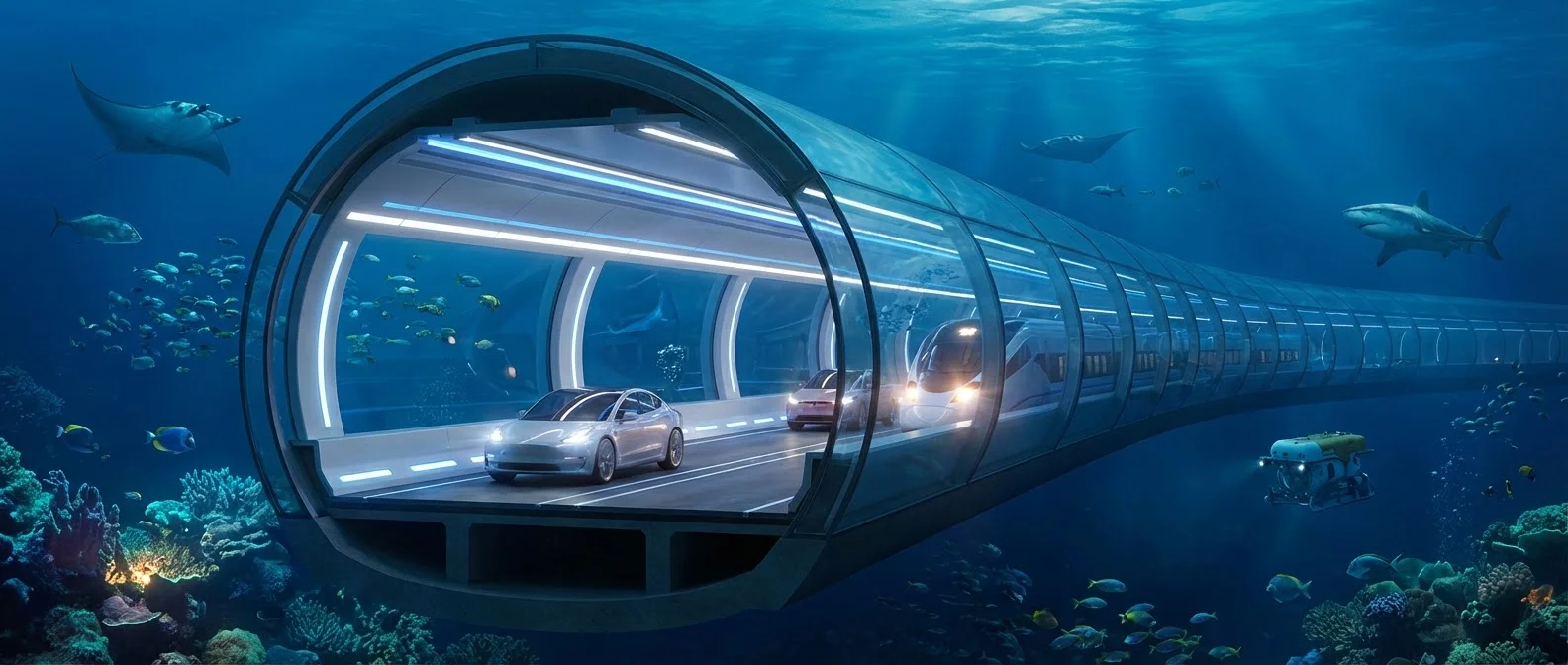
The most futuristic method: a tunnel that floats in water at a depth of 20-50 metres, supported by Archimedes' principle (hence also called the “Archimedes Bridge”). Cables anchored to the seabed or pontoons on the surface keep the tunnel in hydrostatic equilibrium. Although none has ever been built, the technology is considered ideal for deep fjords, narrow sea passages, and great lengths — as structural performance is independent of length.
📖 Read more: Starship Point-to-Point: London to Sydney in 1 Hour
🔬 The Science Behind Undersea Tunnels
Building a tunnel beneath the sea is an engineering challenge that pushes technology to its limits. Engineers must contend with:
🔑 Critical Design Factors
Hydrostatic pressure: At 240 metres depth (Seikan), water pressure exerts enormous forces on the structure. Waterproofing is vital — even a small leak can become catastrophic.
Geological diversity: In the Channel Tunnel, the British side had smooth chalk with a dip of less than 5°, while the French side featured faults up to 15 metres and a 20° dip, requiring different open/closed-mode TBMs.
Seismic resistance: The Seikan Tunnel crosses a seismic zone — it was built through dense volcanic rock for greater safety. Water inflow increases after major earthquakes.
Ventilation and cooling: The Channel Tunnel required 480 km of cooling pipes carrying 84 million litres of water — Europe's largest cooling system — to keep temperatures below 35°C.
For submerged floating tunnels (SFTs), the calculations are even more complex. The optimal placement depth (20-50 metres) must balance avoiding marine traffic, wave resistance, and minimising hydrostatic pressure. Control of the anchoring system — whether through seabed cables or pontoons — requires dynamic analysis accounting for currents, waves, earthquakes, and gravitational changes from tides.
🚀 The Grand Plans for the Future
Fehmarn Belt Fixed Link — Denmark/Germany (~2029)
The Fehmarn Belt Fixed Link will become the longest immersed tube tunnel in the world, with 17.6 km connecting Denmark to Germany beneath the Baltic Sea. It will carry both cars and trains, dramatically reducing travel time between Scandinavia and central Europe.
Norway E39 — Floating Tunnels in Fjords
Norway is planning the most ambitious undersea tunnel programme in the world: eliminating all ferries along the western E39 corridor, from Kristiansand to Trondheim. The estimated cost is $25 billion with a target completion date of 2050. The Norwegian Public Roads Administration (NPRA) is specifically investigating Submerged Floating Tunnels for deep fjords where conventional bridges are not feasible. Norway's first related patent dates to 1923 (Trygve Olsen).
China SIJLAB — Prototype in Lake Qiandao
The Sino-Italian Joint Lab (SIJLAB) designed a 100-metre prototype floating tunnel in Lake Qiandao (Zhejiang), as a precursor to a 3,300-metre tunnel in the Jintang Strait (Zhoushan Archipelago). This will likely be the first SFT ever built in the world.
Indonesia — Sunda Strait
Indonesia is exploring the possibility of building an SFT across the Sunda Strait, separating Java from Sumatra. Estimated cost: $15 billion. It would be a tremendous leap forward for transportation in Southeast Asia.
Transatlantic Tunnel — The Ultimate Dream
The idea of a tunnel between America and Europe was featured on Discovery Channel's Extreme Engineering (2003) and is the subject of academic studies. Such a tunnel would span over 5,000 km, requiring technologies that don't yet exist — possibly an underwater hyperloop travelling at over 1,000 km/h. Hyperloop One examined multiple European locations for an underwater hyperloop in 2017.
📖 Read more: Supersonic Planes: Athens-New York in 2 Hours
⚖️ Advantages and Challenges
Advantages
Undersea tunnels offer unique advantages over bridges and maritime transport:
- Extreme weather resistance: Unlike bridges, they are unaffected by wind, ice, or storms
- Seismic resistance: SFTs can withstand earthquakes thanks to freedom of movement in water
- No impact on navigation: They do not obstruct maritime traffic
- Length independence: An SFT's structural performance is independent of length, allowing multi-kilometre constructions
- Lower cost: An SFT can cost up to 50% less than an equivalent bridge
- Minimal environmental impact: Studies indicate low impact on marine life
Challenges
- Joint waterproofing: Connecting segments underwater remains extremely difficult
- Vulnerability to ship anchors: Tunnels exposed on the seabed face risks from anchor drops or impacts from sunken objects
- Emergency evacuation: Long stretches beneath the sea create complex evacuation scenarios — the Channel Tunnel has 270 cross-passages connecting its tunnels
- Maintenance costs: The Seikan Tunnel has cost 30 billion yen ($286 million) in maintenance since 1999 alone
- Construction time: Large bored tunnels require decades — the Seikan took over 20 years (1964–1988)
📅 Undersea Tunnel Timeline
🌍 Global Perspective
Nations with complex coastal geography — thousands of islands, narrow straits, and sea passages — could transform their transport networks with undersea tunnel technology:
🌉 Island-to-Mainland Connections
Countries like Greece, Indonesia, the Philippines, and Japan face similar challenges: connecting scattered islands without depending on weather-vulnerable ferries. Immersed tube tunnels work for short crossings, while floating tunnels could link entire archipelagos.
🏝️ Mediterranean Crossings
Several ambitious projects have been proposed across the Mediterranean — including a tunnel or bridge across the Strait of Gibraltar connecting Spain to Morocco, and connections between Sicily and the Italian mainland. Such crossings would cut freight shipping times and create new passenger routes between Europe and Africa.
🌍 Strategic Transport Hubs
Countries positioned at the crossroads of continents could become critical nodes in future undersea networks. Links between Europe, Africa, and the Middle East through underwater corridors would shift cargo routes and passenger flows away from traditional maritime lanes.
🔮 The Vision for 2060
Engineering teams worldwide are developing:
- The first operational Submerged Floating Tunnels in Norway and possibly China
- Undersea tunnel networks across entire archipelagos (Indonesia, Philippines, Greece?)
- Underwater hyperloop in pilot connections (e.g., UK–Europe in minutes)
- Autonomous underwater drones for tunnel construction and maintenance
- Tunnels with integrated energy generation (ocean currents, thermal gradients)
- Serious feasibility studies for a transatlantic tunnel (New York–London in a few hours)
Undersea tunnels are not just technological achievements — they are symbols of human ambition. From Mathieu-Favier's first thought of a horse-drawn tunnel beneath the Channel to floating tunnels in Norwegian fjords, this journey reflects two centuries of relentless innovation. The sea is no longer an obstacle — it is the next frontier that engineering will conquer.