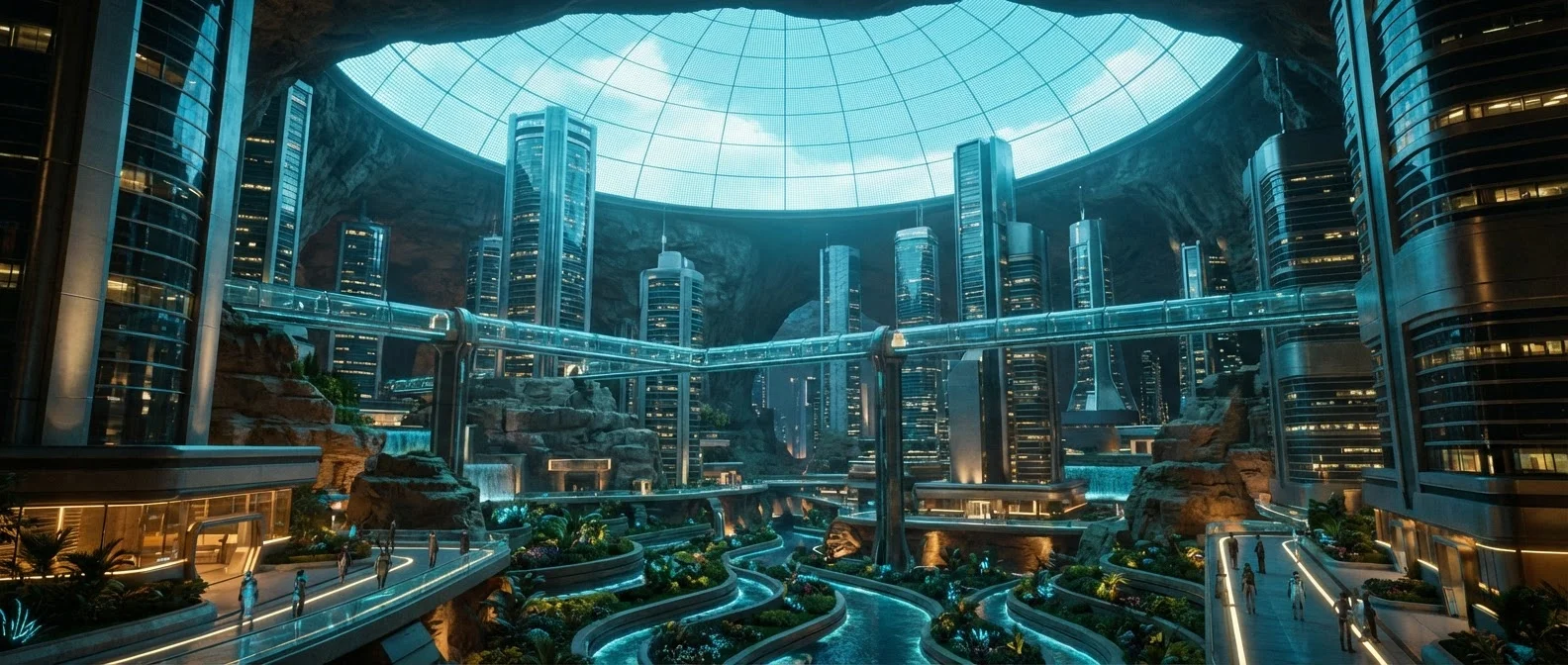
Beneath the bustling streets and foundations of modern cities, an entirely new world is preparing to be born. Underground cities are no longer science fiction — cities from Montreal to Helsinki are expanding below ground. With climate change threatening, population exploding, and surface space running out, humanity is turning its gaze below the earth — where temperature remains constant, energy savings reach 90%, and complete communities can thrive.
📖 Read more: pangeos-terayacht
🏛️ The History of Underground Living
The idea of living below ground is not new — it dates back thousands of years. From the underground homes of China to the ancient cities of Cappadocia, humanity has a long history of subterranean habitation.
Derinkuyu, Turkey
The largest excavated underground city in the world. Built by the Phrygians in the 8th-7th century BC in the volcanic rock of Cappadocia, it reaches a depth of 85 meters and housed up to 20,000 people with their livestock and food. It featured churches, schools, storage rooms, 55-meter ventilation shafts, and rolling stone security doors. It was connected to Kaymakli city through an 8-9 km tunnel.
Coober Pedy, Australia
A modern mining town where residents live literally underground to escape temperatures exceeding 40°C. Hotels, churches, homes and shops — all carved into rock. Underground living isn't theory here, it's everyday life.
Underground Homes of China
Along the Yellow River, 30-40 million Chinese live today in earth homes — cave-like dwellings dug into the ground at 10 meters depth around a central courtyard. This is an architectural tradition spanning millennia that exploits the thermal stability of the soil.
Beijing Underground City
Built during the Sino-Soviet conflict, consisting of a tunnel network spanning 85 square kilometers beneath Beijing. Designed as a shelter for millions of citizens, it closed in 2008 but remains a monument to urban planning.
🌆 Modern Underground Networks Operating Today
We don't need to wait for the future to see underground cities. Several metropolises already have impressive underground networks serving millions of people daily.
| City | Network | Size | Features |
|---|---|---|---|
| Montreal | RÉSO | 32 km of tunnels | Largest habitable underground network in the world. 2,000+ shops, 8 metro stations, 40 cinemas, 500,000 users/day |
| Helsinki | Underground Master Plan | 55,000 m² (Kamppi Center) | World's only comprehensive underground city plan. Underground shopping centers, metro stations, shelters |
| Osaka | Chikagai | 81,765 m² (Crysta Nagahori) | Japan has the most advanced underground networks. Umeda has 1,200+ stores underground |
| Toronto | PATH | 30+ km | One of the largest underground pedestrian networks in North America |
| Houston | Tunnel System | 11 km of tunnels | Connects office buildings, hotels and retail in an air-conditioned environment |
| Kansas City | SubTropolis | 5 million m³ | 55 million sq ft underground business complex in a former limestone mine |
| Singapore | Underground Network | 19 buildings (Raffles Place) | Plans for Jurong Innovation District — a complete underground innovation city |
🔬 The Science of Underground Living
Why is life below ground so efficient? The answer lies in physics and geothermal science.
Thermal Stability
At a depth of 5-15 meters, ground temperature remains constant year-round — equal to the average of summer and winter temperatures. This means natural heating in winter and cooling in summer, with zero energy consumption. The thermal mass of the earth acts as a natural temperature regulator.
Energy Efficiency
Underground structures achieve 90-95% energy savings compared to surface buildings. Insulation is provided free by soil layers, with thermal resistance of R-0.25 to R-0.65 per inch of soil layer.
Protection from Extreme Events
Underground spaces offer protection from wind, fire, earthquakes and even nuclear explosions. Sound insulation is excellent, while preserving the natural landscape on the surface is complete.
Environmental Benefits
Zero surface space occupation means more greenery on the surface. Reduction of the urban heat island effect, preservation of biodiversity and natural ecosystems. The land becomes a park while the city hides below.
🏗️ Future Visions: What Will Underground Cities Look Like?
Current networks pale beside what's on the drawing board. Several ambitious projects are in the planning or construction phase.
📖 Read more: Bioluminescent Buildings: Architecture That Glows
The Line — NEOM, Saudi Arabia
A massive linear project 170 km long with underground transport and infrastructure levels. Planned for 9 million residents with 510 km/h trains in the underground network. Estimated cost $100-200 billion. Although the project faces serious delays and criticism, it demonstrates the ambition of underground urbanization.
Alice City — Japan
The Japanese concept from the 1980s for a cylindrical underground city remains relevant. A massive vertical shaft containing residences, offices, parks and shopping centers — “Alice City” was the precursor to all modern underground urban plans.
Singapore Underground Master Plan
Singapore, with a serious space problem, is planning an underground innovation city in the Jurong Innovation District. Already 19 buildings at Raffles Place are connected underground, while CityLink Mall covers 60,000 sq ft below ground.
Earthscraper — Mexico City
The inverted pyramid: a building that instead of rising plunges 300 meters below ground in downtown Mexico City. 65 underground levels with museums, residences, shopping centers and artificial sunlight via fiber optics.
🔧 Technologies Making the Impossible Possible
Technology is evolving exponentially, unlocking capabilities that until recently were unthinkable.
TBMs — Tunnel Boring Machines
Elon Musk's Boring Company is reducing tunnel boring costs by 10x. New TBMs dig kilometers per month with automated systems.
Artificial Solar Lighting
LED systems that reproduce the full solar spectrum. Lighting changes color temperature according to circadian rhythm — dawn, noon, sunset.
Vertical Farming
Underground farms with hydroponics and artificial lighting produce food 365 days a year, without pesticides, using 90% less water.
Filtration & Ventilation
HEPA and ULPA systems purify air to medical grade. Ventilation shafts with AI sensors automatically regulate quality and humidity.
Geothermal Energy
The stable subsoil temperature powers geothermal heat pumps — heating in winter, cooling in summer, free from nature.
AI & Automation
Artificial intelligence manages lighting, ventilation, transport and security. Robotic construction and maintenance systems operate 24/7.
⚠️ Challenges & Concerns
Underground living is not without difficulties. Several serious obstacles must be overcome.
💧 Moisture & Waterproofing
The biggest technical problem in any underground construction. Constant moisture pressure requires advanced waterproofing, drainage and dehumidification systems. Any failure can lead to mold, leaks and structural problems.
🧠 Mental Health & Claustrophobia
The absence of natural light and horizon can cause depression, claustrophobia and disorientation. Architecture must create feelings of open space through artificial skies, large atriums and biophilic design.
💰 Construction Costs
Underground construction costs 2-4 times more than equivalent surface building. Reinforced concrete, specialized excavation machinery, pumping systems and high engineering complexity dramatically increase costs.
📖 Read more: Sponge Cities: Absorbing Floods
🚨 Evacuation & Safety
Fire safety and evacuation in underground environments are far more complex. Multiple staircases, airtight sections, autonomous fire suppression systems and real-time AI monitoring are required.
📅 Underground Living Timeline
🌍 Global Perspective
Countries around the world are increasingly recognizing the potential of subterranean development as a solution to pressing urban challenges.
Thessaloniki Metro Discoveries
The metro excavation in Thessaloniki, Greece revealed an entire ancient city beneath the modern surface — Byzantine streets, shops, walls and aqueducts. The Venizelos station is becoming an underground museum, proving that underground cities already exist — they're just ancient.
Ancient Quarries & Modern Tunnels
From ancient quarries in Paros to modern highway tunnels (Egnatia Odos, Attiki Odos), extensive tunnel networks already exist that could be leveraged for future underground urban networks worldwide.
Underground Tourism
From the Diros Caves in Greece to the underground networks of metro systems worldwide, underground spaces are proving they can become tourism magnets — bridging history and technology across continents.
🔮 The Underground City of 2060
What will a fully developed underground city look like in a few decades?
Residences
Homes at 20-50 meters depth with artificial LED windows showing live surface views. Constant 20°C temperature without air conditioning. Biophilic design with real plants in every room.
Parks & Recreation
Massive atriums with artificial skies that change colors. Underground parks with real trees under specialized growth lighting. Pools, sports fields, theaters — a complete city.
Transportation
Autonomous vehicles on underground roads. High-speed trains in dedicated tunnels. High-speed elevators connect underground levels to the surface in seconds.
Food Supply
Underground hydroponic farms produce fresh vegetables, fruits and proteins 365 days a year. Vertical farming with growth LEDs — “sunlight without the sun.”
Conclusion
Underground cities are not utopia — they are an inevitable evolution. With surface space running out, temperatures rising, and technology advancing, life below ground is a logical, sustainable, and fascinating solution. From Derinkuyu to Montreal's RÉSO, humanity already proves it can live below the earth — soon it will do so at city scale.