The Red Planet's Ultimate Challenge
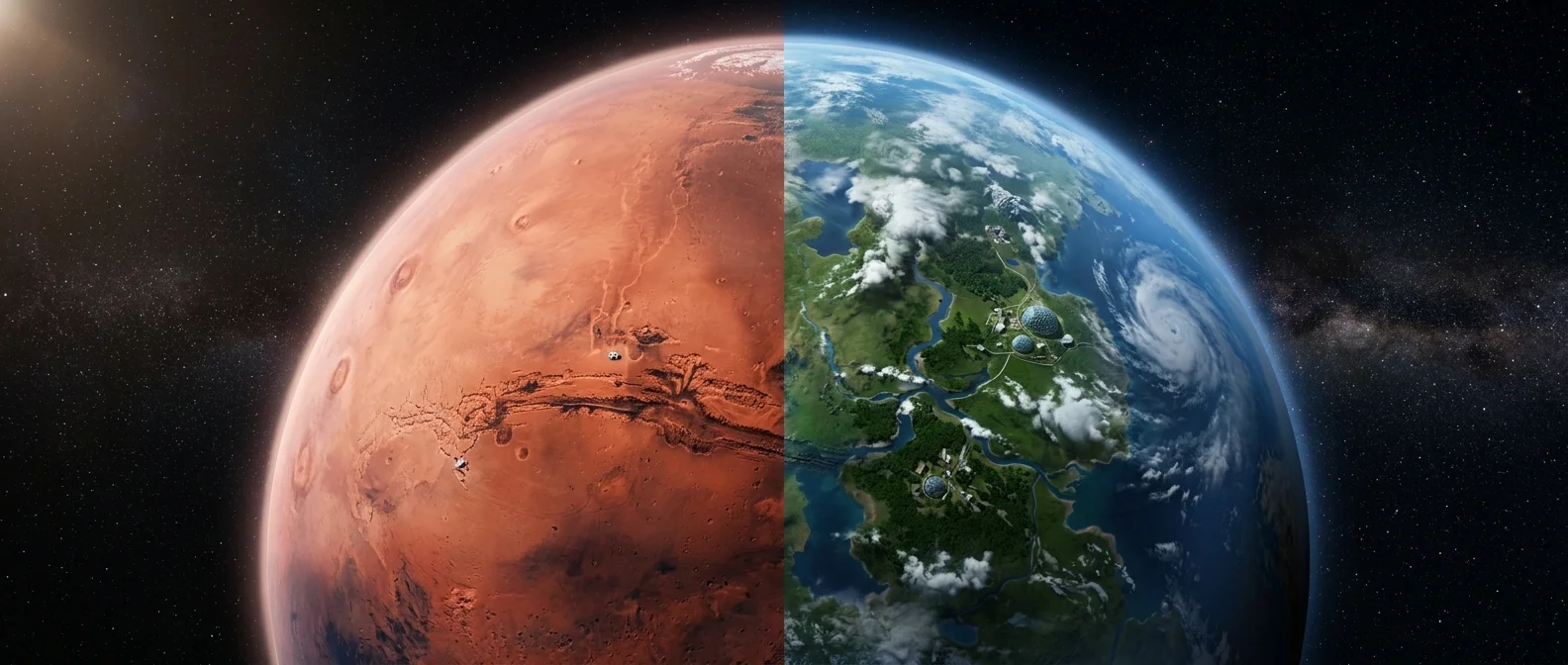
Picture looking out your window and seeing a green sky instead of Earth's blue one, with clouds forming from water vapor drifting overhead. This isn't science fiction — it's the vision of Mars terraforming, a process that could transform the red planet into a world suitable for human life without spacesuits or pressurized habitats.
Today, Mars averages -60°C on its surface. To live there without domes or specialized facilities, we'd need to raise temperatures to 0°C and create atmospheric pressure 150 times greater than what exists now.
📖 Read more: Mars Colony: When Will We Live on the Red Planet?
📖 Read more: Interplanetary Internet: Network from Earth to Mars
The Science Behind Terraforming Mars
Mars terraforming would require pumping greenhouse gases into the atmosphere. These would serve a dual purpose: increasing atmospheric pressure and trapping heat from the sun, raising temperatures. The most available greenhouse gas on Mars is carbon dioxide (CO₂).
But reality is far more complex than it appears. The less we know about how to actually terraform Mars, the easier we think it is. As we dig deeper into the science, it becomes increasingly difficult.
📖 Read more: Do You Trust AI? Why We're Getting It Wrong
Reality Check: The Obstacles
Research reveals major problems with current terraforming plans. The main obstacle is Mars simply doesn't have enough CO₂. Scientists once believed the equivalent of an Earth-like atmosphere might exist in the polar ice caps, but this idea has been debunked.
Current estimates show that releasing all CO₂ from the polar caps would only double atmospheric pressure. That's nowhere near what we need.
CO₂ Sources on Mars and Extraction Difficulty
| CO₂ Source | Release Method | Difficulty | Effectiveness |
|---|---|---|---|
| Polar ice caps | Dark dust on ice | Easy | Low |
| Carbonate minerals | Heating to 300°C | Very difficult | Very low |
| Soil (regolith) | Mining entire planet | Impossible | Zero |
New Technological Approaches to Mars Terraforming
Despite the obstacles, new techniques have emerged that could raise Mars' global average temperature by tens of degrees within decades. One fascinating proposal involves using nanoparticles in the atmosphere to trap more solar energy.
Other approaches examine using solar sails to direct solar radiation toward the planet, or even asteroid impacts to release gases from the planet's interior. These ideas, while sounding like science fiction, are based on real physical principles.
Nanoparticles
Microscopic particles that trap solar energy and increase atmospheric temperature
Solar Sails
Massive structures that direct additional solar radiation toward Mars
Asteroids
Controlled impacts to release gases from the planet's interior
📖 Read more: Climate Engineering: Can We Save the Planet?
Biological Terraforming and Microorganisms
The biological approach to terraforming involves genetically modified microorganisms that could survive Mars' harsh conditions. These microorganisms would perform oxygenic photosynthesis, producing oxygen and helping create a breathable atmosphere.
Researchers have already discovered twenty bacterial species that can grow in simulated Mars conditions at 0.7 kPa pressure. This shows life can adapt to extremely challenging environments.
The Terraforming Timeline
According to researchers, terraforming would first involve warming to enable oxygenic photosynthesis by genetically modified microorganisms, followed by slow oxygen accumulation that would allow more complex life forms.
The Cost and Practical Challenges
One ambitious proposal suggests we could terraform Mars for about $50 billion using solar sails. This amount, while enormous, is comparable to major government programs or military budgets.
However, the real cost could be much higher when we factor in technological challenges, risks, and the need for long-term maintenance. We'd also need decades or even centuries to see significant results.
Advantages
- Creating a second habitable planet
- Security for humanity
- Scientific advancement
- New technologies
Disadvantages
- Enormous cost
- Uncertain outcome
- Environmental risks
- Ethical questions
📖 Read more: Exoskeletons: Superpowers for Every Human
Ethical and Environmental Questions
Before deciding whether warming Mars is worth the effort, compared to leaving Mars as pristine wilderness, we must address practical requirements, costs, and potential risks.
Serious questions exist about our right to transform an entire planet. What happens if microbial life already exists on Mars? How would we affect the planet's geological and climate systems?
"The fact that we're inadvertently changing Earth's environment underscores that we don't really understand how climates work."
— Bruce Jakosky, NASA researcherResearch Priorities and Future Directions
Research priorities include focusing on understanding the fundamental physical, chemical, and biological constraints that will shape any future decisions about Mars. This research will drive advances in Mars exploration, bioscience, and climate modeling.
New techniques in genetic engineering and synthetic biology open possibilities for creating organisms that could survive and thrive in Mars conditions. Meanwhile, advances in launch technology, like SpaceX's Starship, make transporting large quantities of materials to Mars more feasible than ever.
Genetic Engineering
Creating organisms adapted to Mars conditions
Climate Modeling
Simulating terraforming impacts
Space Technology
Improved transport and installation capabilities
The Future of the Red Planet
Mars terraforming remains one of humanity's most ambitious and controversial ideas. While technological challenges are enormous and costs astronomical, research continues revealing new possibilities. Perhaps most importantly, studying terraforming helps us better understand our own planet and how to protect it. If we ever manage to turn the red planet green, it will be the greatest achievement in human history.
Sources: