When Thoughts Become Digital Signals
A paralyzed patient moves a cursor across a screen using nothing but thought. No words. No gestures. Pure intention converted to digital command. What sounds like science fiction is now daily reality for dozens of people worldwide.
Brain-Computer Interface (BCI) technology has evolved from experimental trials to functional systems enabling direct communication between brain and machine. Companies like Synchron, Paradromics, and Sam Altman's Merge Labs are developing systems that promise to transform neural impulses into digital commands with unprecedented precision.
📖 Read more: Neuralink: Brain Implants and Our Minds
📖 Read more: Neural Interface: Controlling with Thought
The Technology Behind Telepathy
Modern BCI systems work by recording electrical activity from neurons through microscopic electrodes. Synchron has developed a system inserted through blood vessels in the brain, avoiding the need for open surgery. Paradromics, which received FDA approval in 2025, uses thousands of microelectrodes to capture signals from individual neurons.
The challenge isn't just recording signals — it's interpreting them. Each thought creates a unique pattern of neural activity, and AI systems learn to recognize these patterns with increasing accuracy. Nvidia has partnered with Synchron to integrate its AI technologies into BCI systems.
From Medical Treatment to Daily Life
Initially, BCI systems were developed for medical purposes. People with paralysis, multiple sclerosis, or other neurological conditions can now control computers, smartphones, and even robotic limbs using only their thoughts. One patient participating in a Neuralink trial for over 5 years can play chess online and send messages at speeds approaching those of a healthy person.
The next phase involves integrating BCI technologies into consumer devices. One startup aims to integrate BCI capabilities into the Apple Vision Pro, allowing users to navigate virtual environments using their thoughts directly. This could revolutionize how we interact with technology.
Medical Rehabilitation
Control of robotic limbs and computers for people with mobility challenges
Augmented Reality
Navigation in VR/AR environments without controllers or gestures
Direct Communication
Transmission of thoughts and emotions without words or movements
Challenges and Limitations
Despite progress, BCI technology faces significant challenges. Implants have limited lifespans — most function effectively for 3-5 years before requiring replacement. Signal accuracy decreases over time as the brain forms scar tissue around electrodes.
There are also serious ethical and legal issues. Neuralink faces legal challenges for attempting to trademark the terms "Telepathy" and "Telekinesis." Questions about thought privacy, data security, and potential social inequalities remain open.
Critical Security Issues
BCI systems are vulnerable to cyberattacks that could directly affect brain function. Developing robust encryption and security protocols is essential.
📖 Read more: Direct Air Capture: Machines that Suck CO2
China's BCI Industry
China is rapidly developing its own BCI industry, with companies focusing on non-invasive solutions. One Chinese startup is developing BCI systems that don't require surgical implantation, using advanced sensors placed on the skull. This approach could make the technology more accessible and safer for widespread use.
The Chinese government has invested billions in BCI research, considering the technology strategically important for the future. This creates global competition that accelerates development but also raises questions about international cooperation and security standards.
American Approach
- High-precision invasive implants
- Focus on medical applications
- Private funding and FDA approval
Chinese Approach
- Non-invasive mass production solutions
- Consumer and industrial applications
- State funding and rapid development
The Future of Telepathic Communication
Investment in the sector continues to grow. OpenAI invested in Sam Altman's Merge Labs in January 2026, showing that AI giants see BCI as the next big step in human-machine interaction. Merge Labs, which started as a non-profit organization, converted to a commercial company in December 2025.
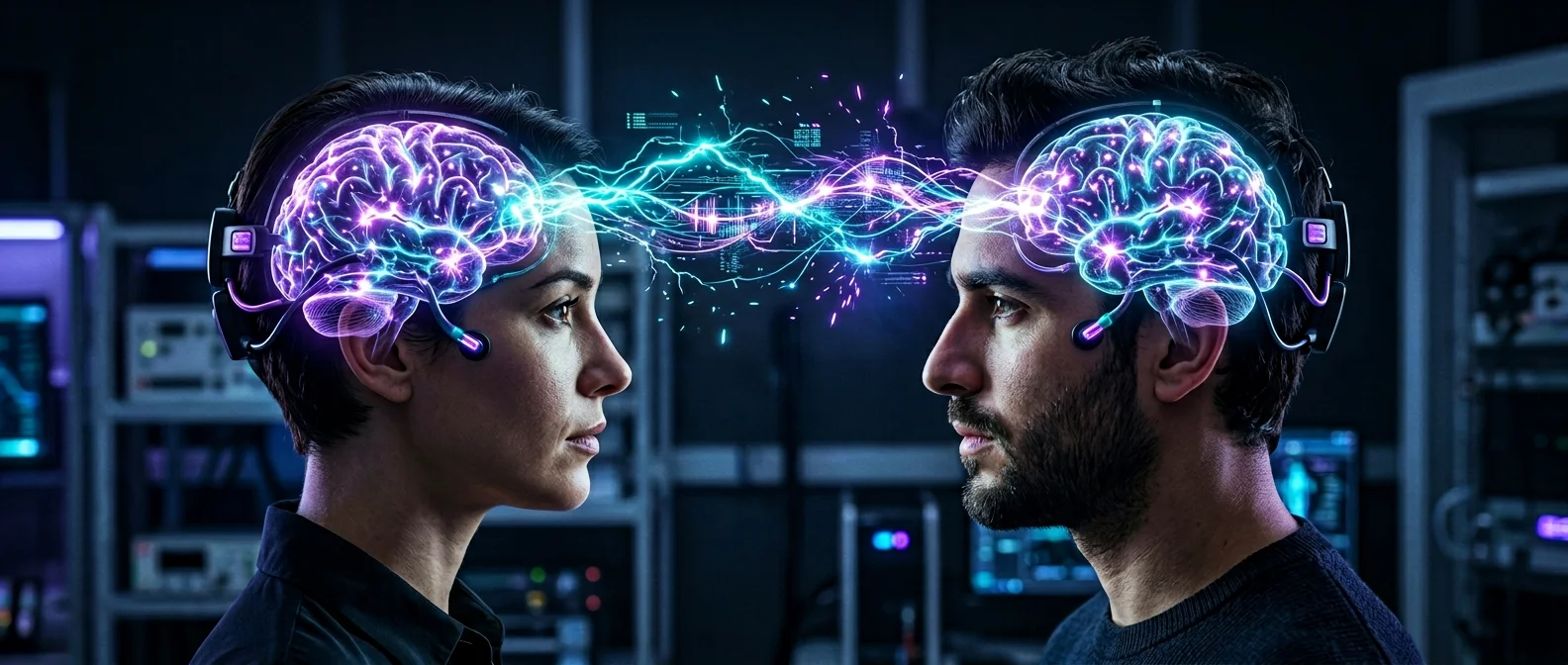
In the next 10 years, we expect to see BCI systems that allow not only device control but also direct transmission of thoughts between humans. Imagine being able to send an idea, emotion, or memory directly to someone else's mind — without words, without misinterpretation.
Telepathy as a Service
By 2035, analysts predict commercial "telepathic" communication services for professionals who need immediate and accurate transmission of complex information — from surgeons to fighter pilots.
Toward a Connected Future
BCI technology isn't just about replacing lost functions — it's about augmenting human capabilities. Just as smartphones changed how we communicate and access information, BCI systems could fundamentally change how we think and interact with the world.
In a world where thoughts can be transmitted directly, language might remain important for art and literature, but daily communication could become more immediate, more accurate, and more emotionally rich than what's possible today with words.
The Silent Revolution
Telepathic communication is no longer a question of "if" but "when." With dozens of companies developing BCI technologies and millions of dollars being invested in research, we're at the dawn of a new era in human communication — an era where thoughts travel at the speed of light.
Sources: