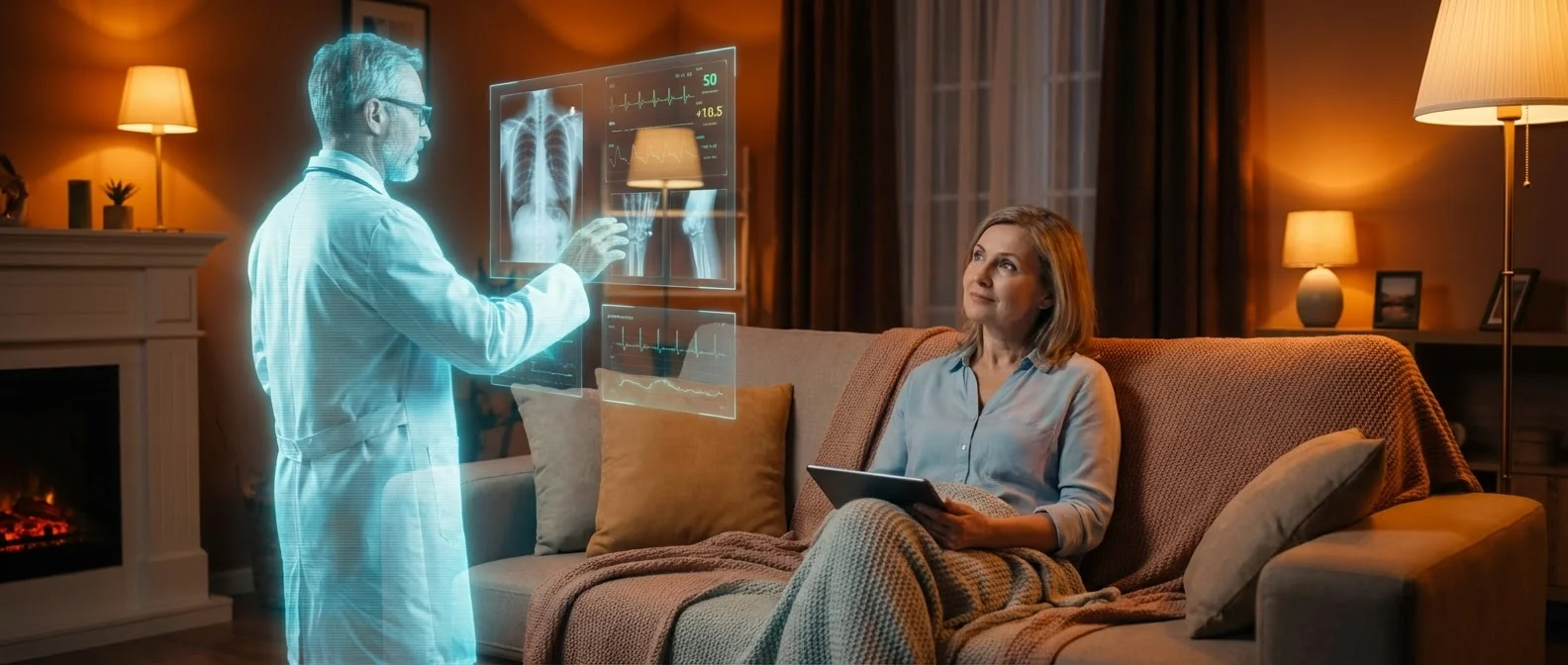
Imagine your doctor appearing in your living room as a three-dimensional hologram — examining you, viewing your sensor data in real time, diagnosing with AI, and prescribing treatment. No waiting room, no commute, no delay. Telemedicine in 2040 will look nothing like the video calls we know today.
📖 Read more: Nanobots in the Blood: Doctors Inside the Body
From Telephone to Hologram
1st Wave (1879-2000)
Telephone diagnosis. First reference in The Lancet (1879). Radio therapy for remote areas. Australian Royal Flying Doctor Service.
2nd Wave (2000-2019)
Video calls & streaming. Teladoc IPO 2015. Mercy Virtual (Missouri 2015) — first hospital without patients. Wearables & IoT.
3rd Wave (2020-2025)
COVID-19 explosion: 1.4M → 35M telehealth visits (Q2 2020, US). AI diagnostics. 154% increase (CDC). Telesurgery advances.
4th Wave (2030-2040)
Holographic telepresence. AI doctor-assistant. In-body nanosensors. Remote haptic feedback for examination and surgery.
Holographic Telepresence: How It Works
Holography was invented by Dennis Gabor in 1948 (Nobel Prize in Physics 1971). It uses lasers to record light fields in 3D. In 2010, researchers (Blanche et al., Nature) demonstrated real-time 3D holographic telepresence using photorefractive polymer. For the first time, someone could appear as a full 3D hologram in real time.
Now companies are racing to commercialize it. Companies like PORTL, PROTO, and Microsoft Mesh are developing holographic platforms. Medical application is a natural evolution — a doctor in 3D can demonstrate gestures, point to areas of pain, and explain diagrams right next to the patient.
Key Technologies
AI Diagnostics
Image recognition algorithms analyze X-rays, skin lesions, retinas — with accuracy equal to or exceeding specialists
Wearable Sensors
Smartwatches, rings, patches: heart rate, SpO2, glucose, blood pressure, ECG — data streaming to the doctor
Robotic Surgery
da Vinci system, trans-Atlantic surgery (Lindbergh operation 2001). Haptic feedback minimizes latency to <100ms
5G/6G Networks
Ultra-low latency (<1ms), massive bandwidth, network slicing — essential for high-resolution real-time holograms
Nanosensors
Microscopic in-blood sensors measuring biomarkers, detecting cancer cells & releasing drugs on command
📖 Read more: Capsule Apartments: Living in 9 sqm
Digital Health Twin
Digital replica of your body — simulates drug responses, predicts diseases before they manifest
Scenario 2040: A Holographic Visit
🕐 08:00 — Morning Alert
Nanosensors in your blood detect an anomaly in inflammation markers. The AI notifies you: “Holographic examination recommended within 2 hours.”
🏠 09:30 — The Doctor Appears
A three-dimensional holographic form of your doctor appears in the living room. They see your real-time data: heart rate, blood pressure, oxygen, biomarkers — everything your sensors transmit.
🔍 09:35 — AI-Enhanced Diagnosis
The doctor uses an AI assistant that compares your data across millions of medical records. Diagnosis in minutes, with ranked probabilities and confidence levels.
💉 09:45 — Treatment & Monitoring
A prescription is sent digitally. Your nanosensor adjusts to monitor therapeutic response. Next holographic visit is automatically scheduled in 48 hours.
Telesurgery: The Surgeon on Another Continent
Telesurgery allows a surgeon to operate on a patient via robotic teleoperator. The first transcontinental surgery (Lindbergh Operation, 2001) was performed from New York on a patient in Strasbourg — 6,400 km away. The critical limitation is connection latency. With 5G/6G networks below 1ms, telesurgery becomes practically equivalent to local intervention.
In the future, integrating haptic feedback (telehaptics) will allow surgeons to “feel” tissue remotely — a technological step that will complete the convergence of physical and digital surgery.
Applications by Specialty
Cardiology
Tele-ECG, 24/7 Holter monitoring, AI arrhythmia detection. Smartwatches already detect atrial fibrillation.
Neurology
Tele-neurology for Parkinson's (Dorsey study: patients prefer remote specialists). Remote neurotherapy.
Ophthalmology
Tele-ophthalmology: diabetic retinopathy screening in rural areas. In India, 10,000+ patients (Mizoram, 2011-2015).
📖 Read more: Digital Clones: AI Avatars After Death
Orthopedics & Physical Therapy
Tele-rehabilitation: exercises via camera, AI motion correction, holographic physiotherapist beside you.
Oncology
Tele-pathology: virtual microscopy for remote biopsies. AI histological image analysis. Second opinions in hours, not weeks.
Mental Health
Tele-psychotherapy: reduced stigma, patients more honest remotely. Narrative medicine through telemedicine.
Challenges & Barriers
Data Security
Medical data privacy, GDPR, HIPAA. Hackers target hospitals. Holographic streams must be encrypted end-to-end.
Digital Divide
2.9 billion people without Internet (ITU 2021). Rural areas without broadband. Holograms require massive bandwidth.
Regulatory Framework
Cross-border physician licensing. Medicare limits reimbursement. Every country with different rules.
Human Touch
25% of patients believe telehealth doesn't provide equal quality. Physical examination cannot be fully replaced.
Global Impact
Horizon 2030-2040
Telemedicine started as a telephone by the bedside. After COVID-19, it became a video call. By 2040, it will be a hologram examining you in your own home — with AI, nanosensors, and haptic feedback. Medicine isn't just going digital. It's going spatial.