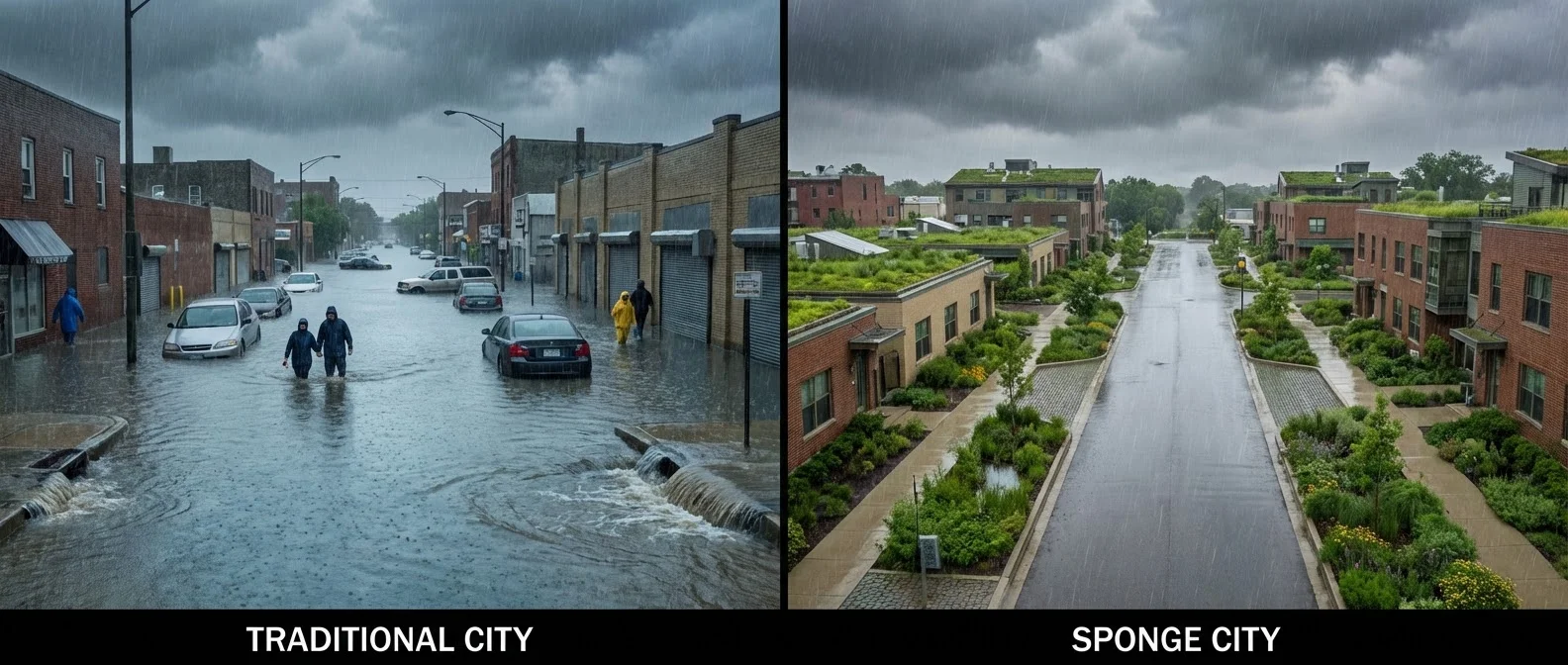
Every year, floods cause tens of billions of dollars in damage worldwide. Instead of building higher dams, what if cities themselves could absorb water like a sponge? That's the idea behind “Sponge Cities” — urban areas designed to store, filter, and reuse rainwater through natural infrastructure.
📖 Read more: floating-homes-netherlands
What Is a Sponge City?
The concept was originally proposed by Chinese landscape architect Kongjian Yu in the early 2000s. Instead of “grey infrastructure” (concrete, pipes, dams) that pushes water away, it uses green infrastructure that mimics nature: wetlands, rain gardens, green roofs, permeable pavements. The philosophy: distribute and retain water at its source, clean it naturally, and adapt rather than fight.
The Sponge City Toolkit
Green Roofs
Vegetation on building rooftops that absorbs rainwater and reduces temperature
Rain Gardens
Planted depressions with special vegetation that collect and filter stormwater
Permeable Pavements
Porous materials instead of asphalt — water passes through and recharges groundwater
Constructed Wetlands
Artificial lakes & wetlands that store floodwater and filter pollutants naturally
📖 Read more: Underground Cities: Life Below the Surface
Bioswales
Planted channels along roads that clean and redirect stormwater runoff
Urban Park Reservoirs
Parks designed to flood in a controlled manner, storing thousands of m³ of water
Why Are They Needed Now?
| Problem | Traditional Solution | Sponge City Solution |
|---|---|---|
| Flooding | Dams, pumps, pipes | Wetlands, rain gardens, permeable surfaces |
| Water scarcity | Transport water from afar | Collect & store rainwater locally |
| Heat island effect | Building air conditioning | Green roofs, trees, evaporation cooling |
| Water pollution | Treatment plants | Natural filtration through plants & soil |
| Groundwater levels | — | Aquifer recharge through infiltration |
📖 Read more: Artificial Trees: Machines That Absorb CO2
Examples That Work
🇨🇳 Wuhan, China
One of the first 16 pilot cities (2015). Construction of wetlands along the Yangtze River, green roofs on public buildings, permeable parking lots. Flood damage reduced by 30% in retrofitted areas.
🇹🇭 Benjakitti Park, Bangkok
A former abandoned tobacco factory transformed into a 52.7-hectare park (2023) with storage capacity of 187,500 m³ of rainwater. Cost just $20/m². In 2022, Bangkok flooded but the park and surrounding area stayed dry.
🇨🇳 Sanya, Hainan Island
Mangrove Park: restored mangrove forest along riverbanks. “Interlocking finger” ecotone design reduces tidal force. Dong'an Wetland Park: 68 hectares, storing 830,000 m³ of stormwater, reducing floods in neighboring communities.
🌍 Berlin & Los Angeles
The sponge city model is spreading globally: Berlin integrates green infrastructure into new neighborhoods, while Los Angeles converts abandoned lots into “absorption basins” to tackle droughts and flash floods.
China Leading the Way
After the catastrophic Beijing floods of July 2012 (79 deaths), the Chinese government formally adopted the Sponge City initiative. In a December 2013 speech, President Xi Jinping stated: "Priority to retaining rainwater using the power of nature — natural absorption, natural infiltration, natural purification."
📖 Read more: Climate Engineering: Can We Save the Planet?
Three phases followed:
- 2015-2018: Small-scale pilots — 16 first-batch cities
- 2018-2020: Publication of standards, monitoring, evaluation
- 2020-2030: Full integration — target 80% of urban areas with sponge city adaptations
🌐 A Global Movement with Many Names
The sponge city idea isn't exclusively Chinese — similar approaches exist everywhere: "Green Infrastructure" in Europe, "Low-Impact Development" (LID) in the USA, "Water-Sensitive Urban Design" in Australia, "Nature-Based Solutions" in Canada. Sponge cities combine ecological and technical methods, while LID focuses on technical solutions.
Challenges & Limitations
💰 Cost & Funding
National-scale implementation is estimated to require $230 billion by 2030. The Chinese government subsidizes just one-fifth of costs — remaining funding must come from municipal budgets and private investments (PPP model).
📊 Monitoring & Data
19 of 30 pilot cities experienced flooding after implementation — but areas that were actually retrofitted remained dry. Lack of monitoring stations and evaluation standards makes measuring effectiveness difficult.
🏗️ Urban Planning
Projects are more effective in new construction than in retrofitting. The “grey infrastructure” mentality and outdated building codes create inertia against change.
What Does It Mean for You?
Anyone can build a sponge city at home: a green roof on your building, a rain garden in your yard, concrete replaced with gravel or stone. Every square meter of impermeable surface converted into a “sponge” contributes to reducing floods, improving water quality, and lowering temperatures.