The History of Space Tourism
"The Earth is so thin, so fragile — and we had the privilege of seeing it from above. It changes how you see everything."
The Major Players
🚀 SpaceX — Crew Dragon
The dominant player. Crew Dragon carries NASA crews to the ISS ($55M/seat) and private missions. Inspiration4, Polaris Dawn, Fram2 and Axiom missions. Goal: lunar tourism with Starship — Dennis Tito and his wife already have reservations.
🔵 Blue Origin — New Shepard
Suborbital flights lasting 10-12 minutes above the Kármán line (100 km). By October 2025, over 10 crewed flights with dozens of passengers. NS-31 (April 2025) featured celebrities like Katy Perry. Estimated price: $200-300K.
✈️ Virgin Galactic — SpaceShipTwo
Tickets at $250,000 for suborbital trips to 80-90 km. First commercial flight Galactic 01 in June 2023. Sold 700+ tickets before the first commercial flight. Richard Branson flew aboard VSS Unity in July 2021.
🏗️ Axiom Space
Specializing in private ISS missions via Crew Dragon. Four missions completed (Ax-1 through Ax-4), Ax-5 planned for 2027. Each seat costs ~$55 million. Planning their own private space station to succeed the ISS.
How Much Does Space Cost?
💰 What Does an ISS Ticket Include?
According to NASA, staying on the ISS costs $35,000 per day (food, air, power). Transportation via Crew Dragon is estimated at ~$55M per seat. Tourist training lasts several months and includes g-force endurance, zero-gravity simulation in parabolic flights, and emergency procedures.
Space Hotels of the Future
🏨 Vast Haven-1
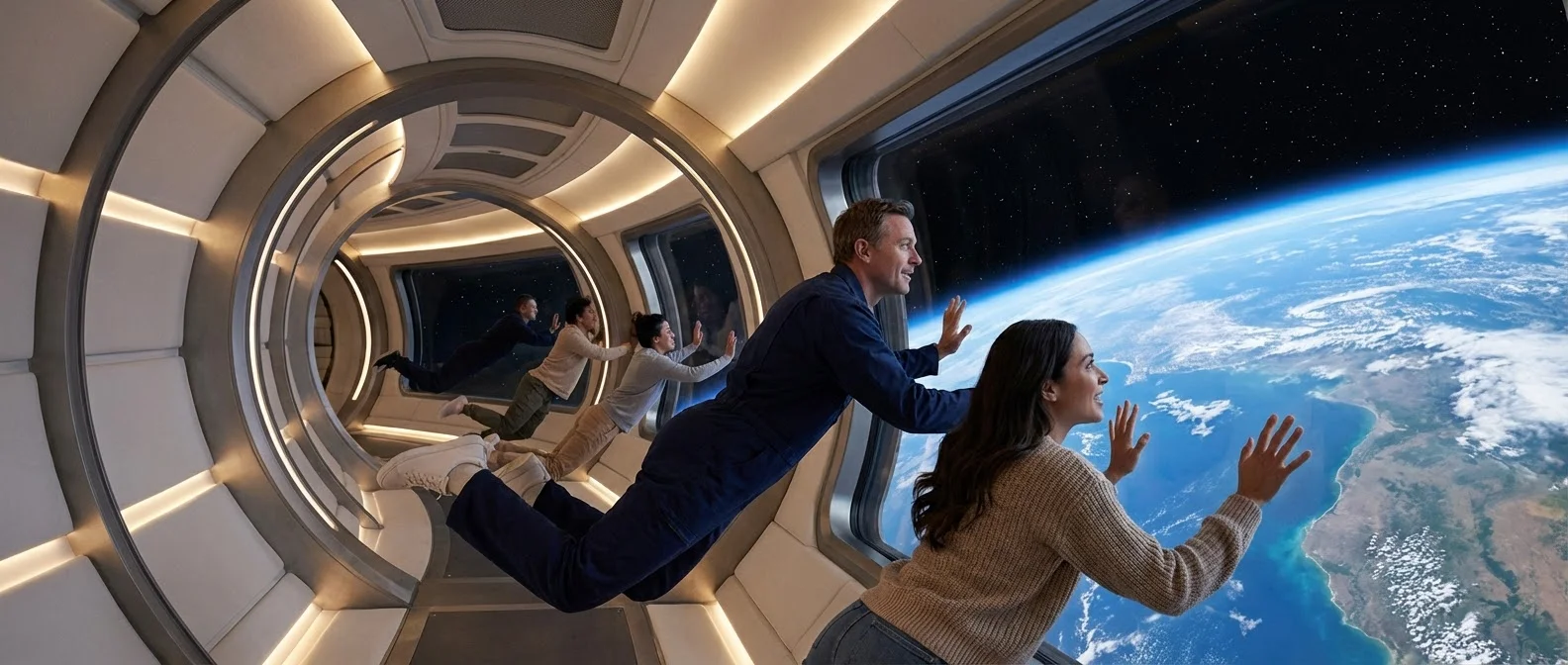
Vast is planning Haven-1, the first commercial private station, with a 2027 launch via SpaceX Falcon 9 and Crew Dragon transport. It will host small groups of tourists in a luxury cabin with Earth-view windows.
🛰️ Axiom Station
Axiom Space is building modules that will attach to the ISS and eventually detach as an independent station after the ISS is decommissioned (~2030). It will offer both research and tourist positions.
🌐 Orbital Reef (Blue Origin)
A joint venture of Blue Origin, Sierra Space, Boeing and others. Planning a “mixed-use” space station — research, industrial, tourist — in low Earth orbit (LEO). Expected to be operational by the late 2020s.
🎯 Starlab (Voyager + Airbus)
Another private station under development by Voyager Space (formerly Nanoracks) in partnership with Airbus. Designed as a next-generation orbital laboratory with capacity for researchers and tourists alike.
The Experience: What Does a Space Tourist Feel?
"Spaceflight is hard and risky. It takes grit. Don't believe it's like first class on an airplane."
Global Impact and Industry Growth
Space tourism has moved beyond billionaire joyrides to drive an entire ecosystem of innovation. The commercial space economy has created tens of thousands of jobs across the United States, Europe, and beyond. Companies like SpaceX have slashed launch costs from ~$54,500/kg (Shuttle era) to under $2,720/kg with Falcon 9. This cost revolution makes tourism financially viable while enabling satellite internet, space manufacturing, and scientific research. With the UAE, Japan, India, and South Korea developing commercial space capabilities, the market has gone global.
Criticism and Concerns
🌿 Environmental Impact
A 2022 study (Geophysical Research Letters) shows rocket launches emit soot particles into the stratosphere, damaging the ozone layer. 1,000 suborbital flights per year would emit 600 tons of black carbon.
💸 Access Inequality
Prince William stated: “We should be saving Earth before spending so much on space.” Critics argue that billions could address hunger and climate change instead of sending billionaires to space.
⚠️ Safety
Virgin Galactic lost VSS Enterprise in a test flight (2014, 1 fatality). SpaceX had a capsule explosion during testing (2019). Space tourism remains experimental — passengers sign informed consent waivers.
📜 Legal Framework
The Commercial Space Launch Amendments Act (2004) requires tourists to fly “at their own risk.” The FAA licenses flights but no longer certifies “commercial astronauts” (program ended 2021). Internationally, the legal framework significantly lags behind the technology.
What Awaits Us by 2040?
🔮 Market Forecast
According to a Research and Markets study (2022), the global space tourism market will reach $8.67 billion by 2030, with a compound annual growth rate of 37.1%. Private stations (Haven-1, Axiom, Orbital Reef) are expected to be operational by the end of the decade. SpaceX promises tourist lunar flights with Starship — while Blue Origin is developing New Glenn for larger missions. Reusable rocket advances could drive orbital trip costs below $1 million by 2040.