📖 Read more: Greece in Space: The First National Mission
The Numbers Behind the Orbital Chaos
According to ESA's Space Debris Office (updated January 2026), approximately 7,170 rocket launches have placed 25,170 satellites into Earth orbit since 1957. Of those, only 14,200 remain operational. The rest — along with upper rocket stages, collision fragments, and explosion remnants — form what we call space junk.
NASA estimates the average impact speed of these objects reaches 10 km/s — over 36,000 km/h. At that velocity, a coin-sized fragment can completely destroy an operational satellite. The greatest concentration of debris sits between 750 and 1,000 km altitude — precisely where hundreds of Earth-observation and communications satellites operate.
The Kessler Syndrome: When Debris Creates Debris
In 1978, astrophysicist Donald J. Kessler proposed a scenario that seemed extreme at the time: eventually, debris in orbit would multiply on its own, without any new launches. Each collision generates thousands of new fragments, those fragments hit more objects, and the cascade becomes unstoppable. Today, this isn't theory anymore — it's a clear possibility.
📖 Read more: AI World Simulation: Digital Universes
Two events made the situation dramatically worse. In 2007, China deliberately destroyed its Fengyun-1C weather satellite in an anti-satellite weapons test, creating over 3,500 cataloged fragments. Two years later, in 2009, the American communications satellite Iridium-33 accidentally collided with the derelict Russian Cosmos-2251. Together, these two incidents account for nearly one-third of all cataloged orbital debris.
"The greatest threat to space infrastructure isn't some asteroid — it's the objects we left up there ourselves."
📖 Read more: Ammonia Ships: Zero Emissions in Shipping 2035
Who's Cleaning Up the Sky
Until recently, removing debris was purely theoretical. That changed in the past two years, with two companies leading what's called Active Debris Removal (ADR).
Astroscale: The First Debris Inspection in History
Japanese company Astroscale launched ADRAS-J (Active Debris Removal by Astroscale – Japan) in February 2024, as part of JAXA's CRD2 program. No spacecraft had ever flown within touching distance of a dead rocket stage before.
ADRAS-J achieved successive approaches to within 15 meters of its target, performed fly-around observations, and captured high-resolution imagery. That was Phase I — Phase II (ADRAS-J2) will attempt physical capture and controlled deorbit of the object.
ClearSpace: Capture and Atmospheric Plunge
Swiss-based ClearSpace, funded and commissioned by ESA, is preparing the ClearSpace-1 mission — the first large-debris removal mission in history. The target is ESA's PROBA-1 satellite, which is no longer operational but remains in orbit. The mission, with a budget of €100 million and an expected launch in 2028, will use robotic arms to grab the target and guide it into controlled atmospheric reentry.
ClearSpace's parallel missions: The PRELUDE mission, in partnership with ESA, targets a 2027 launch to demonstrate in-orbit servicing technologies. The CLEAR mission, funded by the UK Space Agency, focuses on active debris removal using British technology.
📖 Read more: Anti-Aging: Will We Live to 150?
Next-Generation Removal Technologies
Capturing an object moving at 28,000 km/h, tumbling unpredictably, with no attachment points isn't straightforward. Engineers are trying everything:
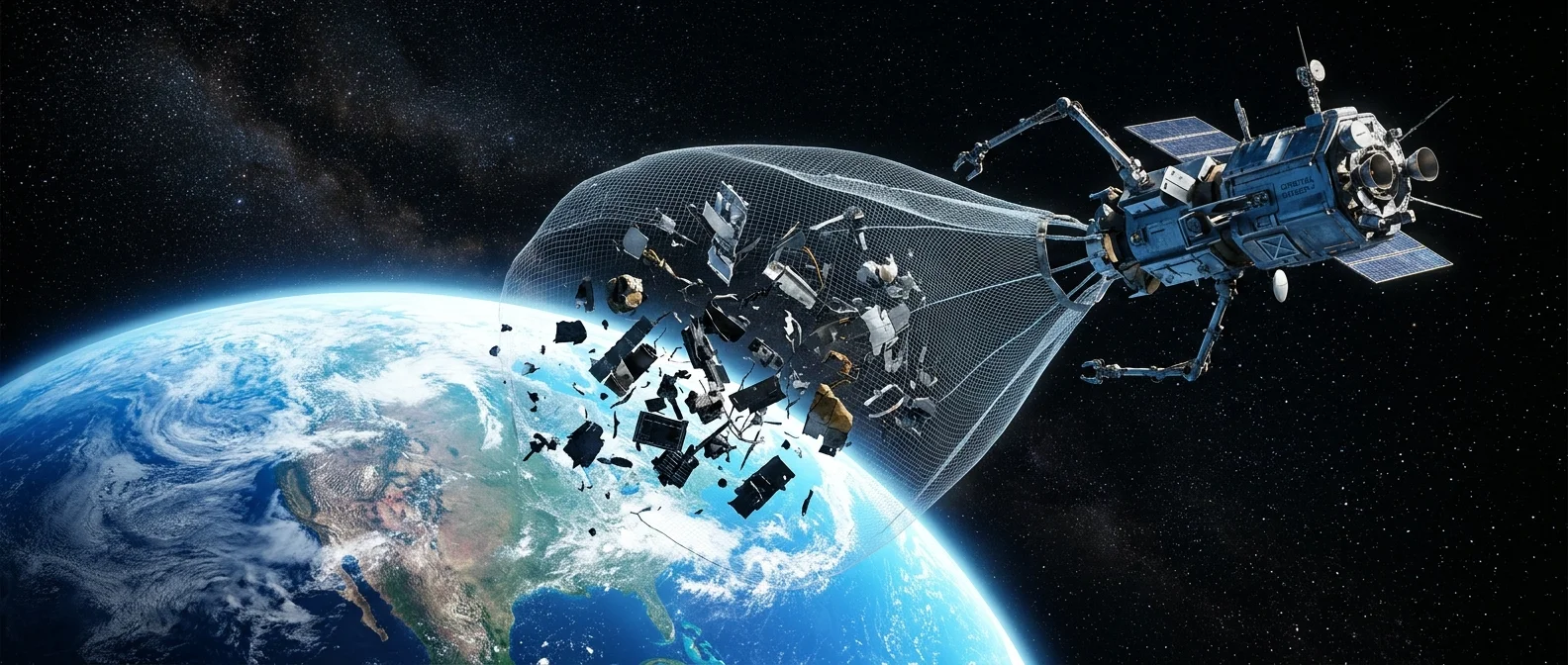
- Robotic capture arms: ClearSpace's primary method — a spider-like spacecraft with four articulated arms that surround the target. Requires precision navigation at distances of just a few meters.
- Magnetic nets and harpoons: Launched toward the target, wrapping around it without requiring physical contact with the main spacecraft. Tested experimentally during the University of Surrey's RemoveDEBRIS mission.
- Laser deorbit: A laser beam from Earth or orbit heats one side of the debris, creating thrust that gradually lowers its orbital altitude. Theoretically capable of removing multiple objects daily.
- Electrodynamic tethers (EDT): Metallic cables that exploit Earth's magnetic field to produce opposing thrust, slowing the satellite without fuel.
Regulation, Cost, and Responsibility
Who pays for cleanup? And who's responsible? Currently, there's no international treaty specifically addressing space debris. The United Nations has issued guidelines through COPUOS, and the 25-year rule — requiring every new satellite to deorbit within 25 years of its mission's end — is gradually being adopted. The US FCC recently shortened this deadline to 5 years for American missions.
📖 Read more: Artificial Trees: Machines That Absorb CO2
Mega-constellations — Starlink (SpaceX), OneWeb, Amazon Kuiper — add thousands of new objects annually. SpaceX alone plans over 12,000 Starlink satellites, with applications filed for 42,000 more. Each satellite has a built-in deorbit system, but if even a small percentage fail, the problem scales rapidly.
The Active Debris Removal market is projected to exceed €1 billion annually by the 2030s. This isn't just environmental concern — without clean orbits, there's no GPS, no weather forecasting, no satellite internet. The 21st-century economy literally depends on keeping the sky clear.
What Comes Next
The decade 2025-2035 will be decisive. ESA has committed to zero new debris creation by 2030 (its “Zero Debris” policy). JAXA is proceeding with CRD2 Phase II through Astroscale — the first actual removal. ClearSpace is preparing three missions within four years.
Meanwhile, companies across the US, Europe, and Asia are developing autonomous robotic vehicles capable of removing multiple objects in a single mission — drastically cutting per-removal costs. The idea of an orbital garbage truck, once belonging to science fiction, is now in pre-design phase.
So far, no large piece of debris has ever been actively removed from orbit in a controlled manner. ClearSpace-1 and ADRAS-J2 will be the first missions to attempt it — and their success will determine whether cleaning the sky becomes reality or remains a wish.