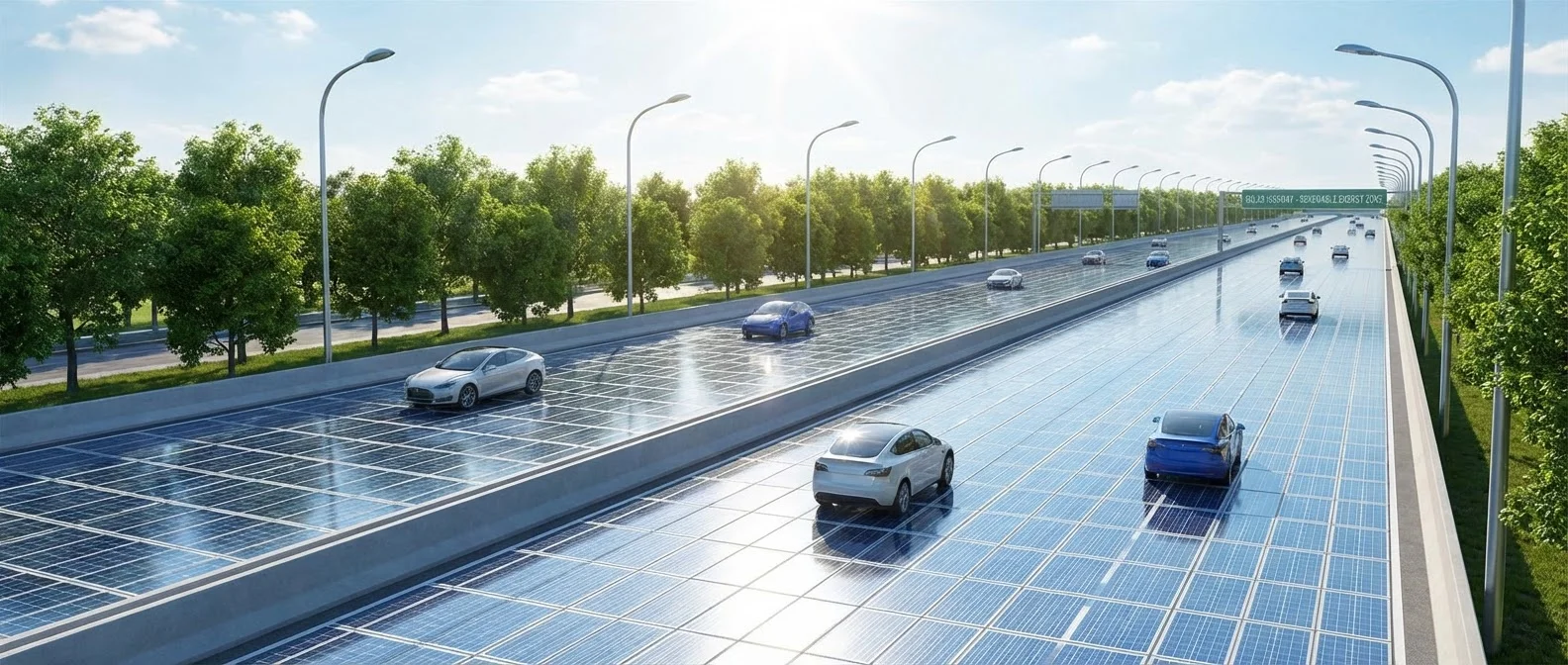
What if roads could generate electricity? Photovoltaic panels instead of asphalt, LEDs instead of painted lines, heating instead of road salt. The idea sounds revolutionary — and it's been tested in France, the Netherlands, China, and the US. The results? Mixed to disappointing — but the technology is evolving and new approaches offer hope.
📖 Read more: Hydrogen: The Fuel That Changes Everything
The Idea: Roads as Solar Farms
The global road network spans approximately 64 million kilometers. If even a small fraction of this surface were converted to photovoltaic, the energy produced would be enormous. The basic idea is simple: replace traditional asphalt or concrete with durable photovoltaic panels embedded in the road surface.
⚡ Power Generation
Photovoltaic cells beneath toughened glass convert sunlight into electricity — powering grids, lighting, nearby buildings.
💡 LED Road Markings
Dynamic lane markings, warning messages ("Reduce Speed"), real-time traffic information displayed on the road surface.
🧳 Ice Melting
Heating elements powered by the panels themselves can prevent ice formation — no more road salt or chemicals needed.
🔋 Wireless EV Charging
Inductive coils in the road charge electric vehicles while driving — no stops, no cables required.
The Major Experiments
Why Do They Fail?
Critics explain that solar roads face fundamental problems that haven't been solved:
📖 Read more: Wave Energy: Electricity from the Sea
The 6 Major Problems
- No tilt — panels must be flat, losing 30-40% efficiency vs angled panels
- Thick glass — must withstand tons of weight, reducing transparency
- Shading & dirt — vehicles, dust, mud, oil all shade the cells
- Temperature — without ventilation, overheating = performance drop
- Cost — €5,000/m² for Wattway vs ~€50/m² for traditional road
- Durability — braking, turning, heavy vehicles cause rapid wear
"Solar roadways are more expensive, less productive, and require much more maintenance than conventional solar installations."
The Evolution: What Actually Works?
If PV on road surfaces fails, newer approaches look more practical:
🔌 Electric Roads (Sweden)
Instead of PV, conductive rails embedded in the road power electric trucks while driving. First permanent electric road: E20 Hallsberg-Örebro, by 2026. Target: 3,000 km of electric roads by 2045.
📶 Wireless Charging (Electreon)
Israel's Electreon develops dynamic wireless EV charging — coils inside the road transfer energy to moving vehicles. Pilots in Sweden, Italy, and Germany.
☀️ Solar Bike Paths
Where there are no heavy vehicles, PV panels perform much better. The SolaRoad in the Netherlands proved that the technology works on bike paths.
🌟 Glowing Roads
Studio Roosegaarde (Netherlands) developed photo-luminescent paint for road markings — charges with light and glows for 10 hours. Piloted in Brabant (Apr. 2014), but moisture destroyed the paint within 2 weeks.
The KAIST Case: Online Electric Vehicle
The Korea Advanced Institute of Science and Technology (KAIST) developed the “Online Electric Vehicle” — buses charged via inductive coils embedded in the road. The technology was tested on KAIST's campus bus route, but commercialization was unsuccessful, sparking controversy over continued public funding (2019).
📖 Read more: AI vs Creativity: Does It Surpass the Average Human?
Success Rates by Type
What Works and What Doesn't
- PV on highways — ❌ Failure (Wattway, Jinan): weight, wear, shading
- PV on bike paths — ✅ Success (SolaRoad): light traffic, panels hold up
- Conductive charging — ✅ Promising (Sweden E20): doesn't generate power but feeds EVs
- Wireless charging — 🔄 In progress (Electreon, Magment): pilots in multiple countries
- Glowing roads — ⚠️ Partial failure: paint doesn't withstand moisture
Global Impact: Where Smart Roads Make Sense
Sun-rich countries and regions with extensive road infrastructure stand to benefit most from evolving smart road technologies:
Opportunities & Challenges Worldwide
- Sunshine belts — Southern Europe, Middle East, Australia ideal for solar sidewalk pilots
- Nordic countries — Sweden leads electric road charging, Norway follows for EV-heavy traffic
- Urban bike networks — Amsterdam, Copenhagen, growing city bike lanes perfect for SolaRoad-type installations
- Electric highways — major corridors like E20 Sweden could become models for EU Trans-European Transport Network (TEN-T)
- Cost challenge — still early stage, but EU Green Deal and national EV strategies drive investment
Timeline
Maybe the Road of the Future Isn't “Solar”?
The biggest lesson from a decade of experiments: solar roads for cars don't make sense — they're more expensive and less efficient than panels on rooftops, parking canopies, or roadside installations. But the “smart road” idea lives on through:
- Electric roads (conductive/inductive) — charging while driving
- Solar sidewalks & bike paths — light traffic, less wear
- Solar canopies — covers above roads that provide shade AND generate power
- Piezoelectric roads — generating electricity from traffic vibrations
The road of the future won't necessarily replace asphalt — but it will become energy-active, helping cities generate power where they need it most.