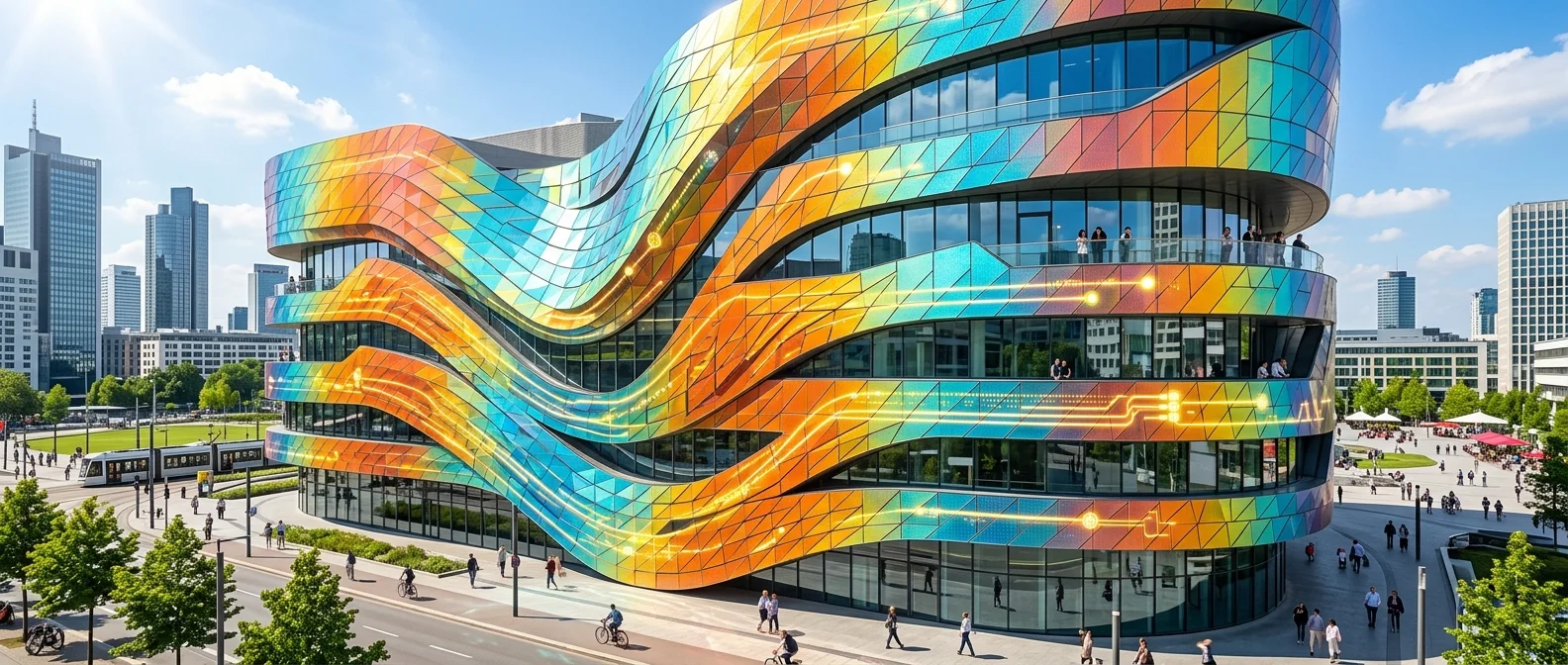
What if every wall of every building could generate electricity? Not with panels — with paint. Solar paint could turn any surface into a solar collector.
📖 Read more: OTEC: Energy from Ocean Temperatures
What is Solar Paint?
Solar paint isn't a single product but an umbrella of technologies that convert photovoltaic materials into a paintable form. There are three main approaches:
- Quantum dot solar paint: Semiconductor nanoparticles that absorb light and convert it to electricity. Lab efficiency up to 16.6%.
- Perovskite solar paint: Perovskite materials in liquid form that dry into photovoltaic films. Lab efficiency above 25%.
- Hydrogen solar paint: Generates hydrogen from air moisture using sunlight (RMIT University research).
RMIT's Hydrogen Paint
RMIT University in Melbourne developed a paint that generates hydrogen fuel from air moisture using sunlight. The material contains synthetic molybdenum disulfide (MoS₂), a semiconductor that acts as a catalyst for water splitting. Combined with titanium dioxide, the paint absorbs moisture and splits water molecules into hydrogen and oxygen.
The advantage? It works even in humid climates — all it needs is moisture in the air and sunlight. In tropical and Mediterranean regions with abundant sunshine, this opens up thousands of square miles of potential energy-generating surfaces.
"A paint that produces hydrogen fuel from the sun and moist air — no clean water needed, no electrolysis required."
— Dr. Torben Daeneke, RMIT UniversityPerovskite — The Wonder Material
Perovskites are the most promising photovoltaic material of the era. In the lab, they've achieved efficiency above 25%, nearly matching traditional silicon panels, but at a fraction of the cost and weight. Companies like Swift Solar and Oxford PV are developing perovskite-silicon tandem cells exceeding 29% efficiency. Toyota is investing in perovskite coatings for its electric vehicles.
📖 Read more: Self-Sufficient Cities 2050: Zero Waste
The critical point: perovskites can be applied in liquid form — like paint or printer ink. The durability problem — perovskites degrade with moisture — is being solved through new encapsulation methods.
Quantum Dots: Quantum dots are semiconductor nanoparticles measuring 2-10 nm. They can be “tuned” to absorb different wavelengths of light, harnessing more of the solar spectrum than traditional panels. This tunability makes them uniquely suited for solar paint applications.
Real-World Applications
Every sun-facing surface could generate energy. Buildings, fences, cars, even clothing. In sun-rich countries like Greece, with over 300 sunny days per year, solar paint would have an enormous impact. For heritage buildings where traditional panel installation is impossible, paint could be the only viable solution for solar energy generation.
When Will It Be Ready?
The technology is still in early stages for commercial use. Perovskite paints are expected to be ready for pilot applications by 2028-2030. RMIT's hydrogen paint needs further development for efficiency and durability. But the direction is clear: the future of solar energy isn't just panels on rooftops. It's every surface that sees the sun.