📖 Read more: Organoids: Mini Human Organs in a Dish
What Is Soft Robotics
Traditional robotics relies on metal frames, motors, and gears. Every movement is calculated to the millimeter — but if something fragile gets in the way, a metal gripper's pressure can destroy it. Soft robotics turns this logic upside down. It uses flexible materials — medical-grade silicone, elastomeric polymers, fabric, fibers — to build robots that bend, twist, compress, and leave objects intact.
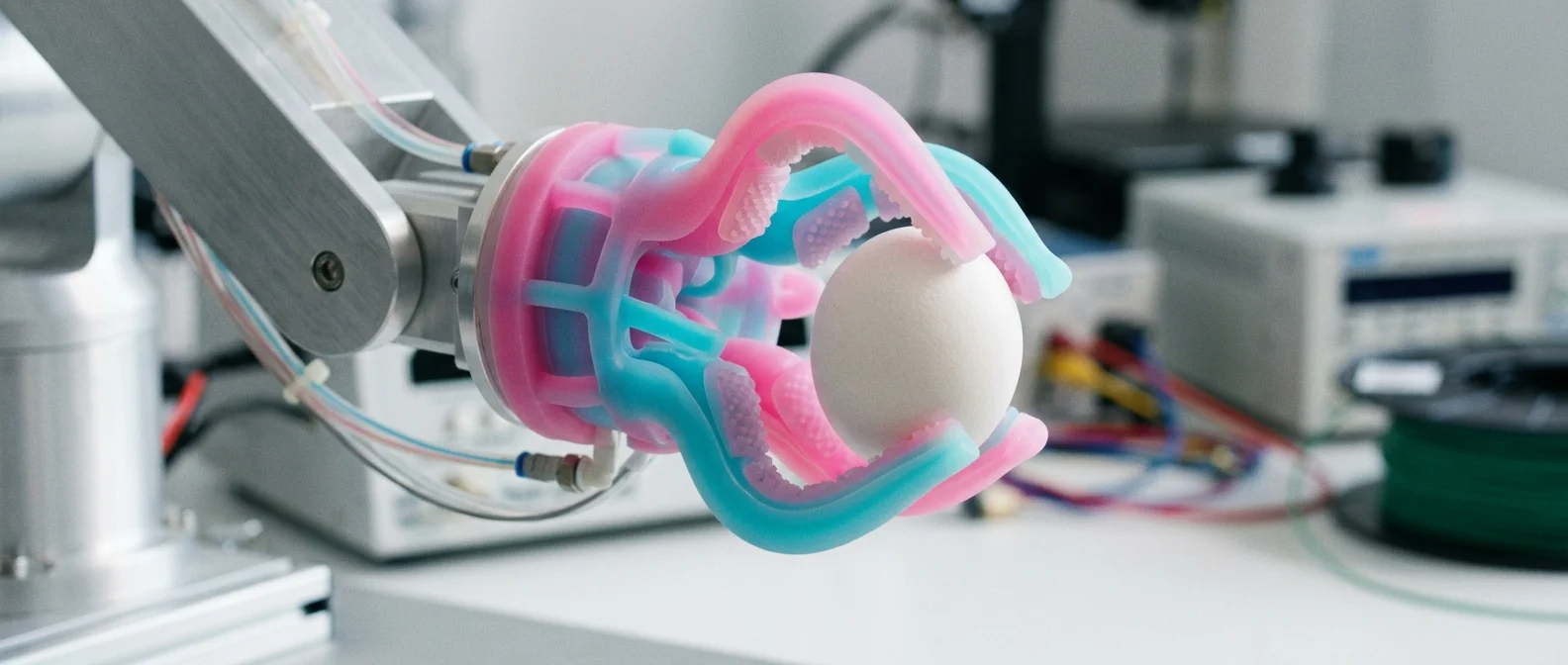
Instead of electric motors, many soft robots operate through pneumatic actuators: chambers inside the elastomer fill with air or fluid, changing shape in fractions of a second. A single chamber can bend like a finger; three together form a gripper that wraps around objects of any shape — from eggs to sea creatures.
How They Are Made
Harvard's Biodesign Lab — part of the School of Engineering and Applied Sciences — ranks among the most active soft robotics centers worldwide. Professor Conor Walsh's team develops multi-material fluidic actuators: elastomeric matrices with embedded flexible materials such as cloth, paper, fibers, and particles. These actuators are rapidly fabricated through a multi-step molding process and can achieve contraction, extension, bending, and twisting with a single control input: pressurized fluid.
The challenge is not purely mechanical. Because elastomers behave nonlinearly — the force-deformation relationship shifts with pressure — researchers use analytical, numerical, and experimental models to predict each new actuator's behavior. Fully soft sensors are integrated during manufacturing, while electronic valves, pumps, and control boards regulate pressure, motion, and force in real time.
For those eager to experiment, the Soft Robotics Toolkit (softroboticstoolkit.com) offers an open library of design files, fabrication guides, and models created at Harvard. The 2023 SRT Competition crowned the torsional gripper “ROSE” from Japan's JAIST — designed specifically for agricultural harvesting.
📖 Read more: Exoskeletons: Superpowers for Everyone
Medical Applications: Gloves, Hearts, Brains
Medicine shows the clearest commercial promise. In the United States, more than 4 million chronic stroke survivors live with partial or total loss of hand mobility. The Harvard Biodesign Lab develops portable soft rehabilitation gloves: lightweight, modular, affordable, designed for home use. Their goal extends beyond physical therapy to daily activities — opening a jar, gripping a spoon.
In cardiology, the same team works on a Direct Cardiac Compression (DCC) sleeve: an elastomeric device that wraps around the heart and contracts in phase with the natural heartbeat. Unlike conventional VADs (Ventricular Assist Devices) that contact blood and carry thrombosis risks, DCC operates externally — dramatically reducing complications.
EPFL Brain Implant: Researchers in Switzerland developed a soft robot that unfurls inside the skull. Six spiral arms with gold electrodes evaporated onto medical-grade silicone rubber deploy through an eversion technique using a water solution. The implant, 4 centimeters in diameter, enters through a hole just 1 millimeter wide — eliminating the 100 cm² skull openings previously required. The spinoff Neurosoft Bioelectronics received CHF 2.5 million from Innosuisse for clinical development.
📖 Read more: AI Protein Design: The Food Revolution
Industry and Food
An industrial robot with a metal gripper can lift a car part without issue. A tomato? Different story. Soft grippers are transforming the food industry. Made from food-grade elastomers, they conform to each object's shape — strawberry, chocolate, pastry — without requiring recalibration.
Agriculture applications are advancing rapidly. Soft robotic hands are being tested for automated fruit harvesting — something rigid robots failed at for decades due to variable shapes and ripeness levels. The ROSE gripper, which won the 2023 SRT Competition, was designed at JAIST precisely for this: a torsional soft gripper that twists and detaches fruit without damage.
📖 Read more: AI Teachers: How We'll Learn in the Future
Ocean Exploration and Urban Environments
Ocean environments favor soft designs. Rigid robots work flawlessly in structured environments — factories, warehouses. But on the seabed, among coral and fish, a metal frame becomes an obstacle. Robots inspired by octopuses, jellyfish, and snails move gently through sensitive ecosystems — collecting samples or recording data without disturbing organisms.
In urban environments, soft robots are being tested for search and rescue operations: they can squeeze through cracks in buildings after earthquakes, where a metal robot would get stuck. Their ability to change shape recalls mollusks — and it is no coincidence that biology provides most of the design inspiration.
Challenges and the Road Ahead
Soft robotics is not a cure-all. Soft materials cannot exert the force of a metal arm — lifting 50 kilograms demands a rigid robot. Durability, resistance to heat, and chemical resilience remain open issues. Precise control of a soft actuator is also harder: nonlinear materials do not follow simple mathematical models.
The numbers tell the story. The soft robotics market is projected to exceed $6 billion by 2030. Materials are getting more durable, predictive models more accurate, and silicone 3D printing is paving the way for mass production of custom actuators.
The convergence of soft robotics with artificial intelligence promises robots that do not just learn how to grasp an object — they learn how tightly. Hands that feel. Tools that bend instead of breaking. Machines that, for the first time, can truly touch the world — without crushing it.