📖 Read more: hydrofoil-boats-flying-ferries
Dynamic Wireless Charging: The Idea Behind Smart Roads
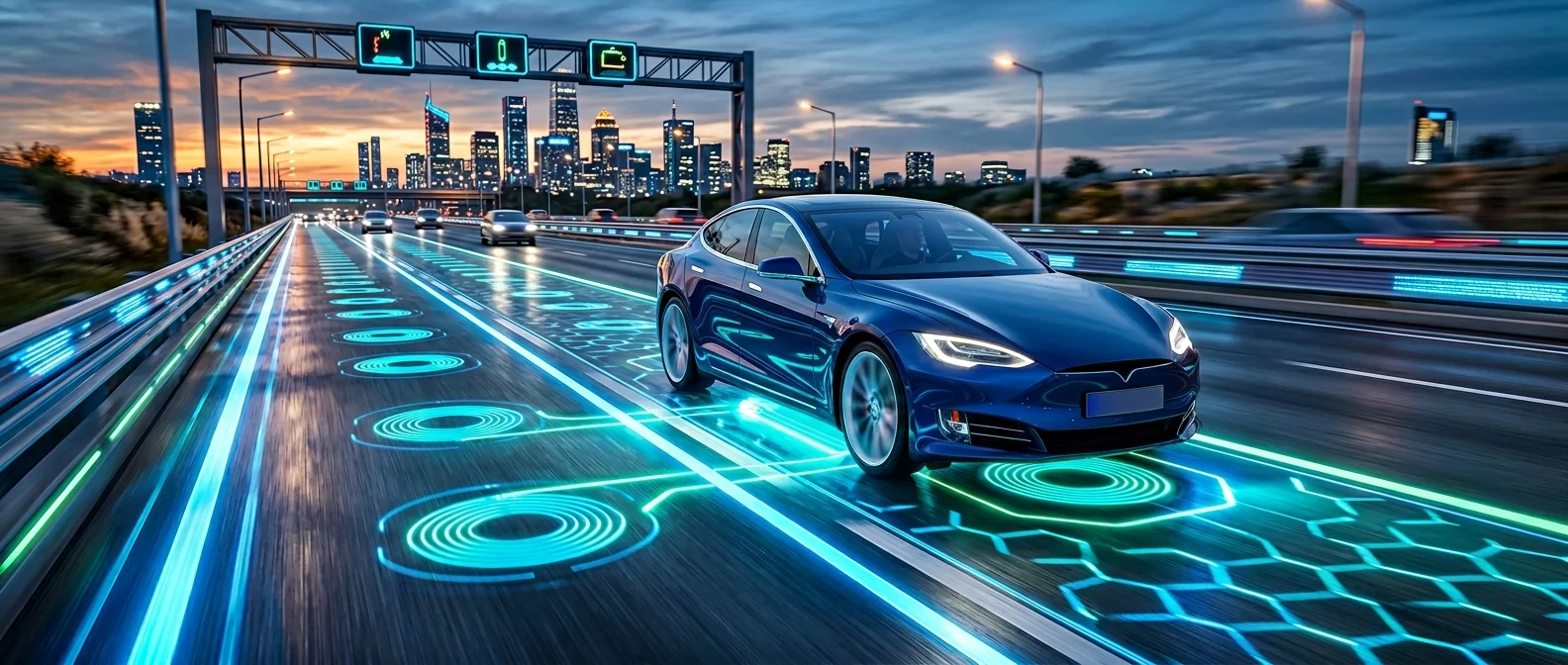
Wireless charging on the move — known as Dynamic Wireless Power Transfer (DWPT) — tackles a problem that has plagued EV owners for years: range anxiety. Instead of hunting for a charging station every 300-400 kilometers, the road itself handles the job. Copper coils sit just below the surface, transferring electrical energy through magnetic induction to a receiver mounted on the vehicle's underside.
The technology isn't limited to passenger cars. Heavy-duty trucks, city buses, and even autonomous vehicles can charge simultaneously from the same infrastructure. A long-haul truck no longer needs a 600 kWh battery — a smaller, lighter one will do, since the road covers part of the energy demand in real time.
How It Works: From Grid to Vehicle
According to Electreon, the leading company in the field, the system consists of three core components:
- Management Unit — Draws power from the electrical grid and transfers it to the embedded coils whenever a vehicle is positioned above them.
- In-road Coils — Copper coils installed at shallow depth, protected by a layer of asphalt or concrete. They deliver energy through magnetic induction.
- EV Receiver Kit — A receiver mounted under the vehicle that converts transmitted energy into usable electricity. Power goes directly to the motor, with any surplus stored in the battery.
Everything is managed through Electreon Flow, an AI-powered platform that provides a real-time view of every interaction between vehicles and road infrastructure. Instant alerts, diagnostics, and full control — all accessible remotely.
The World's First Wireless Charging Highway: A10, France
Southwest of Paris, on the A10 motorway, the world's first wireless charging highway is already operational. In partnership with VINCI Autoroutes and Gustave Eiffel University, Electreon installed coils delivering over 200 kW average power to a heavy-duty truck during normal traffic conditions.
Three vehicles charging at once from the same stretch of road — truck, bus, and car drawing power without interfering with each other. The system is vehicle-agnostic — van, semi-trailer, or compact hatchback, the road treats them all the same way.
France has set ambitious targets: 5,000 km of electric roads by 2030 and 9,000 km by 2035. A government study found that electric road systems could cut road freight emissions by 86% — a critical figure for reaching net-zero by 2050.
Detroit: Wireless Charging in the Motor City
In Detroit — birthplace of the American auto industry — North America's first public wireless EV charging road has been operating for over 18 months. Led by the Michigan Department of Transportation (MDOT), the project sits on 14th Street, adjacent to Ford's Michigan Central innovation district.
A Ford E-Transit shuttle nicknamed “Ellie” was fitted with a wireless receiver and ran regular routes — charging both while moving and while stopped at stations. Inductive coils embedded beneath a quarter-mile stretch powered the shuttle through heavy traffic, winter storms, and summer heat without interruption.
Endless Range from just 20% electrification: With only 20% of the route electrified, the system demonstrated that strategically placed charging zones eliminate the need for dedicated stops, enable smaller batteries, and ease grid demand. Companies like UPS and Xos have already joined the program.
Across Europe: Bavaria, Norway, Italy
Other countries are following suit. On the Bavarian Autobahn in Germany, Electreon deployed wireless charging on a highway section — a significant step for a country that relies heavily on road freight.
In Trondheim, Norway, the first pilot program for wireless BRT bus charging operates during regular routes. Instead of stopping for 20 minutes at a depot, buses charge while picking up passengers.
In Italy, the “Arena of the Future” project on the A35 motorway near Brescia tested wireless charging under real traffic conditions, proving the technology works reliably in Mediterranean climates.
Why This Changes Everything
The benefits extend far beyond convenience:
- Smaller batteries — EVs no longer need massive 100+ kWh packs. Smaller batteries mean lighter vehicles, lower costs, and reduced dependence on lithium and cobalt.
- Lower total cost of ownership — Continuous charging reduces fleet sizes and favors off-peak energy use.
- Invisible infrastructure — Everything sits beneath the asphalt. No visual clutter, resistant to weather and vandalism.
- Grid-friendly — Distributes charging load along the road's length, avoiding demand spikes that stress the electrical grid.
- Autonomous-ready — Self-driving trucks of the future will charge hands-free, running non-stop routes without human intervention.
Challenges on the Road Ahead
Scaling up won't come cheap. Electrifying one kilometer of highway costs hundreds of thousands of euros, and covering thousands of kilometers requires unprecedented levels of public funding and private investment. Maintenance raises questions too — what happens when the asphalt above the coils needs to be torn up and replaced?
Standards are still evolving. A universal global protocol is needed so the same receiver works on roads in France, Germany, and Greece. Electreon already follows ISO-9001 and ISO-45001 standards, but full standardization will take years of international coordination.
The signs point one direction. France is planning 5,000 km by 2030. The US is testing in Detroit. Germany has activated its Autobahn segment. In ten years, we might stop asking if highways will charge our cars and start asking why some roads still don't.