📖 Read more: Longevity Clinics: Living to 200 Years?
What Are Senescent Cells and Why Do They Threaten Us
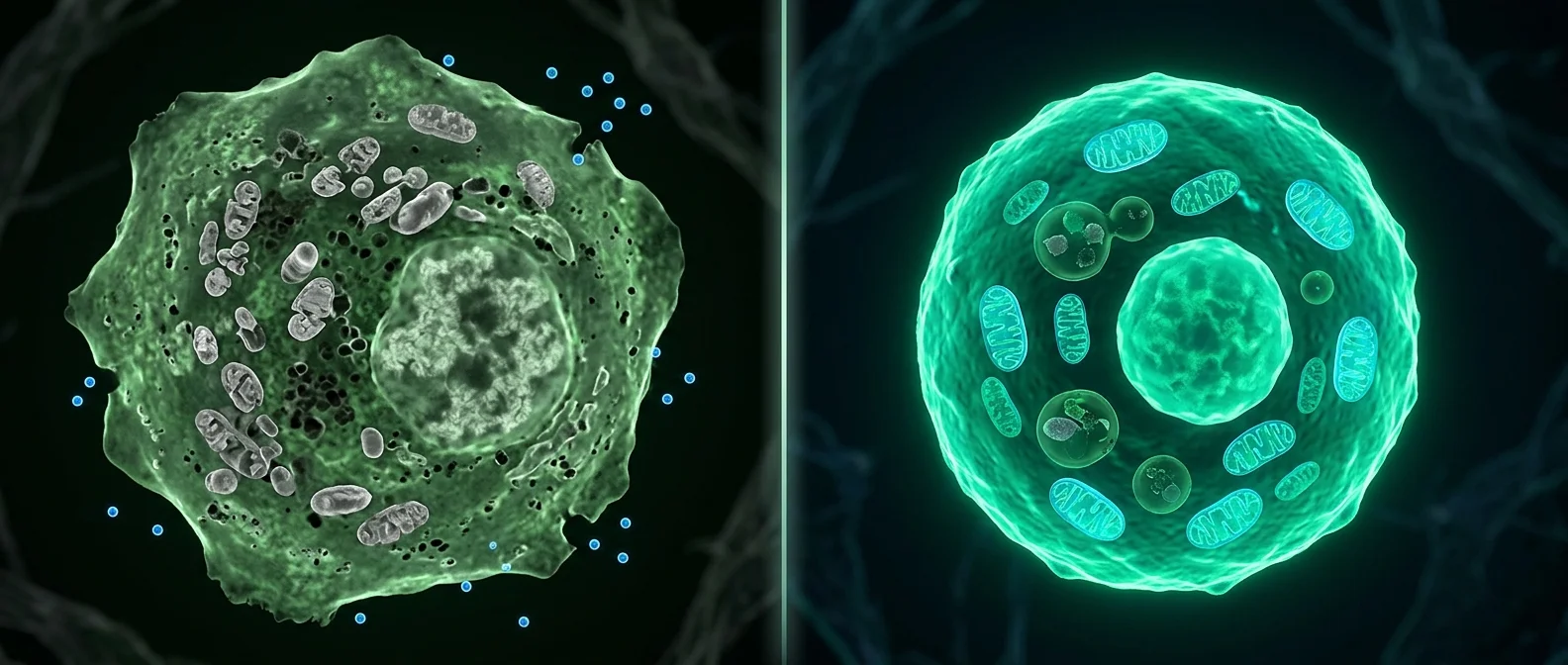
Throughout life, our cells face constant stress: radiation, reactive oxygen species (ROS), telomere shortening, and DNA damage. The normal response to these threats is cellular senescence — cells stop dividing by activating the p53-p21 and p16 pathways. This mechanism exists for good reason: it prevents the uncontrolled growth of potentially cancerous cells.
However, senescent cells don't remain harmless. They develop what science calls SASP (Senescence-Associated Secretory Phenotype) — a cocktail of inflammatory cytokines, chemokines, and proteases that they continuously secrete into their microenvironment. These signals “infect” neighboring healthy cells, push them into senescence too, and trigger a chain reaction of chronic inflammation.
In youth, the immune system recognizes and destroys these “stuck” cells through apoptosis. But with age, immune surveillance weakens substantially. Zombie cells accumulate in kidneys, blood vessels, adipose tissue, and joints — becoming one of the central mechanisms behind biological aging.
The Birth of Senolytics: Dasatinib + Quercetin
In 2015, a team at the Mayo Clinic analyzed the transcriptomic profiles of senescent cells and made a critical discovery: these cells overexpress pro-survival genes, essentially becoming “armored” against programmed cell death. By targeting these pathways, the team identified two small molecules with senolytic activity.
Dasatinib, originally a leukemia drug, proved effective at eliminating senescent preadipocytes. Quercetin, a flavonoid found in onions, apples, and tea, showed senolytic activity primarily in endothelial cells through AMPK activation and NRF2-NF-kB signaling. Combining them (D+Q) created a synergy far more powerful than either substance alone.
In mouse experiments, intermittent D+Q administration reduced aging markers, improved physical function, and increased lifespan. Even more striking: removing just 30% of zombie cells was sufficient to significantly slow age-related decline.
First Clinical Trials in Humans
The transition from mice to humans was a critical step. In 2019, the clinical trial led by Hickson and colleagues tested the dasatinib+quercetin combination in patients with diabetic kidney disease — a condition where cellular senescence in the kidneys dramatically worsens the disease.
D+Q Clinical Trial (Hickson et al., EBioMedicine 2019):
Patients received dasatinib (100 mg) + quercetin (1,000 mg) for 3 days. In just 11 days after treatment, researchers recorded reduced senescent cells in adipose tissue and skin, along with significant decreases in circulating SASP factors.
Similarly, raltegravir treatment reduced senescent T lymphocytes in patients with HIV. Even more intriguing: non-pharmacological interventions — such as a 6-month horticultural therapy program for adults aged 61-77 — managed to reduce interleukin-6 (IL-6) levels and T cell exhaustion. This data demonstrates that addressing cellular senescence isn't limited to pharmaceuticals alone.
Companies on the Front Lines: Who's Developing Senolytics
Unity Biotechnology: The Pioneer That Didn't Make It
Unity Biotechnology, founded in 2011 in South San Francisco, was the first company to reach clinical trials with senolytics. Built on discoveries from the Mayo Clinic and the Buck Institute for Research on Aging, it attracted over $200 million in venture funding — including investments from Jeff Bezos and Founders Fund. Their first drug, UBX0101 (an MDM2-p53 inhibitor for knee osteoarthritis), failed in clinical trials. They tried UBX1325 (a Bcl-xL inhibitor) for diabetic macular edema, but by 2025 the company had ceased operations.
Siwa Therapeutics: The Immunotherapy Approach
Siwa Therapeutics, one of the oldest companies in the field (Chicago, founded 2006), chose an entirely different strategy: a monoclonal antibody (318H) targeting antigens of increased glycolysis in senescent cells. In preclinical studies, the treatment reduced p16INK4a-positive senescent cells by 66% in aged mice and increased muscle mass — essentially reversing sarcopenia. It also achieved a 30% reduction in metastasis in triple-negative breast cancer models. The company has completed tolerability studies in primates.
📖 Read more: AI Drug Discovery: New Drugs in 18 Months
Senolytic Therapeutics and Rejuveron
Senolytic Therapeutics (Barcelona) is developing two senolytic candidates — STX519 and STX43 — targeting fibrotic diseases of the liver, lungs, and kidneys. A third molecule, STX255 (a monoclonal antibody), recruits the immune system against senescent cells and has been licensed to Swiss company Rejuveron. They're also developing nanoparticle delivery systems for targeted senolytic payloads — technology that could drastically reduce side effects.
Next Generation: CAR-T Cells and Anti-Aging Vaccines
Beyond small molecules, research is exploring more sophisticated approaches. In Nature (2020), the Amor team presented chimeric antigen receptor T cells (CAR-T) specifically engineered to recognize the uPAR receptor on the surface of senescent cells. Results both in vitro and in vivo were impressive: CAR-T cells destroyed senescent cells with high specificity, reversing senescence-associated pathologies.
Simultaneously, anti-aging vaccines are in early stages. Researchers have created vaccines targeting CD153-positive senescent T cells and GPNMB-positive senescent endothelial cells, with promising results in obese mouse models. The idea of “training” the immune system to autonomously find and kill zombie cells — without exogenous drugs — could make senolytic therapy far more accessible.
Senomorphics: The Alternative Path
Beyond senolytics that kill senescent cells, there are senomorphic drugs — substances that instead of destroying them, modify the toxic SASP signals they emit. Metformin, a well-known diabetes drug for decades, blocks NF-kB signaling and reduces SASP. Ruxolitinib (a JAK inhibitor) alleviated age-related frailty in elderly mice, while rapamycin (an mTOR inhibitor) suppresses SASP through autophagy in endothelial cells and fibroblasts.
Natural substances also show senomorphic activity: resveratrol, melatonin (which regulates PARP1 and reduces SASP gene expression), and ginsenosides from ginseng extracts that protect mesenchymal stem cells via NRF2. The takeaway? The future senotherapeutic “toolkit” won't be a single drug, but a combination of complementary approaches.
Challenges and Risks
But reversing aging faces real obstacles. Senescent cells aren't solely harmful: they play roles in wound healing (by secreting PDGF-AA), in cellular reprogramming via p16 and IL-6, and in immune surveillance against cancer. Indiscriminate elimination could lead to impaired healing or even increased tumor risk.
Some senolytics, like navitoclax (a BCL-2 inhibitor), cause serious thrombocytopenia — reduced platelet counts — and neutropenia at high doses. Treatment timing appears critical: too early in life could harm developmental processes. Mouse studies suggest that intermittent rather than continuous dosing may be more effective. Additionally, each tissue harbors different populations of zombie cells using different survival pathways — there's no “one pill fits all.”
What Does This Mean for Us?
No senolytic is yet approved as an anti-aging therapy. The evidence keeps building. The first clinical trials demonstrate that targeted removal of senescent cells in humans is feasible, measurable, and linked to improved biomarkers.
Real progress likely won't come from a single “youth pill,” but from personalized protocols: senolytics for zombie cell clearance, senomorphics for reducing inflammation, vaccines for boosting immune surveillance — combined with regular moderate exercise, proper nutrition, and caloric restriction, which on their own reduce senescent cell accumulation according to clinical data.
Key takeaways:
- Senescent (zombie) cells emit inflammatory SASP signals that accelerate aging
- The dasatinib+quercetin combo reduced senescent cells in patients in just 11 days
- CAR-T cells and vaccines represent the second generation of senolytics
- Senomorphics (metformin, rapamycin) modify signals instead of killing cells
- Safe application requires personalization: timing, dosage, targeted delivery
Sources: Nature Reviews Nephrology — Cellular senescence: the good, the bad and the unknown (2022), Lifespan.io — What Are Senolytics?