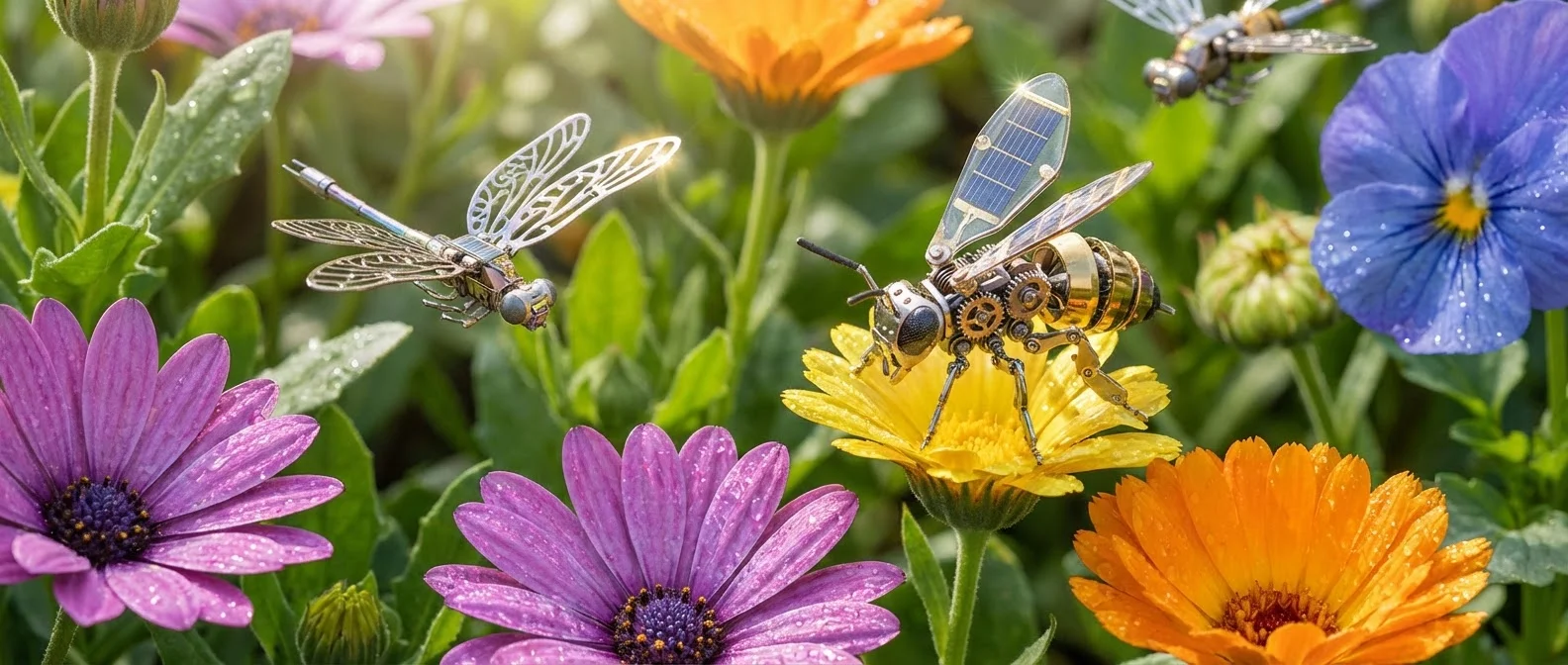
Nature spent 400 million years of evolution perfecting insects — the most successful organisms on the planet. Now, researchers in labs worldwide are building robotic insects that mimic the incredible abilities of bees, ants, cockroaches, and dragonflies. From bee-robots weighing 80 milligrams that fly autonomously, to swarms of 1,024 micro-robots that self-organize — biomimetic robotics is opening new frontiers in search and rescue, agriculture, medicine, and defense.
📖 Read more: Synthetic Biology: Creating New Life
What Is Bio-Inspired Robotics
Bio-inspired robotics is the field that studies biological systems and applies their principles to robot design. It's not simply about copying — it's about understanding the mechanisms that nature optimized through millions of years of evolution and transferring them to mechanical systems.
Insects are an ideal source of inspiration for many reasons. They represent over 80% of all known animal species, with an estimated 10 million species worldwide. Each species evolved to address specific challenges: flight, climbing, swimming, carrying loads many times their body weight, collective behavior without central control. Engineers need robots that can do exactly what insects do.
Robots That Fly Like Insects
RoboBee — Harvard's Robotic Bee
RoboBee from Harvard's Microrobotics Lab (Prof. Robert Wood) is perhaps the most iconic robotic insect in the world. Weighing just 80 milligrams — roughly the same as a real bee — it can take off, hover, attach to surfaces using electrostatic adhesion, and even dive underwater. Its wings are driven by piezoelectric actuators — materials that change shape when electrical current is applied — instead of conventional motors that would be far too heavy at this scale.
In 2019, an advanced version (RoboBee X-Wing) achieved untethered autonomous flight, powered by photovoltaic cells. This was the first time an insect-scale robot flew without external power supply, a milestone published in Nature.
DelFly Nimble — The Agility of a Fly
At Delft University of Technology (Netherlands), the DelFly Nimble mimics the remarkable agility of the fruit fly (Drosophila). With two pairs of independently beating wings, it can perform maneuvers comparable to a real insect — sudden turns, hovering, inverted flight. It's one of the most agile Micro Aerial Vehicles (MAVs) ever constructed.
DelFly Nimble changed everything. It proves that insect aerodynamics, based on flapping wings rather than rotating blades, can be harnessed in artificial systems. At small scales (low Reynolds number), traditional aerodynamic principles change — viscous forces dominate inertial forces, something insects exploit perfectly.
Robots That Run and Climb
iSprawl — Stanford's Cockroach
One of the first successes of biomimetic robotics was robots inspired by cockroaches. A cockroach runs at 50 body lengths per second, turns instantly, and can squeeze through incredibly narrow gaps. iSprawl from Stanford University exploited these principles to create a hexapod robot that runs at 15 body lengths per second, reaching 2.3 m/s.
Similarly, RHex (Reliable Hexapedal Robot) was designed to traverse uneven terrain — rocks, stairs, mud — using simple legs with semicircular feet that function as both wheels and legs simultaneously. What makes the difference is passive adaptation: instead of complex sensors, the flexible legs mechanically adapt to the ground.
HAMR-E — A Robot That Walks on Ceilings
HAMR-E (Harvard Ambulatory MicroRobot with Electroadhesion) goes one step further — literally. It can walk on horizontal, vertical, and inverted surfaces thanks to an electroadhesion system. Four compliant footpads create electrostatic attraction, allowing the robot to move on glass, wood, and metal. The inspiration? Geckos and insects that defy gravity.
Robots That Jump Like Locusts
A locust can jump 20 times its body length — equivalent to a human jumping 35 meters. Engineers took notice. At EPFL (Switzerland), a mini-robot weighing just 7 grams inspired by a locust was built that can jump up to 138 centimeters — over 18 times its own height.
The record belongs to TAUB (Tel-Aviv University & Braude College): it weighs just 23 grams and jumps up to 365 centimeters. It uses torsion springs as energy storage and a wire-latch mechanism for compression and release. The principle is the same as in nature: slow energy storage, rapid release — exactly like the hind legs of a locust.
Jumping robots have a huge advantage in search and rescue: they can leap over obstacles that would stop any wheeled or tracked robot. Think of earthquake rubble — small robots jumping between boulders searching for survivors.
The Power of the Swarm
Perhaps the most impressive aspect of insects isn't individual but collective. Ants build bridges with their bodies, bees find flowers through dance, locusts form swarms of millions. No individual insect “knows” the big picture — intelligence emerges from simple rules of individual behavior.
Swarm robotics applies this principle. At Harvard, a team created a swarm of 1,024 Kilobot robots that self-organizes into various shapes without central control. Each robot follows three simple rules — follow the nearest neighbor, avoid collision, move toward the target — and the result is remarkable collective behavior.
Micro-Robots in Medicine
Perhaps the most promising application concerns medicine. Bio-inspired micro-robots are being designed to navigate the human body with precision that seemed like science fiction just years ago.
📖 Read more: Swarm Robotics: 1,000 Robots on One Mission
Micro-robots based on microalgae have been tested in mice for targeted drug delivery to the brain, lungs, and gastrointestinal tract. Bacterial hybrid micro-robots — bacteria modified to carry pharmaceutical payloads — can be magnetically guided to hypoxic tumor regions, exactly where conventional drugs struggle to reach.
In 2022, researchers built magnetically controlled bacterial robots that infiltrate cancerous tumors with significantly increased effectiveness compared to passive delivery. Additionally, nanoparticle-loaded algae micro-robots were successfully tested for treating bacterial pneumonia in laboratory animals.
Xenobots: Robots Made from Living Cells
An entirely new category appeared in 2020: Xenobots. Researchers at the University of Vermont and Tufts University created the first “living robots” — microscopic organisms constructed from biological tissue (frog cells from Xenopus laevis) instead of metal and electronics.
Xenobots are self-powered (using their own biological energy), biodegradable, and biocompatible. They can move, carry microscopic payloads, and — most remarkably — self-replicate in a way never before observed in biology. They open an entirely new path in robotics where “robots” are no longer made of metal but of cells.
RoBeetle: Autonomy in 88 Milligrams
One of the most impressive achievements in micro-robotics is RoBeetle, an autonomous crawling robot weighing just 88 milligrams — roughly the weight of three grains of rice. Published in Science Robotics (2020), it's powered by catalytic combustion of methanol instead of batteries.
The innovation lies in the artificial micro-muscles made from nickel-titanium-platinum alloy (NiTi-Pt). The catalytic reaction with methanol heats the muscles, causing contraction and relaxation — exactly like a biological muscle. The mechanical control system automatically regulates the cycle, allowing RoBeetle to crawl autonomously without external control or power supply.
Applications & Future
Search & Rescue
Swarms of micro-robots can infiltrate damaged buildings after earthquakes, exploring spaces too small or dangerous for humans or larger robots. The cockroach-robot that fits through millimeter-wide cracks and the locust-robot that leaps over obstacles are ideal instruments.
Precision Agriculture & Pollination
With bee populations declining worldwide, robotic bees could assist with artificial pollination. Additionally, micro-robot swarms can monitor crops, detecting diseases and pests at much earlier stages.
Environmental Monitoring
Swimming micro-robots inspired by microorganisms can monitor water pollution in real time. Aerial insect-robots can measure atmospheric pollution in locations inaccessible to conventional drones.
Defense Applications
The research began precisely there: in the 1970s, the earliest conceptual studies of micro-robots were conducted for U.S. intelligence agencies. Today, DARPA funds programs including reconnaissance micro-robots, surveillance swarms, and autonomous micro-robots for prisoner rescue missions.
Technical Challenges
Despite progress, biomimetic micro-robotics faces serious technical challenges:
Power: At such small scales, batteries are too heavy. Alternatives include photovoltaic power (RoboBee X-Wing), catalytic combustion (RoBeetle), external magnetic fields, and energy harvesting from vibrations or light.
Control & Communication: How do you control a swarm of 1,000 robots? Centralized communication doesn't scale. The solution — inspired again by insects — is decentralized control: each robot follows local rules, and collective behavior emerges.
Manufacturing: At the millimeter scale, traditional engineering doesn't apply. MEMS (Micro-Electro-Mechanical Systems) techniques are essential but still expensive.
Resilience: An 88 mg robot can't withstand much. But nature provides the solution again: swarms function even when members are lost, exactly like an ant colony.
Horizon 2030-2040
Experts estimate that within the next decade we'll see: autonomous bee-robot swarms for commercial pollination, medical nano-robots in human clinical trials, biological robots (Xenobot-type) for targeted therapy, and modular search-and-rescue swarms in every fire department.
The convergence of AI, new materials, MEMS, and biology creates a perfect environment for explosive progress. Insects needed millions of years — we may need just one more decade.