📖 Read more: Wave Energy: Electricity from the Sea
What Is Ocean Thermal Energy Conversion
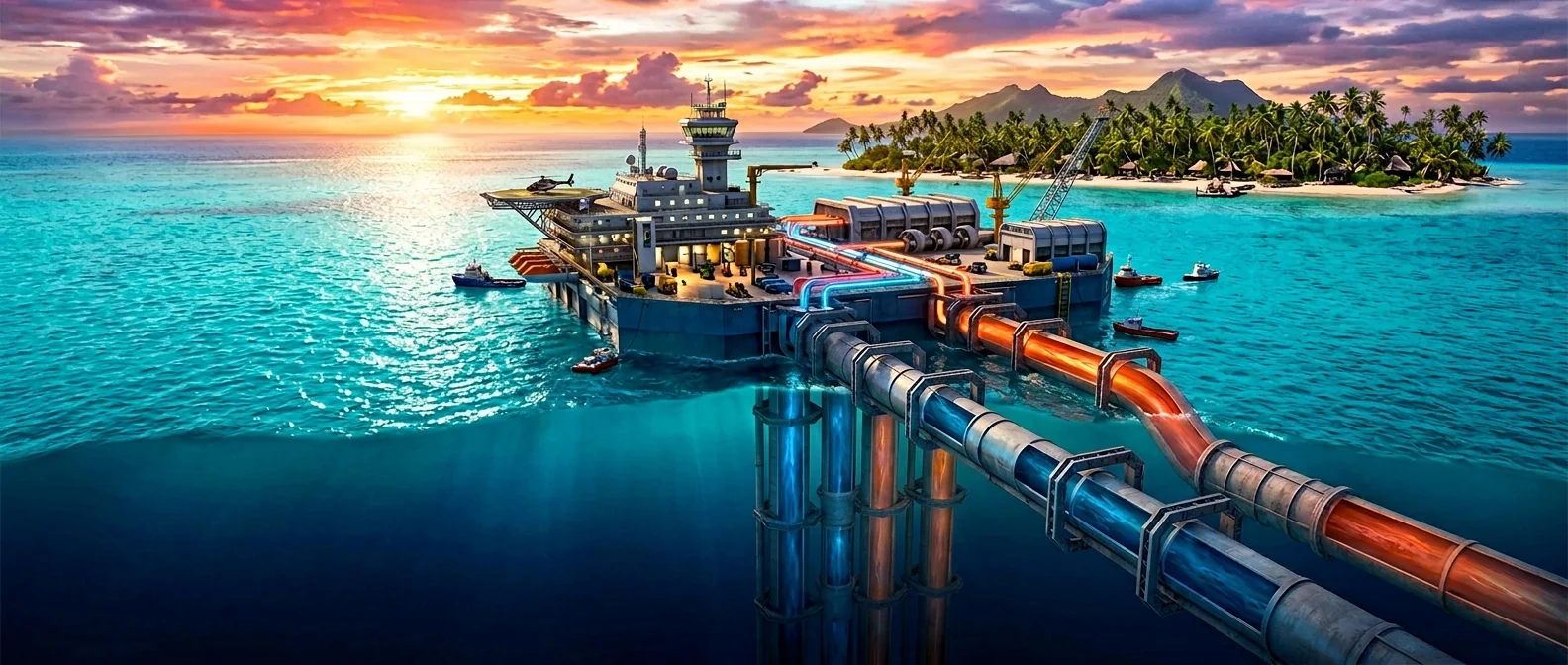
Ocean Thermal Energy Conversion (OTEC) exploits the natural temperature difference between warm surface seawater and the cold depths of the ocean. In tropical regions, the surface typically reaches 25–28°C, while water at roughly 1,000 metres depth hovers around 4–5°C. A gap of at least 20°C is enough to drive a thermodynamic cycle that generates usable electricity.
The concept dates back to the 1880s, when French engineer Jacques-Arsène d'Arsonval first proposed it. Nearly a century passed before it became practical. In 1979, off the coast of Hawaii, Mini-OTEC produced 15 kilowatts of net power from a barge — the first system to deliver useful electricity from ocean temperature differences.
Three Types of OTEC Systems
Closed-Cycle — The Most Common
Warm surface seawater heats a working fluid, typically ammonia, which has a very low boiling point. The ammonia vaporises, spinning a turbine connected to a generator. Cold deep seawater then condenses the vapour back into liquid form, and the cycle repeats continuously. This is the design behind most modern OTEC installations.
Open-Cycle — No Refrigerant Needed
Here, the seawater itself acts as the working fluid. Warm water enters a near-vacuum chamber, partially flash-evaporates, and the resulting steam drives a low-pressure turbine. A key bonus: the condensed steam yields fresh desalinated water — a critical resource for tropical islands where drinking water is scarce.
Hybrid Systems
These combine elements from both approaches. Steam from warm seawater in a vacuum chamber vaporises a secondary fluid, which then drives a higher-efficiency turbine. The result is improved power output while retaining the desalination benefits.
📖 Read more: Self-Sufficient Cities 2050: Zero Waste
Hawaii: The World's OTEC Laboratory
Hawaii has been the focal point of OTEC research for decades. The Natural Energy Laboratory of Hawaii Authority (NELHA) operates a unique test facility with access to both shallow and deep seawater at utility-scale flow rates — fewer than five such facilities exist worldwide.
Makai Ocean Engineering has worked on the technology since 1979. In August 2015, they installed a 105 kW turbine-generator at NELHA, creating the world's largest grid-connected closed-cycle OTEC plant. It marked the first time closed-cycle OTEC electricity was delivered to an American utility grid — a milestone four decades in the making.
Key milestones in OTEC history:
1979 — Mini-OTEC, Hawaii: 15 kW net power (first working plant)
1981 — Nauru, Pacific: 35 kW net power (Japanese programme)
1999 — NELHA, Hawaii: 250 kW pilot plant
2015 — Makai, Hawaii: 105 kW, first closed-cycle grid connection in the US
📖 Read more: Solar Paint: Buildings That Generate Power
What Makes OTEC Different from Other Renewables
Unlike solar panels and wind turbines, ocean thermal energy delivers steady baseload power. The ocean never stops storing heat. There are no batteries required, no seasonal swings, and no nighttime shutdowns.
OTEC output is also dispatchable — it can ramp up or down in seconds, compensating for fluctuations in wind or solar generation. When solar drops at sunset and wind dies at midnight, OTEC keeps running.
According to IRENA, ocean energy resources could theoretically produce between 45,000 and 130,000 TWh of electricity per year — more than double the world's current total demand.
Far More Than Just Electricity
An OTEC plant doesn't only produce power. Its by-products may be even more valuable than the electricity itself:
- Desalination: Open-cycle systems produce fresh drinking water, essential for tropical islands with limited freshwater supplies
- Air Conditioning (SWAC): Cold deep water feeds district cooling systems, slashing energy consumption for air conditioning across entire neighborhoods
- Cold-Water Agriculture: Cold water piped beneath fields allows farmers to grow temperate-climate crops in tropical zones
- Hydrogen Production: Surplus electricity can power electrolysis to produce green hydrogen
- Nutrient-Rich Deep Water: Deep ocean water contains trace elements valuable for aquaculture and pharmaceutical applications
The Obstacles Standing in the Way
The biggest barrier remains construction cost. Deep-water pipelines (up to 1.4 metres in diameter, stretching kilometres), heat exchangers, and floating platforms all demand enormous upfront investment before a single kilowatt-hour is produced.
📖 Read more: Thorium: The Reactors Changing Everything
For years, the accepted wisdom held that a plant needed to reach 100 MW to be economically viable — a prohibitively large first step. However, Makai's development of Thin Foil Heat Exchangers (TFHX) has dramatically improved system efficiency. Current estimates suggest plants as small as 10 MW could be commercially viable in locations with high electricity costs.
A cost analysis placed OTEC electricity at 7 cents per kWh — assuming a 100 MW facility located 10 km off Hawaii's coast. That figure is already competitive with fossil fuels, especially on island grids where imported diesel costs several times the mainland rate.
— Makai Ocean Engineering
Where OTEC Plants Could Appear
The technology is best suited for tropical and subtropical regions where deep cold water lies close to shore:
- Island grids: Hawaii, Guam, Puerto Rico, the Maldives, Mauritius, and Pacific island nations
- Coastal states: Japan, Indonesia, the Philippines, Papua New Guinea, and parts of the Indian Ocean
- Military installations: Remote bases needing energy independence and reduced fuel logistics
- Offshore industrial hubs: Hydrogen and ammonia production, offshore data centres, district cooling
What Comes Next
The technology stands at a critical inflection point. Better heat exchangers, modular construction, and declining material costs are steadily moving OTEC from proven-but-expensive lab work toward real commercial deployment.
Makai is already evaluating offshore facilities that would export energy to the continental US using ammonia as a transportable carrier. According to IRENA, ocean energy — including wave, tidal, and salinity gradient technologies alongside thermal conversion — forms a foundational pillar of the emerging “blue economy.”
For the millions of people on tropical islands who depend on imported diesel for their electricity, OTEC is not an academic exercise. It represents a tangible path to energy independence — provided the political will and initial capital materialise for the first commercial-scale plants.