📖 Read more: Epigenomics: Changing Genes Without Changing DNA
What Exactly Are Organoids?
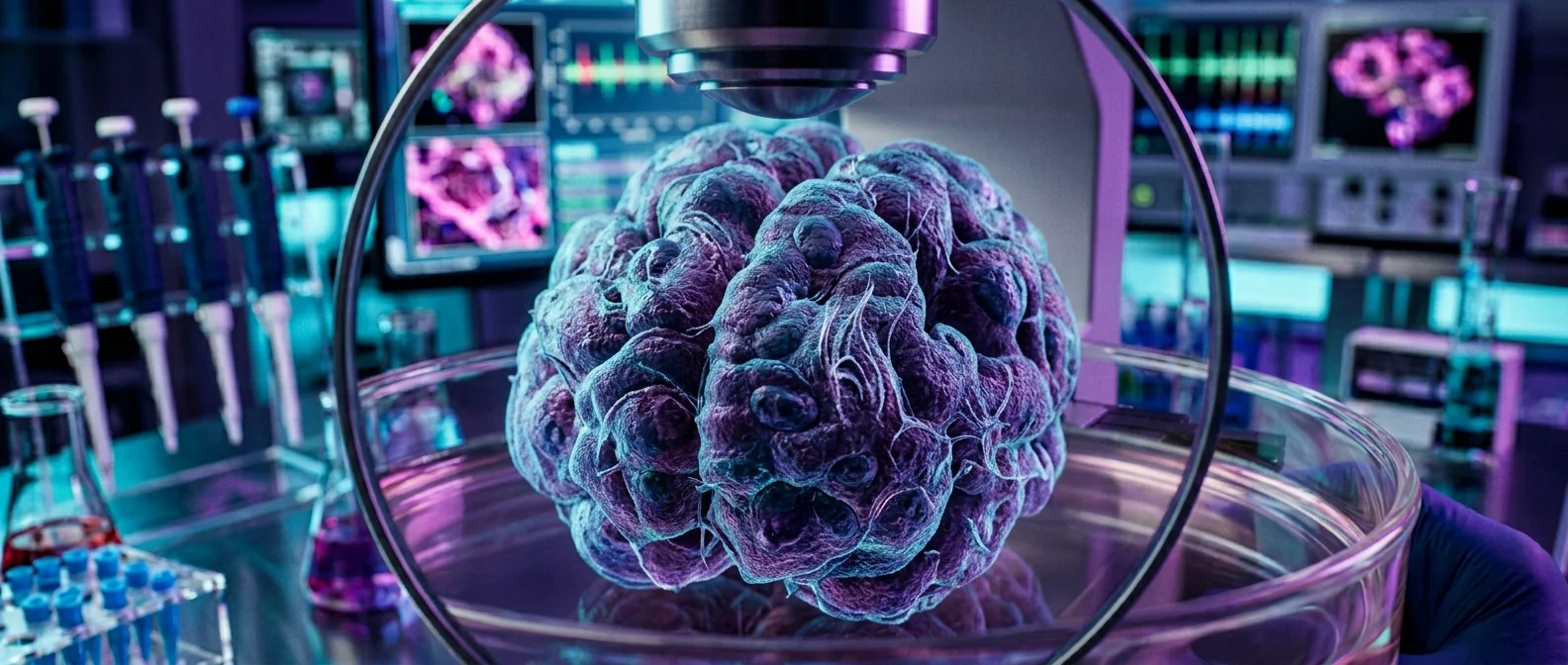
Organoids are miniature, three-dimensional tissue cultures grown from stem cells. Researchers provide the right chemical signals so the cells follow their genetic instructions and self-organize into structures that resemble real organs — from less than the width of a human hair to about five millimeters across.
So far, scientists have built organoids that mimic the brain, kidney, lung, intestine, stomach, liver, and retina. Each one recapitulates key features of its real-world counterpart: layered architecture, specialized cell types, and functional responses to stimuli.
Brains in a Dish
Brain organoids are perhaps the most striking example. In Paola Arlotta's laboratory at Harvard, researchers developed protocols that allow organoids to grow for months, reaching a level of complexity and maturity never achieved before. These mini brains contain thousands of cells across multiple types — excitatory neurons, inhibitory neurons, glial cells — all interacting in elaborate networks.
The Arlotta lab used these organoids to investigate how neuropsychiatric conditions like schizophrenia and autism affect communication between neurons. Other researchers demonstrated how the Zika virus causes microcephaly by triggering premature differentiation of neural progenitor cells — a discovery that was essentially impossible to make using animal models alone.
— Paola Arlotta, Harvard University
From Lungs to Diabetes
Researcher Carla Kim at Harvard became the first to develop lung organoids that replicate two distinct compartments of the lung: the airways and the alveolar sacs where gas exchange occurs. Her lab uses them to study how stem cells malfunction in diseases like emphysema and cystic fibrosis — conditions where the lung's ability to repair itself breaks down.
On a completely different front, Harvard researchers David Breault and Qiao Zhou achieved a breakthrough: they converted intestinal cells into insulin-producing beta cells and tested the approach using gut organoids. When they implanted the modified cells into a diabetic mouse, the animal successfully regulated its blood sugar levels. The result opens a potential path toward treating type 1 diabetes without organ transplantation.
Reinventing Drug Discovery
For decades, the pharmaceutical industry relied on lab animals and flat cell cultures that bear little resemblance to actual human tissue. According to Lee Rubin at Harvard, this partly explains why the average cost of developing a new drug reaches $2 billion — and why so many clinical trials fail at late stages.
Organoids disrupt this costly cycle. They can be grown from a patient's own cells — through iPSC reprogramming from a simple blood draw, no biopsy needed. This means drugs can be tested on a “mini version” of that specific person's organ, opening the door to truly personalized medicine. A drug that works in a generic mouse model might fail for a particular patient; an organoid built from that patient's cells reveals the mismatch before treatment begins.
📖 Read more: Neuron Computers: Biological Brains on a Chip
What organoids make possible:
• Disease modeling (autism, schizophrenia, Zika, cystic fibrosis)
• Drug testing on human tissue instead of animals
• Personalized therapy from the patient's own cells
• Massive reduction in animal experimentation
• Scalable research for rare diseases with few patients
The End of Animal Testing?
Organoids could slash or eliminate animal experimentation entirely. Testing on human tissue is far more accurate than testing on mice, and it sidesteps the ethical dilemmas that have surrounded animal research for decades.
For rare diseases where patient numbers are extremely small, organoids offer something animal models cannot: an unlimited supply of tissue from each patient, enabling large-scale screening that would otherwise be impossible.
Challenges and the Road Ahead
Organoids aren't perfect. They lack blood vessels, they don't interact with other organs, and their size remains limited. The technology is moving quickly. Organ-on-a-chip systems already connect multiple organoids through microfluidic channels, simulating the cross-talk between organs inside a living body.
In the not-too-distant future, every patient admitted to a hospital might have their own “organoid library” — microscopic versions of their organs, ready to test drugs before they're administered. What once required years of animal trials and billion-dollar gambles could happen in weeks, on a chip, with tissue that matches the patient exactly.