📖 Read more: Holograms: From Sci-Fi to Reality
🦑 Nature's Marvel: How an Octopus Disappears
If you've ever watched a video of an octopus vanishing before your eyes, you know that nature has already “solved” the problem of invisibility. Cephalopods — octopuses, cuttlefish, squid — possess the most sophisticated camouflage system on Earth. But how do they do it?
The secret lies in three layers of specialized cells in their skin:
Chromatophores
Pigment sacs controlled by muscles. When the muscles contract, the sac expands and the color becomes visible. Each octopus has millions of chromatophores that can shift in just 200ms.
Iridophores
Cells with microscopic plates that reflect light like mirrors. They produce metallic hues — blue, green, even gold — colors that chromatophores alone cannot create.
Leucophores
Cells that scatter light and produce a white base layer. They act as a backdrop, enhancing the contrast of the colors above.
The twist? Octopuses are colorblind — they see only in black and white. Yet they can blend perfectly with any environment. Scientists believe their skin “sees” on its own through specialized light-sensitive proteins — a distributed visual system that doesn't need the brain.
🔬 From Nature to the Lab: The Biomimetics Revolution
Scientists aren't just copying the octopus — they're trying to beat it. Biomimetics takes nature's designs and builds better versions, and cephalopod skin has become a research obsession.
"Nature had 500 million years to perfect this system. We're trying to do it in 20. But we have one advantage: we understand the physics behind it."
Key Approaches
🎖️ Military Applications: The Invisible Army
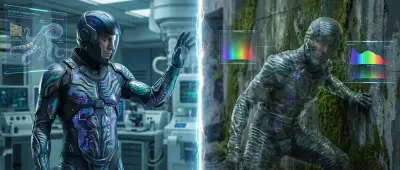
Militaries saw the potential immediately. DARPA (Defense Advanced Research Projects Agency) in the U.S. has invested millions in adaptive camouflage programs. The goal? Uniforms that automatically adapt to their surroundings.
Quantum Stealth: The Canadian Patent
Canadian company Hyperstealth Biotechnology claims to have developed an “invisibility” material that requires no power. Quantum Stealth is a thin sheet that “bends” light around objects. It has been demonstrated to military officials, but the details remain classified.
Beyond uniforms, cloaking technology is being explored for:
- Vehicles: Tanks and armored vehicles that shift “color” to match the terrain
- Drones: UAVs that become invisible against the sky
- Naval: Ships with surfaces that mimic the water
- Aircraft: Complementary stealth technology beyond radar evasion
📖 Read more: Home Robots: They Clean, Cook, Do Everything
👗 Fashion & Lifestyle: Clothes That Transform
But this technology isn't just for the military. Consider the possibilities:
📅 The Journey So Far
⚠️ Challenges & Limitations
Six major problems still need solving:
- Power: Most systems require electricity. A battery-powered suit is heavy and limited in duration.
- Speed: An octopus shifts in 200ms. The best artificial systems still need 1–2 seconds.
- Resolution: Producing detailed patterns (e.g., leaves, stones) is extremely difficult.
- Cost: A single square meter of adaptive camo costs thousands of euros.
- Durability: The materials are vulnerable to tears and weather conditions.
- Thermal signature: Even if you're visually invisible, thermal cameras can still see you.
"True invisibility — Harry Potter style — is physically impossible. But adaptive camouflage that makes someone extremely hard to detect? That's very close."
🔮 What Does the Future Hold?
Experts predict that by 2035:
- Military uniforms will have built-in adaptive camo
- Premium cars will change color on demand
- "Smart" clothing will feature color-shifting elements
- Buildings will have façades that adapt to light conditions
Octopus technology — 500 million years in the making — may prove to be one of nature's most valuable gifts to human innovation. Soldiers disappearing in forests, dresses that match your emotions — what sounds like science fiction is already in prototype.
Check out the floating homes the Netherlands is building, or the electric ferries that fly above water. The future is here — we just can't see it coming. Literally.