📖 Read more: Space Tourism: Vacation in Space
The Man Who Wanted to Move Us Off Earth
Gerard K. O’Neill, a Princeton physics professor, didn’t ask how to colonise other planets. He asked something more radical: “Is the surface of a planet really the right place for an expanding technological civilisation?” His answer, published in 1974 in Physics Today, was no. Better to build our own worlds in the void.
His 1976 book “The High Frontier” laid out three tiers of space settlement: Island One (a Bernal sphere, 500 metres across, 10,000 residents), Island Two (a Stanford torus, 1.8 km diameter, 140,000 residents), and the legendary Island Three — the O’Neill Cylinder, a colossal pair of counter-rotating cylinders capable of housing millions.
Island Three by the Numbers
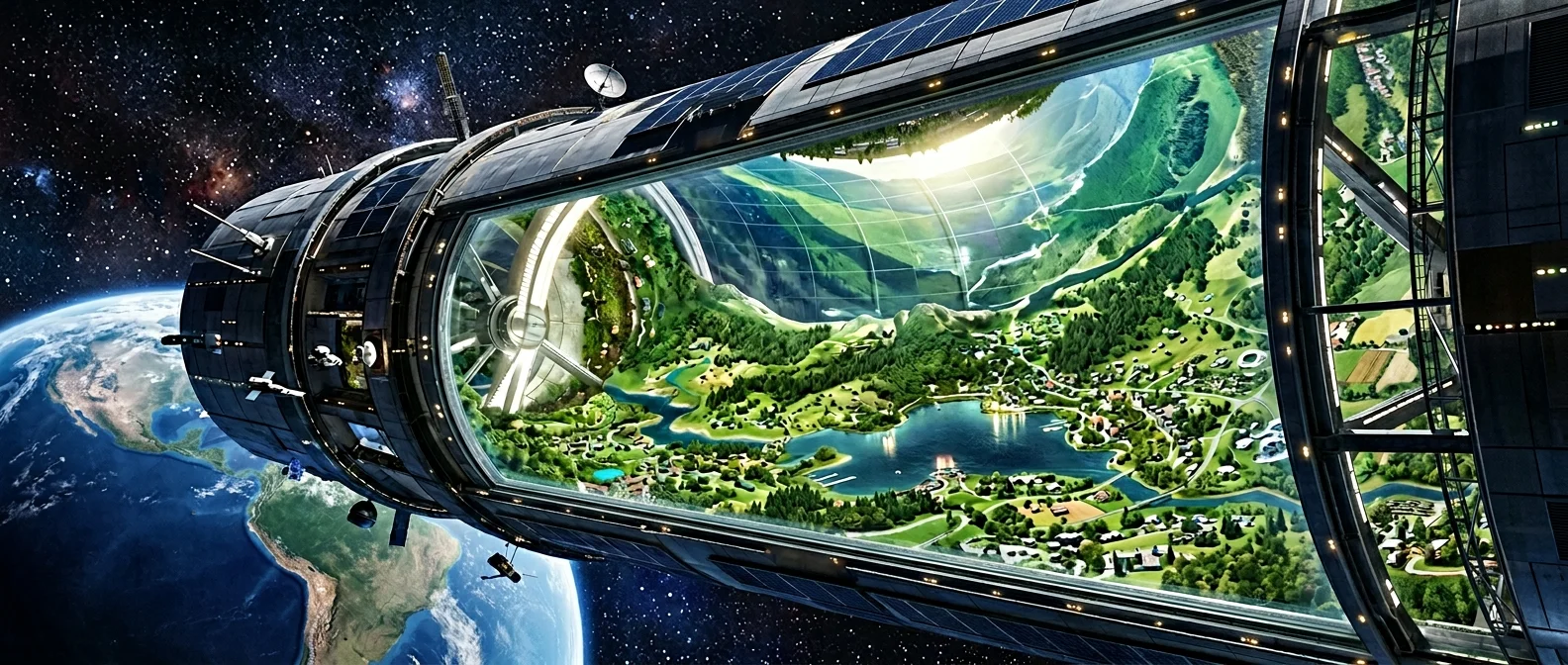
The O’Neill Cylinder consists of two counter-rotating cylinders, each 8 km in diameter and 32 km long. The opposing spin cancels gyroscopic precession, keeping the axis pointed steadily at the Sun.
Each cylinder is divided into six alternating strips: three “valleys” with soil, vegetation, rivers and settlements, and three transparent window strips. Outside the cylinder, enormous adjustable mirrors reflect sunlight through the windows, creating a natural day-night cycle.
One full rotation takes roughly 40 seconds — slow enough to avoid motion sickness, yet fast enough to generate Earth-standard gravity on the inner surface. Look up, and you’d see other cities and hills overhead — the far side of the cylinder curving above you.
Location: The L5 Lagrange Point
NASA’s 1975 Summer Study — one of the most detailed examinations of space settlement ever conducted — proposed locating the colony at the L5 Lagrange point of the Earth-Moon system. At this gravitational sweet spot, an object maintains a stable orbit without needing fuel for corrections.
Why not the Moon’s surface? Because the Moon only gets sunlight half the time, its gravity is just 1/6 of Earth’s, and transporting solar power satellites to geostationary orbit from there would be prohibitively expensive. Free space offers continuous sunlight, freedom to choose any gravity level, and direct access to orbital infrastructure.
📖 Read more: GPAI: How Close Are We to General AI?
Building Materials: Mining the Moon
Lifting construction materials from Earth would be ruinously costly. The solution: lunar mining. The Moon’s regolith contains aluminium, titanium, iron, silicon and oxygen — everything a colony needs for structure, glass, atmosphere and radiation shielding.
The NASA study envisioned an electromagnetic mass driver on the lunar surface: small packages of compacted regolith accelerated at 30g, collected at the L2 point, then shipped to L5 for processing. Over a million tonnes per year.
O’Neill’s three tiers:
Island One — Bernal Sphere: 500m diameter, 10,000 residents
Island Two — Stanford Torus: 1.8 km, 140,000 residents
Island Three — O’Neill Cylinder: 8×32 km, millions of residents
Surviving Deep Space
Space is hostile. Cosmic radiation, solar flares and micrometeorites threaten any habitable structure. The NASA study concluded that passive shielding — roughly 4.5 tonnes of matter per square metre wrapped around the habitat — would reduce radiation exposure below 0.5 rem per year, comparable to a safe terrestrial level.
That translates to millions of tonnes of shielding, sourced from slag left over after refining lunar ore. The shield doesn’t spin with the cylinder — it remains nearly stationary while the habitat rotates inside it at 87 metres per second.
Life Inside the Cylinder
The atmosphere contains oxygen at normal Earth levels and nitrogen at reduced pressure, with total pressure around half of sea level — sufficient for comfortable breathing while saving enormous structural mass.
📖 Read more: Plasma Recycling: The End of Plastics 2030
Agriculture relies on real crops and livestock, not synthetic food. Photosynthesis regenerates oxygen, absorbs CO₂, and provides fresh water through transpiration. All waste is recycled through wet oxidation, producing sterile water and nutrients. The colony is designed to be a closed, self-sustaining ecosystem.
Jeff Bezos and the O’Neill Vision
One of O’Neill’s students at Princeton was Jeff Bezos. Decades later, he founded Blue Origin with the long-term goal of moving heavy industry into space and building O’Neill-type colonies. In a 2019 presentation featuring dramatic renders of cylindrical habitats, he declared:
— Jeff Bezos, 2019
Blue Origin is already developing the Blue Moon lunar lander and the New Glenn rocket — foundational steps toward the infrastructure an O’Neill colony would eventually require.
Why a Cylinder, Not a Planet
O’Neill’s argument was straightforward: planets have fixed surface area, fixed gravity, and often hostile atmospheres. A cylinder offers:
- Tuneable gravity: From 0g at the axis to 1g at the rim
- Constant sunlight: 24/7 energy with no night (unless artificially chosen)
- Controlled climate: Temperature, humidity, rainfall — all adjustable
- Unlimited scalability: Thousands of cylinders could be built from asteroidal materials
The NASA study noted that materials within just a few known large asteroids would provide enough raw mass to build colonies with a total habitable area thousands of times greater than Earth’s.
How Far Away Are We?
Very. Nobody is planning to construct an O’Neill Cylinder in the next fifty years. The challenges remain immense: millions of tonnes of material to mine and transport, automated construction in vacuum at scale never attempted, and unknown long-term biological effects of living under artificial gravity.
But O’Neill’s design doesn’t require technology that doesn’t exist. It requires existing technology at vastly larger scale. That distinction is precisely what makes it so compelling: it is not fantasy but engineering waiting for economics to catch up.