When Living Neurons Become Processors
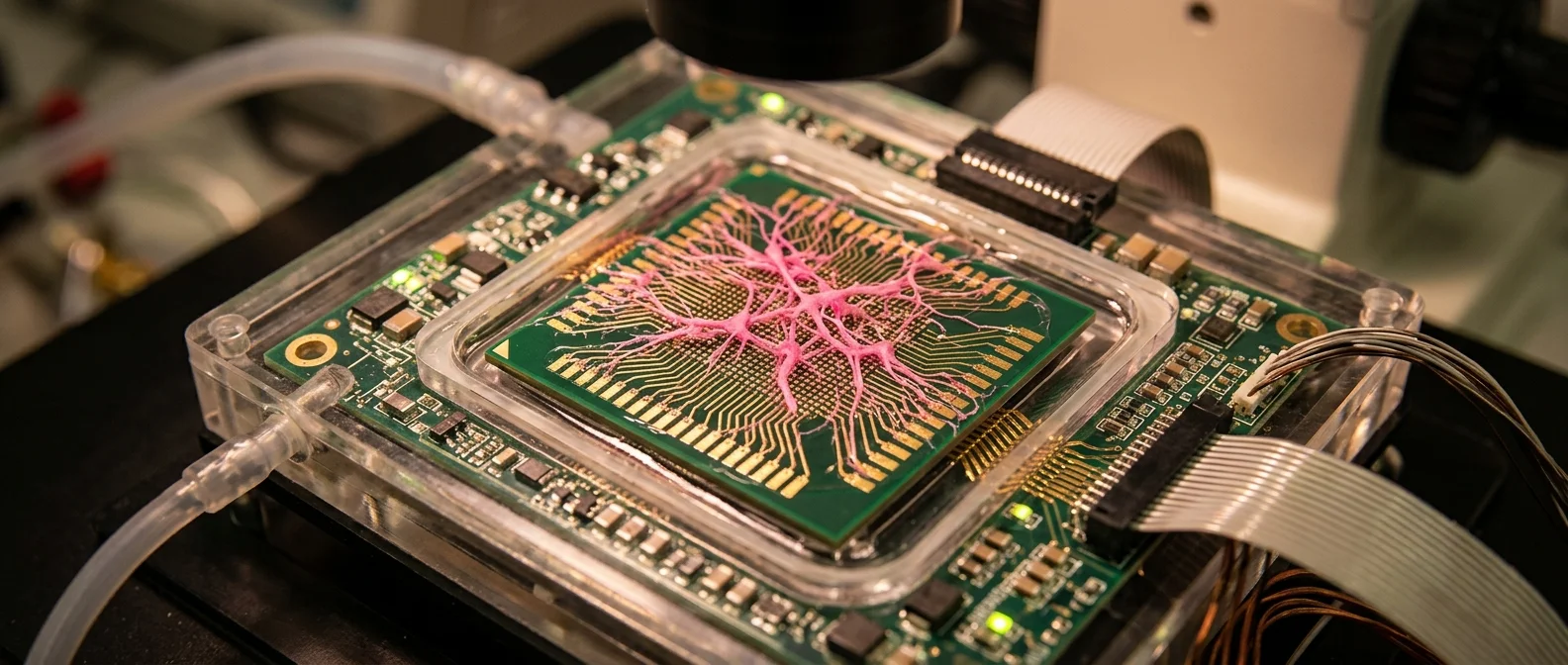
Picture a computer that doesn't use traditional processors. Instead, it runs on actual neurons — breathing, thinking, processing information exactly like the human brain. What sounds like science fiction is taking shape in neuromorphic engineering labs worldwide.
Neuromorphic technology originally aimed to reproduce neuron biophysics in hardware. Now it's evolved into something far more ambitious. Today's researchers aren't just mimicking the brain — they're building hybrid systems that merge living neurons with artificial circuits.
📖 Read more: Biological Computers: Neurons Replace Transistors
Neuromorphic Twins: The Next Evolution
The concept of "Neuromorphic Twins" represents a radical shift in how we think about neurotechnology. Instead of static devices that simply send signals to the brain, these systems create dynamic copies of neural networks that can interact and evolve alongside their biological counterparts.
This technology integrates real-time neuromorphic hardware with adaptive software elements, enabling continuous bidirectional communication. Key features include real-time coupling with biological systems, biomimetic simulation of neural activity at the hardware level, and a software layer for non-real-time customization.
BiœmuS: The Revolutionary Tool
At the heart of this technological revolution lies BiœmuS, a new tool that enables real-time simulation and hybridization using biomimetic Spiking Neural Networks. This system facilitates the exploration and reproduction of detailed neural network dynamics, prioritizing cost-effectiveness, flexibility, and ease of use.
The integrated real-time functionality enhances the system's practicality and accessibility, boosting its potential for real-world applications in hybrid experiments. This opens new pathways for studying neurological disorders and developing therapeutic solutions.
Real-Time Processing
Bidirectional communication with biological systems in milliseconds
Biomimetic Precision
Simulation of complex neuron models with synaptic plasticity
Adaptive Intelligence
Dynamic parameter adjustment for personalized therapies
How Biological Chips Actually Work
The core of this technology lies in neuromorphic systems' ability to engage in bidirectional interactions with living neural networks. Unlike traditional digital circuits that process information in binary code, these systems use spiking neural networks that mimic how real neurons communicate through electrical pulses.
The process involves creating closed-loop architecture that's mandatory for executing hybrid experiments. Closed-loop technologies have seen significant advances, particularly in adaptive, personalized therapies. In Parkinson's disease treatment, adaptive deep brain stimulation devices that adjust stimulation parameters based on neural signals have shown improved effectiveness.
Operating Stages
- Recording: Sensors collect neural signals from biological tissues
- Processing: The neuromorphic chip analyzes signals in real-time
- Simulation: Artificial neurons reproduce biological behavior
- Response: The system sends adapted signals back to the tissue
Neurological Applications That Matter
The potential of this technology for treating neurological disorders is staggering. Millions of people worldwide suffer from neurological conditions that severely impact their cognitive and motor functions. While pharmacological therapies remain limited, exploring alternative approaches like electroceutics becomes increasingly critical.
Neuromorphic twins offer the ability to address major challenges: managing brain complexity in real-time, enabling adaptive and personalized interventions, and monitoring neurological disease progression over time. They can also integrate into low-power consumption devices.
Traditional vs Neuromorphic Therapies
| Feature | Traditional | Neuromorphic |
|---|---|---|
| Adaptability | Static parameters | Dynamic adjustment |
| Personalization | Limited | Fully personalized |
| Response time | Seconds-minutes | Milliseconds |
| Monitoring | Periodic | Continuous |
Hardware Platforms Driving Innovation
Major SNN hardware platforms include TrueNorth, BrainScaleS-2, SpiNNaker, and Loihi. TrueNorth uses digital architecture but draws inspiration from analog computing principles, emphasizing low power consumption and parallel processing capabilities. BrainScaleS-2 primarily uses Leaky Integrate-and-Fire neurons for exploring learning algorithms and plasticity mechanisms.
SpiNNaker provides real-time processing and offers flexibility in simulating different network configurations and neuron models, including LIF and Hodgkin-Huxley, but with limited conductance-based currents. While some of these systems feature mobile versions, most offer access through cloud services rather than direct physical access.
TrueNorth
Digital architecture with analog principles, focused on low power consumption
BrainScaleS-2
LIF neurons for learning algorithms and plasticity mechanisms
SpiNNaker
Real-time processing with flexibility in network configurations
Loihi
Advanced neuromorphic architecture with on-chip learning
Challenges and Future Directions
Despite impressive capabilities, biological computer technology faces significant challenges. Brain complexity across multiple scales requires collecting various data types, including MRI and electrophysiology. Their use is currently limited to specific medical decisions and actions.
Virtual Brain Twins developed so far, while dynamic and capable of simulating complex neural processes, differ from classic Digital Twin technology. They don't allow bidirectional real-time communication with their physical counterparts. Instead, they function as powerful predictive tools for simulating disease progression and treatment outcomes.
Key to the Future
The success of neuromorphic twins depends on developing systems that can interact adaptively and co-evolve with the brain over time, offering continuous, adaptive interaction for treating chronic brain injuries or neurodegenerative diseases.
Next-Generation Neuroprosthetics
Developing neuromorphic devices for biomedical applications signals a transformative shift in biomedical interventions. These devices can integrate into low-power consumption systems, opening new frontiers for neuroengineering and brain repair.
This technology also benefits from Artificial Intelligence, which forms the twin's software core, allowing it to adapt and learn from interactions with the biological system. This creates a dynamic environment where artificial and biological intelligence can collaborate to achieve therapeutic goals.
Toward a New World
Neuron computers represent more than technological innovation — they're the beginning of a new era where biology and technology merge to create solutions that were unthinkable just a decade ago. As this technology matures, it promises to transform how we approach neurological disorders and open new pathways for understanding the human mind.