📖 Read more: Organoids: Mini Human Organs in a Dish
How mRNA Cancer Vaccines Work
The core idea behind mRNA vaccines is elegantly simple: synthetic messenger RNA teaches the body's cells to produce specific proteins. For COVID-19, that protein was the virus's spike. For cancer, things get far more interesting — and far more personal.
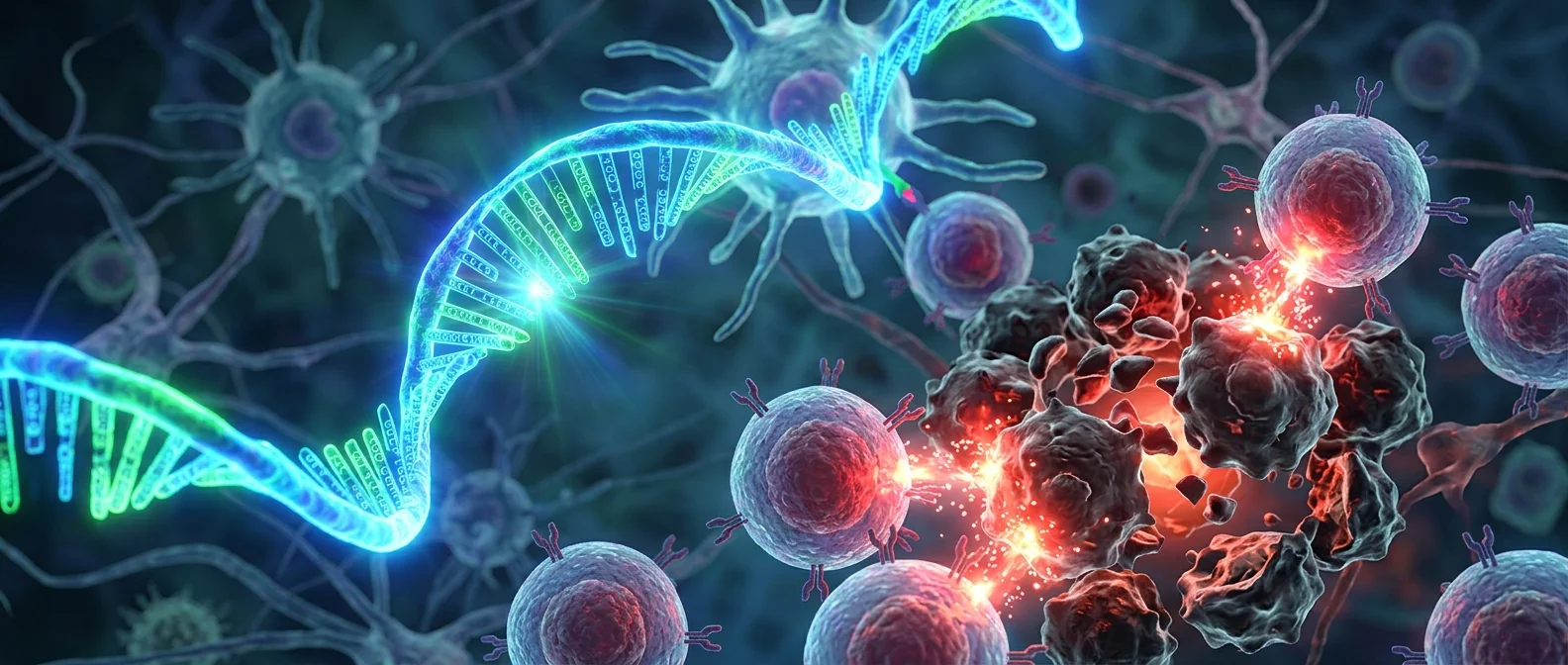
Cancer cells carry mutations that generate neoantigens — proteins not found on any healthy cell. These neoantigens are unique to each patient, like a fingerprint of the tumour itself. Researchers sequence the tumour, identify the mutations, and build an mRNA vaccine encoding exactly those neoantigens.
Once administered, the mRNA enters dendritic cells via lipid nanoparticles. There, ribosomes read the instructions and produce the cancer antigens. These antigens are displayed on cell surfaces through MHC molecules, activating T-cells and B-cells. The result: the immune system learns to recognise and destroy cancer cells wherever they hide in the body.
What makes mRNA cancer vaccines different:
Unlike COVID vaccines, cancer mRNA vaccines don't prevent — they treat. They're not one-size-fits-all but personalised. Each dose is manufactured specifically for a single patient, based on the genomic analysis of their individual tumour.
Moderna and Merck: The mRNA-4157 Breakthrough
Moderna and Merck have pushed furthest ahead in the mRNA cancer vaccine race. Their vaccine, known as intismeran autogene (mRNA-4157/V940), contains 34 mRNA sequences generated by an automated algorithm based on massively parallel sequencing of cancer patients' tumour tissue.
The vaccine is given alongside pembrolizumab (Keytruda), an immunotherapy drug that releases the immune system's “brakes.” Pembrolizumab blocks the PD-1 receptor on T-cells, preventing cancer cells from hiding from immune surveillance.
In the Phase 2b KEYNOTE-942 trial, 157 patients with surgically resected stage IIIC-IV melanoma received either mRNA-4157 plus pembrolizumab or pembrolizumab alone. The results cut deep: the combination reduced recurrence risk by 44%. Only 22.4% of patients in the vaccine arm experienced recurrence, compared to 40% in the control group.
In December 2022, the study met its primary endpoint. By February 2023, the US FDA granted Breakthrough Therapy Designation, and in April 2023, the European Medicines Agency awarded PRIME Designation — both fast-track pathways signalling exceptional promise.
📖 Read more: Neural Interface: Controlling with Thought
BioNTech and Genentech: Taking on Pancreatic Cancer
While Moderna focuses primarily on melanoma, BioNTech — the German company behind the Pfizer COVID vaccine — went after a deadlier target: pancreatic cancer. Pancreatic ductal adenocarcinoma (PDAC) is one of the deadliest cancers, with a five-year survival rate below 12%.
Their vaccine, autogene cevumeran (BNT122), developed with Genentech, encodes up to 20 neoantigens per patient. In the Phase I trial, 34 patients were enrolled, of whom 16 ultimately received the vaccine. The 8 classified as “responders” — meaning they developed detectable T-cells against the neoantigens — showed no cancer recurrence at 18 months. Non-responders had a median recurrence-free survival of 13.4 months.
In October 2023, BioNTech launched an international Phase 2 trial for pancreatic cancer. The company is simultaneously investigating mRNA vaccines for head and neck, lung, and colorectal cancers.
Timeline: Three Decades from Lab Bench to Clinic
First proof: mRNA encoding tumour antigens generates immune response in mice.
📖 Read more: Neuro-Marketing: Shopping with Your Brain
First human clinical trial: dendritic cells loaded ex vivo with mRNA against prostate cancer.
First Phase I/II results from directly injected mRNA against melanoma. BioNTech founded.
Moderna develops mRNA-4157. Clinical trials begin in collaboration with Merck.
First mRNA vaccines ever approved (COVID-19). Technology proven at a scale of billions of doses.
Moderna-Merck announces positive Phase 2b results for melanoma (44% recurrence reduction).
Nature publishes BioNTech's pancreatic cancer vaccine study showing strong immune response.
Phase III launched (V940-001) for melanoma. Phase III registered for non-small cell lung cancer.
Nobel Prize in Physiology/Medicine awarded to Katalin Karikó and Drew Weissman for modified nucleosides.
UK's NHS launches Cancer Vaccine Launch Pad. Phase 2 begins for kidney cancer (INTerpath-004).
📖 Read more: Photonic Chips: Computing with Light
Beyond Melanoma: Which Cancers Are Next
Melanoma was the natural first target because it carries a high mutational burden — meaning it produces many neoantigens the immune system can potentially recognise. The applications spread wider.
Moderna-Merck has already registered a Phase III trial for non-small cell lung cancer (NSCLC) in patients with stage II, IIIA, and IIIB disease following surgical resection. In parallel, the INTerpath-004 Phase 2 study began in 2024 for renal cell carcinoma after nephrectomy. BioNTech is expanding into head-and-neck, lung, and colorectal cancers.
The targets keep multiplying. Researchers are testing mRNA vaccines against:
- Breast cancer — targeting HER2 neoantigens
- Bladder cancer — combined with checkpoint inhibitors
- Glioblastoma — the most aggressive brain tumour
- Ovarian cancer — targeting survivin proteins
- Colorectal cancer — particularly microsatellite instability-high (MSI-High) subtypes
The UK's NHS Leads the Way
In May 2024, the British National Health Service announced something unprecedented: the creation of the Cancer Vaccine Launch Pad, a platform allowing thousands of patients to participate in clinical trials for personalised mRNA cancer vaccines. The initiative marks a shift from isolated research studies to an organised national effort.
The scale is massive. If Phase III results confirm the early data, personalised mRNA vaccines could become standard post-surgical treatment for many cancer types by the end of the decade.
📖 Read more: Quantum Computers: What Will They Change?
Challenges That Remain
The exciting progress shouldn't blind us to real difficulties. First, manufacturing time: each vaccine must be custom-built after tumour sequencing. This process takes several weeks — precious time for patients with aggressive cancers.
Second, cost. Personalised vaccine manufacturing doesn't scale the same way mass-produced COVID vaccines did. Every dose is unique. Third, results so far primarily concern adjuvant therapy — treatment after surgical tumour removal. Effectiveness against metastatic cancer remains an open question.
There's also the challenge of immune evasion. Tumours can evolve, lose neoantigens, or locally suppress immune activity. That's why combination with checkpoint inhibitors like pembrolizumab is considered critical — it prevents cancer cells from cloaking themselves from the immune response.
The 2023 Nobel Prize highlighted the foundational breakthrough:
Katalin Karikó and Drew Weissman were awarded for their use of modified nucleosides — particularly pseudouridine — that allow mRNA to enter cells without triggering a strong inflammatory response. This 2005 discovery paved the way for both COVID vaccines and the cancer vaccines now in trials.
The Road Ahead: When Will Patients Benefit
With three Phase III studies under way and dozens more at earlier stages, industry analysts expect the first mRNA cancer vaccine approvals between 2026 and 2028. If the V940-001 melanoma trial confirms the Phase 2b results, Moderna-Merck could file for approval as early as 2026.
Long-term, researchers envision mRNA vaccines as a standard part of treatment protocols: the patient undergoes surgery, the tumour gets sequenced, a personalised vaccine is manufactured, and it's administered alongside immunotherapy to eliminate any remaining micro-metastases. Self-amplifying mRNA (saRNA) technology could reduce dosing requirements and enhance efficacy further down the line.
Vaccines are no longer just for viruses. The pandemic proved mRNA can go from lab bench to billions of doses faster than any drug platform in history.
Nature Medicine — Personalised anti-cancer vaccine combining mRNA and immunotherapy (2023)
Merck/Moderna — KEYNOTE-942 Phase 2b clinical trial results (2022-2023)
BBC News — Thousands to trial personalised cancer vaccines, NHS Cancer Vaccine Launch Pad (2024)