📖 Read more: Terraforming Mars: The Red Turns Green
Starship: The Transport System for Millions
No colonization plan begins without a way to get there. Enter the most powerful rocket ever built. SpaceX's Starship stands over 123 meters tall — taller than a 40-story building — and can carry 150 metric tons of payload in fully reusable configuration.
The Super Heavy booster carries 33 methane-oxygen Raptor engines, generating 7,590 tonnes of thrust — nearly double the Saturn V that took humans to the Moon. After launch, the booster returns and gets caught by the launch tower, ready for another flight without refurbishment.
The critical element for Mars isn't raw power alone but orbital refueling. Before departing for the Red Planet, Starship receives propellant from tanker versions of itself in low Earth orbit. This way, it delivers hundreds of tonnes of equipment per mission. SpaceX has announced pricing of $100 million per metric ton for Mars cargo flights, with first missions scheduled for 2030.
At Starbase in Texas, the Starfactory manufacturing hub was designed with capacity to produce up to 1,000 Starships per year — enough to support transporting thousands of people during each Earth-Mars transfer window.
Mars by the Numbers: What Awaits Us
Mars resembles Earth in a few ways — its day lasts 24 hours and 37 minutes, it has seasons, even weather patterns. In every other respect, however, it's a hostile environment.
Atmosphere: 95% carbon dioxide, surface pressure just 1% of Earth's — without a suit, your blood would effectively boil instantly.
Temperature: Average of -60°C. Midday at the equator can reach 15°C, but nights plummet to -130°C.
Radiation: With no magnetic field or thick atmosphere, cosmic radiation on the surface is 40 to 50 times higher than Earth.
Gravity: Just 38% of Earth's. An 80 kg person “weighs” only 30.4 kg.
NASA currently maintains 3 spacecraft in orbit and 2 rovers on the surface. Perseverance, which landed in Jezero Crater in February 2021, pulled off a first: in December 2025, it completed the first autonomous AI-planned drives on another planet. A rock sample it collected, nicknamed “Cheyava Falls,” contains potential biosignatures — “the closest we have ever come to discovering life on Mars,” according to NASA.
ISRU: Living off Martian Resources
The keyword for any colony isn't “mission” but "self-sufficiency." Transporting a liter of water from Earth costs thousands of euros. The solution lies in ISRU — In-Situ Resource Utilization, essentially using local resources.
The first proof came from the MOXIE experiment (Mars Oxygen In-Situ Resource Utilization Experiment) aboard Perseverance. Across 16 runs between 2021 and 2023, this toaster-sized device produced oxygen from Mars's CO₂ atmosphere — 122 grams total. Barely enough to fill a soda can, but it proved the concept. A scaled-up version could produce rocket propellant (methane + oxygen) for the return trip, eliminating the need to haul it from Earth.
Water: Satellites have identified massive ice deposits beneath the surface, especially near the poles. Mining this ice would provide drinking water, oxygen (via electrolysis), and hydrogen for fuel.
📖 Read more: Neuralink: Brain Implants and Our Mind
Regolith: Martian soil can serve as construction material. Research teams are testing conversion into bricks using microwaves — no water or resins needed, relying solely on the iron already present.
Solar + Nuclear: Mars receives 43% less sunlight than Earth, but thin-film solar panels combined with small nuclear reactors (Kilopower-type) can meet a base's energy demands.
When Do the First Colonists Arrive?
Timelines vary dramatically depending on the organization:
- SpaceX (2030): First unmanned cargo missions to Mars. Goal: test landing systems, conduct surveys, pre-position equipment. Elon Musk envisions first crewed missions around 2035, with a self-sustaining city by 2050.
- NASA (2040s): The Moon-to-Mars program uses the Moon as a proving ground. The ESCAPADE mission, launched November 2024, will arrive in September 2027 to study solar wind around Mars.
- ESA (long-term): The Aurora program is developing soft-landing technology, in-situ resource processing, and life-support engineering for a future human mission.
An Earth-Mars transfer window opens every 26 months, when both planets reach optimal alignment. Each mission takes 6 to 9 months to arrive, and communications suffer a 4- to 24-minute delay depending on distance. This means the first colonists will need to solve most problems on their own.
The Big Challenges: Radiation, Psychology, Body
Radiation is the primary enemy. Without a magnetosphere like Earth's, cosmic rays and solar flares strike unimpeded. Scenarios include buried habitats under Martian soil, lava tubes (detected on Olympus Mons), or specially shielded modules. Water ice, needed anyway for survival, makes excellent shielding material between habitat walls.
Low gravity (38% of Earth's) causes muscle atrophy and bone loss. Astronauts on the ISS lose 1-2% bone density per month in zero gravity. On Mars the situation would be better, but intensive exercise regimens and possibly pharmaceutical intervention will be necessary.
And then there's what rarely gets enough attention: psychological pressure. Small teams, confined to tight spaces, thousands of kilometers from any help, with 20-minute delays on even a video call. Isolation experiments (Mars-500, NASA's CHAPEA) show that social dynamics pose as great a challenge as engineering.
Terraforming: The Ultimate Dream
If the colony survives, the next step would be making the planet habitable without a suit. The concept is called terraforming, and on Mars it would require three things: a thicker atmosphere, higher temperatures, and surface water.
Some researchers propose deploying fluorinated gases (super greenhouse gases) that warm the planet thousands of times more effectively per molecule. Others envision a magnetic shield at the L1 Lagrange point, protecting Mars from solar wind and allowing the atmosphere to rebuild. Realistically, any terraforming scenario requires hundreds or thousands of years.
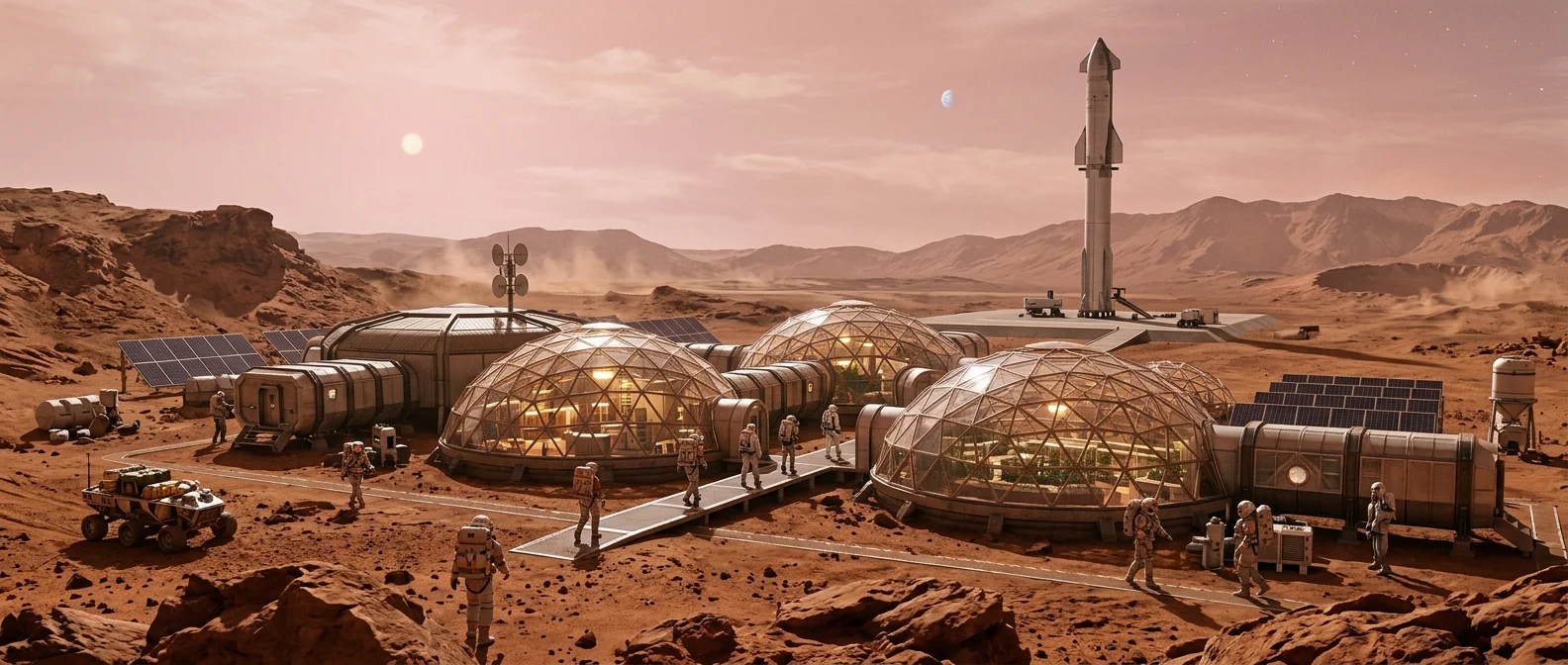
However, an intermediate solution is gaining ground: creating enclosed greenhouses (paraterraforming). Instead of changing the planet, you build large domes with artificial atmospheres. Inside, you grow plants, maintain temperature, and gradually establish small ecosystems. The technology already exists — it just needs scale.
Mars won't become a second Earth anytime soon. What will happen, though, within the next two decades, is the first permanent human presence on another planet. And that, by itself, changes everything.