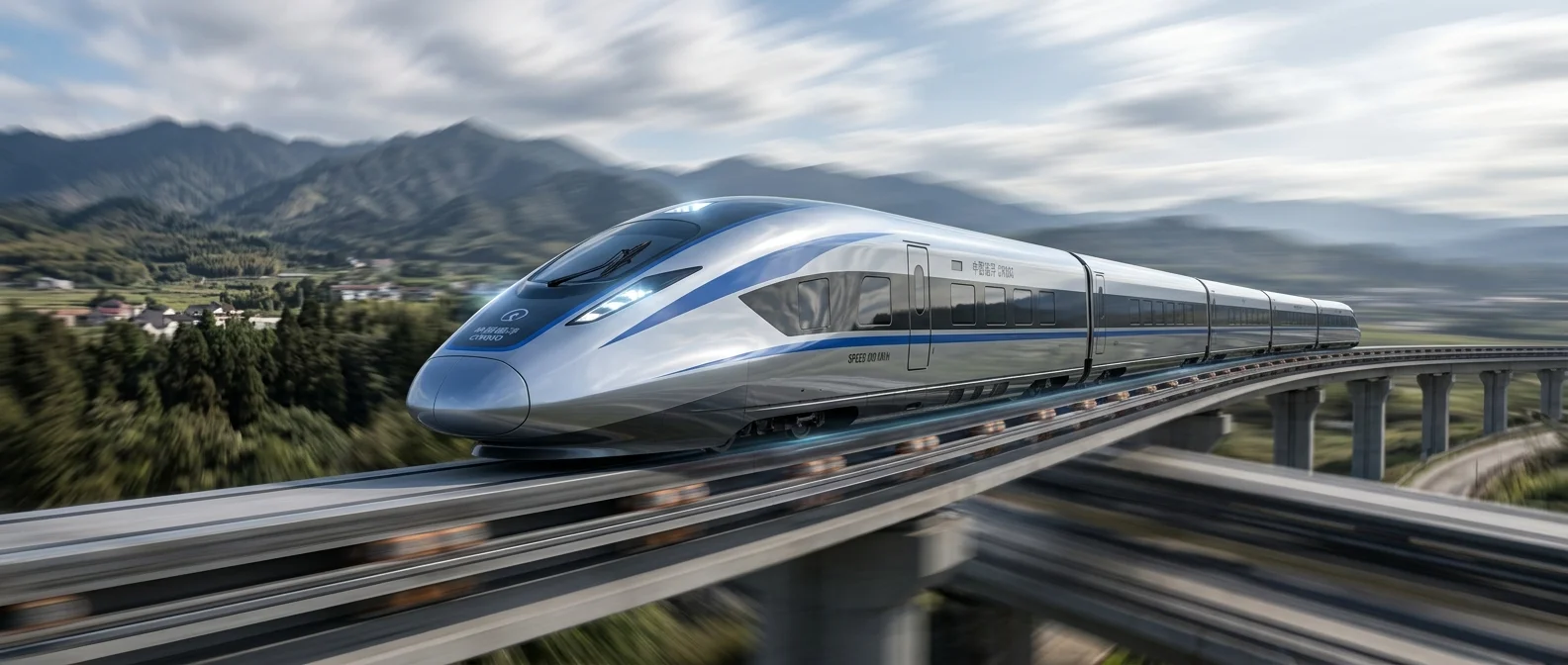
In July 2021, China's CRRC unveiled a train in Qingdao designed for 600 km/h. It doesn't touch the rails. It doesn't need wheels at high speed. It floats above its guideway through magnetic levitation. Two years later, China broke its record at 623 km/h — and by late 2025 reached 800 km/h in an uncrewed test.
📖 Read more: Magnetic Levitation Cargo: Freight Pipelines
What Is Maglev
"Maglev" comes from magnetic levitation. Instead of rolling on tracks with wheels, the train levitates using electromagnets, completely eliminating rolling friction. This means less wear, less noise, and theoretically much higher speeds. In practice, the main resistance comes from air, not the ground.
There are two main technologies. EMS (electromagnetic suspension) uses electromagnets that attract the train toward a steel guideway, while EDS (electrodynamic suspension) relies on superconducting magnets creating repulsive forces. China's CRRC 600 uses EMS based on Transrapid technology, while Japan's SCMaglev uses EDS with superconducting magnets cooled to -269°C.
China's Vision: From Shanghai to CRRC 600
China is the only country operating a commercial high-speed maglev line. The Shanghai Maglev, connecting Pudong Airport with the Longyang Road station, covers 30.5 kilometers in just 8 minutes. Operating since 2004 on German Transrapid technology (Siemens/ThyssenKrupp), it recorded 501 km/h in testing and maintains reliability above 99.97%.
The next step was enormous. CRRC began developing a complete system designed for 600 km/h. The prototype was tested in June 2020 and officially presented in July 2021 in Qingdao as “the world's fastest ground vehicle,” according to Reuters. In parallel, Southwest Jiaotong University in Chengdu developed a second, incompatible prototype — the Super Bullet Maglev — using high-temperature superconducting magnets, designed for 620 km/h.
By late 2025, China's experimental ZMB vehicle reached 800 km/h in 5.3 seconds in an uncrewed test, surpassing every previous record. The test proved the technology works — the challenge is building tracks long enough to use it.
📖 Read more: Smart Highways That Charge EVs While Driving
Japan's Chūō Shinkansen
Japan follows a different path. JR Central's Chūō Shinkansen has been under construction since 2014 and will connect Tokyo to Nagoya (286 km) in just 40 minutes, at an operating speed of 505 km/h. A future extension to Osaka will cover 438 km in 67 minutes.
The L0 Series train holds the world speed record for a crewed train: 603 km/h, achieved on April 21, 2015 at the Yamanashi test track (42.8 km), according to The Guardian. The project costs over 9 trillion yen (approximately €75 billion), with 90% of the route in tunnels. Opening has been delayed due to disputes with Shizuoka Prefecture over water supply issues and is now expected no earlier than 2035.
Critical difference: China's EMS (electromagnetic attraction) levitates at standstill without needing wheels, but requires continuous electronic adjustment of the gap (~15 mm). Japan's EDS (electrodynamic suspension) offers a larger gap and passive stability, but needs wheels at low speeds and superconducting magnets cooled with liquid helium (-269°C).
📖 Read more: Supersonic Planes: Athens-New York in 2 Hours
Why Don't We Have 600 km/h Lines Yet?
After over a century of research, there are only 7 operational maglev lines worldwide: 4 in China, 2 in South Korea, 1 in Japan. None operates commercially above 500 km/h. Cost is the fundamental reason.
The Shanghai line cost $1.2 billion for just 30 km. The Chūō Shinkansen is estimated at over €75 billion for 286 km. Maglev lines cannot use existing railway infrastructure — they require specialized guideways from start to finish. By contrast, conventional high-speed trains like the TGV can run on existing tracks at reduced speeds.
Moreover, at high speeds aerodynamic drag increases with the square of velocity — going from 300 to 400 km/h requires 2.37 times the power. The Chūō Shinkansen, running almost entirely in tunnels, will face even greater air resistance due to the confined space.
European Horizons
It's not just Asia. Polish startup Nevomo developed the MagRail system, which modifies existing railway lines into a hybrid maglev. Testing began in 2023 on a 700-meter track in Poland, targeting speeds up to 300 km/h with significantly lower infrastructure costs. This approach could be Europe's entry point, where the dense railway network makes building standalone maglev lines economically challenging.
In Germany, Max Bögl developed the Transport System Bögl (TSB), a low-to-medium speed maglev (up to 150 km/h) for urban applications and airport shuttles. Tests on a track in Chengdu, China reached 169 km/h in February 2021.
📖 Read more: Underwater Tunnels: Athens to Rome Under the Sea
Advantages and Disadvantages
Maglev trains offer clear advantages: zero rolling friction, minimal guideway maintenance, lower noise than conventional trains, better acceleration, and the ability to climb steeper gradients (up to 4% for SCMaglev, versus 3% for conventional Shinkansen). Additionally, the systems are fully electric, facilitating transition to clean energy sources.
On the other hand, disadvantages are serious. Construction costs are enormous. There is no compatibility with existing rails. And at high speeds, energy consumption increases dramatically due to aerodynamic drag — a 2018 study shows the L0 Series consumes 90-100 Wh/seat-km, versus 70 Wh/seat-km for the N700 Shinkansen.
The Future: 600 km/h or Not Yet?
We know 600 km/h trains work — China just proved it. The real question is whether anyone will pay for them. For distances up to 800 km, maglev could compete with aircraft — without security checks, without taxiing delays, without dependence on weather conditions.
China seems set on building the first commercial 600 km/h line, with a high-speed test track already in development. With conventional fast rail, Beijing-Shanghai (1,300 km) takes about 4.5 hours. With 600 km/h maglev, it would drop to under 2.5 hours — faster than flying when transfer times and check-in are included.