📖 Read more: iatriki-2225
What Is Cultured Meat?
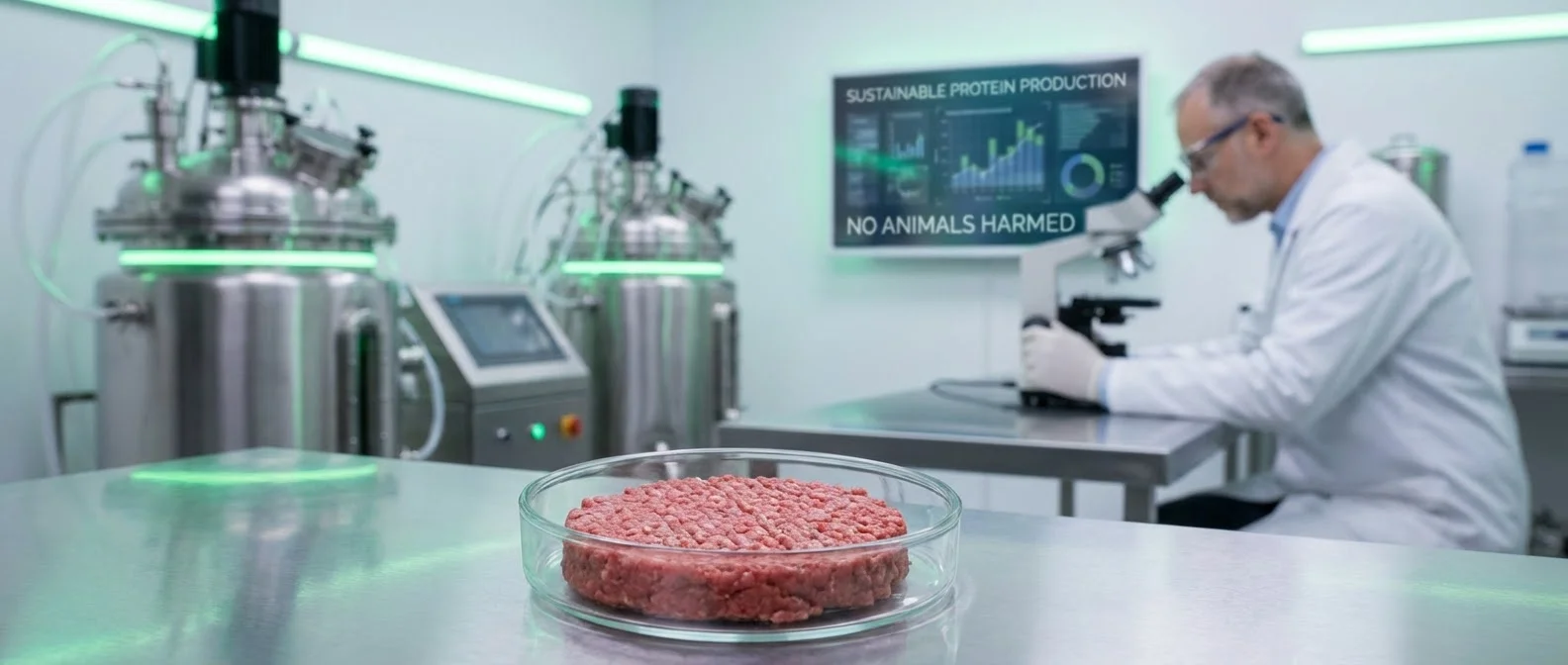
Cultured meat — also known as cultivated or cell-based meat — is real animal meat produced outside an animal through cell cultivation. The process begins with extracting cells (muscle or stem cells) from an animal sample, without harming the animal. These cells are placed in bioreactors — tanks similar to those used in breweries — where they're fed a nutrient-rich growth medium containing proteins, amino acids, vitamins, and minerals.
The cells multiply exponentially, forming muscle fibers and adipose tissue — the exact same structural components of conventional meat. Tissue engineering techniques, originally developed for regenerative medicine, are now being applied to create food products.
🧬 The Process in 5 Steps
- Cell collection: Biopsy from a living animal — painless, only needed once
- Cell lines: Selection and multiplication in cell banks
- Growth medium: Cultivation in nutrient solution with amino acids, glucose, growth factors
- Bioreactor: Mass production in a controlled, sterile environment
- Structuring: Scaffolds or 3D bioprinting to create form (burger, filet, sausage)
Historical Journey: From Vision to Plate
"We shall escape the absurdity of growing a whole chicken to eat the breast or wing, by growing these parts separately under a suitable medium."
— Winston Churchill, 1931The idea of growing meat without animals isn't new. Churchill predicted it nearly a century ago. In the decades that followed, Dutch researcher Willem van Eelen — a former prisoner of war who suffered from starvation — dedicated his life to this concept, filing a worldwide patent in 1999. NASA began cultivating turkey and goldfish meat in 2001 for astronauts, and Jason Matheny founded New Harvest in 2004, the world's first organization dedicated to cellular agriculture research.
Pioneer Companies
The cultured meat industry is developing across three main hubs: Silicon Valley, the Netherlands, and Israel. According to an Oghma Partners report (2023), the top 5 companies absorbed 46.9% of all investment — over £2.6 billion.
🥩 Upside Foods
Formerly Memphis Meats (USA). Chicken. 21.5% of all investment. FDA/USDA approval 2023. First to complete pre-market consultation in the US.
🐄 Mosa Meat
Netherlands, founded by Mark Post. Beef. Crowdfunded €1.5M in 24 minutes (2025). Regulatory applications in EU, Switzerland, UK.
🇮🇱 Aleph Farms
Israel. Beef steak. First cultured meat grown on ISS (2019). Regulatory approval for cultured beef in Israel (January 2024).
🍗 GOOD Meat (Eat Just)
USA/Singapore. Chicken. First commercial sale of cultured meat worldwide (December 2020). Serum-free media approval 2023.
🐟 Wildtype
USA. Coho salmon. FDA approval May 2025 — first cultured seafood company on the US market.
📖 Read more: Megastructures: Constructions of Type II Civilizations
🇳🇱 Meatable
Netherlands. Pork. Pluripotent stem cell technology. First public cultured meat tasting in the EU (April 2024). Sausage.
Environmental Footprint: The Numbers
Livestock farming accounts for an enormous environmental cost: 14.5% of global greenhouse gas emissions, 70% of Amazon deforestation, and massive water and land consumption. The CE Delft study reveals the potential of cultured meat:
| Parameter | Conventional Beef | Cultured Meat | Reduction |
|---|---|---|---|
| CO₂ Emissions | 1,900-2,240 kg/ton | ~160 kg/ton | Up to 92% |
| Land Use | 190-230 m²/ton | ~10 m²/ton | Up to 95% |
| Water Consumption | 367-521 m³/ton | ~82 m³/ton | Up to 78% |
| Pollution | High (manure, antibiotics) | Minimal | Up to 93% |
| Antibiotics | 73% of global use | 0% | 100% |
According to the WHO, antimicrobial resistance — primarily driven by antibiotic use in livestock farming — threatens to cause up to 10 million deaths annually by 2050. Cultured meat, produced in a sterile environment, completely eliminates this need.
The Great Obstacle: Production Cost
The dramatic cost reduction remains the greatest challenge. From $325,000 in 2013, the price has dropped but remains non-competitive:
💰 Cost Trajectory
2013: $325,000 per burger (Mark Post, Maastricht) | 2015: €8 per burger (same team) | 2018: $1,700 per pound (Memphis Meats) | 2019: ~$50 per chicken nugget (Eat Just) | 2021: $100+ per serving (industry average) | Target: $63/kg — but wholesale beef costs ~$6/kg
The main cost drivers are the growth medium at $19.7/kg, labor at $17.7/kg, and bioreactor maintenance at $5.47/kg. Critically, fetal bovine serum (FBS), the traditional nutrient medium, costs ~$1,000/liter. Replacing it with plant-based alternatives or recombinant proteins is a crucial goal.
🔬 Technological Solutions to Cost
- Serum-free media: GOOD Meat achieved SFA (Singapore) approval in 2023 without FBS — a milestone
- Autonomous factor production: 2024 study (Cell Reports Sustainability) — bovine cell lines that produce their own growth factors
- Future Fields (Canada): Growth factors from fruit flies — radical cost reduction
- Magnetic fields (Singapore 2022): Cell stimulation without expensive serums
- Spontaneous immortalization (November 2025): Bovine cells that immortalize after 500 days without genetic modification
Regulatory Landscape: A Global Conflict
The regulatory reality differs dramatically by country. While some are opening doors, others are erecting barriers:
| Country/Region | Status | Details |
|---|---|---|
| Singapore | ✅ Approved | First country (2020). Eat Just, Vow, Meatable |
| USA | ✅ Approved | FDA+USDA joint oversight. Upside Foods, GOOD Meat (2023), Wildtype (2025) |
| Israel | ✅ Approved | Aleph Farms cultured beef (January 2024) |
| Australia | ✅ Approved | Vow cultured quail (April 2025) |
| United Kingdom | 🔄 In progress | Meatly pet food (2024). Mosa Meat application (2025) |
| EU | 🔄 In progress | EFSA applications: Gourmey (2024), Mosa Meat (2025). Long 18+ month process |
| Italy | ❌ Banned | November 2023 law — production and sale prohibited |
| Florida/Alabama | ❌ Banned | State laws 2024. Upside Foods filed lawsuit |
📖 Read more: mRNA Vaccines Against Cancer: The Great Promise
Health and Nutrition
Beyond the environmental dimension, cultured meat offers significant health advantages:
🦠 Zero Antibiotics
Produced in a sterile environment. Eliminates the risk of antibiotic resistance, which the WHO calls “a serious threat to global public health.”
🐄 No Hormones
No artificial growth hormones or steroids needed — unlike industrial livestock farming.
🐔 Zero Pandemics
Closed, controlled system: eliminates risk of zoonotic diseases (avian flu, salmonella, E. coli). Reduced pandemic risk.
🧬 Enhanced Nutrition
Ability to add omega-3 fatty acids. Spanish research is developing cultured meat with healthier fats, reducing cholesterol and colon cancer risk.
Global Impact: A Planetary Transformation
Cultured meat could reshape entire economies. With global population hitting 10 billion by 2050 and meat demand doubling, conventional farming can't keep up. Small island nations and developing countries face particular pressure from climate change destroying grazing lands, while urbanization eliminates agricultural space. Cultured meat can be produced in urban factories, regardless of weather or available farmland.
The economics are staggering. The traditional meat industry employs hundreds of millions globally. Companies like Cellular Agriculture Ltd (founded by Welsh farmer Illtud Dunsford) are exploring how farmers can transition into this new paradigm — growing crops for feedstock, raising animals for genetic material, or producing cultured meat in farm-level bioreactors.
The Future Through 2035
Analysts predict the cultured meat market will exceed $25 billion by 2030, with rapid growth particularly in Asia. Technological maturation, combined with climate pressures, will accelerate the transition. However, this isn't about replacement — it's about complementing. As Meatable's CTO stated, “the traditional meat industry will not be replaced any time soon.”
The goal isn't ending animal farming — it's creating options where meat doesn't require slaughter or massive environmental damage.