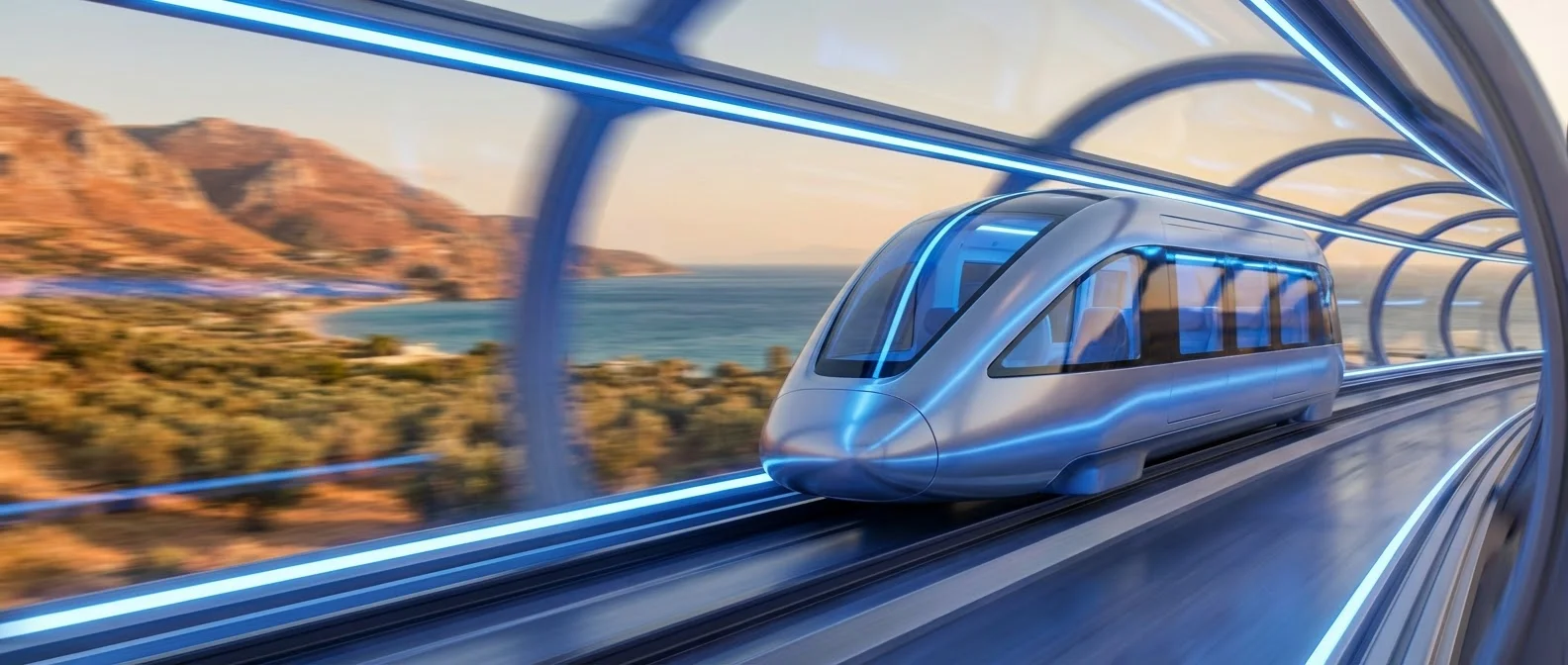
Athens to Thessaloniki in 30 minutes. No airplane, no highway, no delays. Inside a magnetically levitating capsule racing through a low-pressure tube at over 1,000 km/h. That's the promise of Hyperloop — the technology Elon Musk envisioned in 2013, now being tested on tracks across three continents. But how close are we really?
📖 Read more: Maglev 600km/h: The Flying Trains of China
What Is Hyperloop?
Hyperloop is a proposed high-speed transportation system where capsules (pods) travel inside low-pressure tubes. It uses linear electric motors for acceleration and magnetic levitation or air bearings to eliminate friction. Partial air evacuation inside the tube (approximately 100 Pascal, compared to 101,325 Pa at sea level) dramatically reduces air resistance, theoretically enabling speeds approaching — or exceeding — those of aircraft.
🔧 How It Works
- Low-pressure tubes: Steel or aluminum tubes with pressure reduced to ~100 Pa — like the atmosphere at 60 km altitude
- Magnetic levitation: Pods hover above the track, completely eliminating mechanical friction
- Linear motors: Electromagnets along the route accelerate and decelerate each pod
- Autonomy: Fully autonomous operation with no human driver
- Electric power: Capable of running on solar and wind energy
Evolution Timeline
“The Hyperloop is a cross between a Concorde, a railgun, and an air hockey table.”
Who's Building Hyperloop Today?
After the closure of Virgin Hyperloop (formerly Hyperloop One) in December 2023, the technology didn't die — it migrated to newer companies. In December 2022, the Hyperloop Association was founded, an alliance of leading companies in the field, aiming to create regulatory frameworks and technical standards.
🇨🇭 Swisspod (Switzerland)
Building the world's largest test track in Pueblo, Colorado (520m). Tested the AERYS 1 in November 2025 and plans expansion to a 1-mile closed loop covering 43 acres.
🇳🇱 Hardt Hyperloop (Netherlands)
Demonstrated a lane switch without moving parts in Delft (2019). Participates in the European Hyperloop Center in Groningen — a 420m track with €30 million budget.
🇺🇸 HyperloopTT (USA)
Hyperloop Transportation Technologies — signed agreements with governments of India, Slovakia, and Czech Republic. Subsidiary in Italy (Hyperloop Italia). Active since 2013.
🇪🇸 Zeleros (Spain)
Spanish startup from Valencia, member of the Hyperloop Association. Focuses on a pressurized pod design that reduces infrastructure costs.
🇨🇦 TransPod (Canada)
Planning an Edmonton-Calgary line in Canada. Secured $550 million in funding. Maintains presence in France as well.
🇩🇪 TUM Hyperloop (Germany)
From the Technical University of Munich. Holds the speed record (463 km/h). Building a 24m full-scale demonstrator in Ottobrunn, certified by TÜV SÜD.
The Ideal Distance
Routes of 300–1,500 km are the hyperloop sweet spot — too long for efficient car travel but too short for air travel to be truly convenient (when you factor in airport time). Athens-Thessaloniki fits perfectly at ~500 km. Similar routes worldwide have been the subject of feasibility studies: Mumbai-Pune (150 km in 20 minutes), Helsinki-Stockholm (500 km with an undersea tunnel in 30 minutes), Toronto-Montreal (540 km in 39 minutes), and Dallas-Houston (380 km).
Challenges and Criticism
Despite the enthusiasm, Hyperloop faces serious technical and economic challenges. Criticism intensified after the closure of Hyperloop One — the most prominent company in the space — which had raised over $485 million without ever building a commercial line.
📊 Transport Mode Comparison
- Airplane: ~900 km/h, but 2+ hours airport time, high CO₂ emissions
- High-speed rail: ~300 km/h, proven technology, high capacity
- Maglev (Japan): 603 km/h record (2015), Tokyo-Nagoya line under construction
- Hyperloop: 1,000+ km/h theoretical, zero emissions, but still experimental
Global Impact
The hyperloop landscape is increasingly shaped by European leadership. The European Hyperloop Center in Groningen, Netherlands, is a €30 million public-private partnership with a 420-meter test facility including a lane switch. CENELEC released the first technical standard for hyperloop systems in January 2023, giving the technology a regulatory foundation that doesn't exist elsewhere.
In the US, despite Hyperloop One's collapse, Swisspod is building the world's largest test track in Pueblo, Colorado, and tested its AERYS 1 vehicle in November 2025 reaching 102 km/h. The closed-loop system will eventually span one mile across 43 acres. Meanwhile, South Korea shelved its Seoul-Busan hyperloop project in early 2024 due to economic viability concerns, but launched a maglev propulsion research program in April 2025.
The Hyperloop Association — formed in December 2022 by Hardt, HTT, Nevomo, Swisspod, TransPod, and Zeleros — is working to create unified regulatory frameworks. TransPod secured $550 million for an Edmonton-Calgary line, while India continues to explore the Mumbai-Pune corridor. The technology may be progressing slower than promised, but it's far from dead.
"Europe can become the world's first commercial hyperloop hub. European standards and public-private cooperation give us an advantage no one else has."
The Future
After high-profile failures (Hyperloop One, Seoul-Busan), hyperloop is entering a phase of "realism": less hype, more engineering. Swisspod is building the world's largest track, Hardt and EuroTube in Europe are approaching scale testing, and CENELEC standards provide a regulatory foundation.
The first commercial line isn't expected before the 2030–2040 decade. But if the technology proves viable, connections like New York–Washington, Paris–Berlin, or any 500 km city pair could be transformed. The idea may seem utopian today, but 20 years ago the same was true of electric cars.
🌍 Proposed Hyperloop Routes Worldwide
- Helsinki – Stockholm: 500 km, undersea tunnel under the Baltic
- Mumbai – Pune: 150 km, 20 minutes instead of 3 hours
- Toronto – Montreal: 540 km, 39 minutes
- Edmonton – Calgary: 300 km, TransPod, $550 million
- Amsterdam – Frankfurt: Hardt Hyperloop proposal
- Riyadh – Jeddah: Saudi Arabia, feasibility study 2020