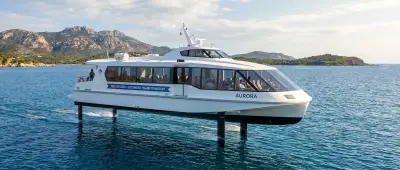
Imagine a vessel that doesn't cut through the waves but flies above them. No noise, no exhaust fumes, no seasickness. This isn't sci-fi — it's the reality of 2026. Electric hydrofoils are radically transforming maritime transport, reducing energy consumption by up to 80% compared to conventional boats.
📖 Read more: Maglev 600km/h: The Flying Trains of China
🌊 What Is a Hydrofoil and How Does It Work?
A hydrofoil is essentially a wing beneath the water. It works on the same principle that keeps an airplane in the air — as the vessel accelerates, underwater wings generate lift that raises the entire hull above the water's surface.
“Literally, they are wings under water,” explains Laura Marimon Giovannetti, a researcher at Sweden's Rise institute. "When you suddenly rise up, it becomes completely silent. The sound changes entirely. If you hear anything, it's a whistling that comes only from the foils moving fast through the water."
"Nobody had done anything serious about electrifying boats. I started researching what could be done." — Gustav Hasselskog, founder of Candela
The idea isn't new. French inventor Emmanuel Denis Farcot filed the first hydrofoil patent in 1869. In the early 20th century, Italian Enrico Forlanini tested a working hydrofoil on Lake Maggiore, while Alexander Graham Bell — yes, the man who invented the telephone — developed the HD-4, which shattered the world water speed record at 113 km/h.
⚡ The Candela Revolution: Ferries That “Fly”
In 2014, Swedish engineer Gustav Hasselskog realized something shocking: his old boat consumed 15 times more fuel per kilometer than his car. At the time, electric cars were about to take off worldwide. Why not boats too?
He founded Candela with a single mission: to build electric boats that combine high speed with long range. The problem? Batteries contain far less energy per kilogram than fossil fuels. The solution? Hydrofoils. By lifting the hull out of the water, drag is dramatically reduced and energy consumption drops by up to 80%.
In October 2024, the Candela P-12 made history: it became the world's first electric hydrofoil ferry to begin commercial service in Stockholm. The ferry seats 30 passengers, cruises at up to 30 knots, and cuts travel time in half.
Why Is It Better Than a Conventional Ferry?
- Zero emissions: 100% electric, no exhaust fumes
- No seasickness: The vessel doesn't bob up and down with the waves
- Silent: Minimal noise compared to diesel engines
- Low wake: Doesn't erode shorelines and harbors
- Faster: Cuts travel time in half
🌍 Global Expansion: From Stockholm to the Maldives
Candela isn't staying in Scandinavia. The “flying ferries” are spreading around the world at a remarkable pace. The technology has proven it can operate in diverse conditions — from the cold waters of the Baltic to tropical oceans.
11 ferries sold to JalVimana. They'll cut the trip to the airport from 1 hour 45 minutes to just 30 minutes. Expected to launch in 2026.
10 P-12 ferries will serve the pristine island of Koh Kood, one of the most unspoiled in the country.
14 ferries for transfers between Malé Airport and luxury resorts. Silent, fast, without harming the coral reefs.
8 hydrofoils for the Red Sea, as part of the futuristic linear city “The Line.”
4 ferries for the famous lake, where environmental protection is a top priority.
In the U.S., Kitsap County near Seattle is developing a prototype 150-seat hydrofoil ferry. It has received $5.2 million from the state of Washington for design and construction. The trip will take 30 minutes instead of 1 hour on conventional ferries.
🏆 Historic Achievement: Electric Boat Crosses the Mediterranean
In May 2025, a Swedish team made history: they crossed the Mediterranean in an electric boat — a flying one at that. The journey from Europe to Africa proved that electric vessels aren't just for lakes and calm harbors. They're ready for the open sea.
Meanwhile, China's CATL — the world's largest battery manufacturer — predicts that within three years, fully electric vessels will be able to cross oceans. If that sounds bold, consider that a decade ago nobody believed electric cars would dominate the roads.
📖 Read more: Magnetic Levitation Cargo: Freight Pipelines
🔧 The Companies Shaping the Future
Candela may be the best known, but it's not alone. A host of companies are competing to bring electric hydrofoils into everyday life. Just as happened with electric cars, competition drives innovation and lower prices.
🇸🇪 Candela
Sweden
The pioneer. P-12 ferry (30 seats), C-8 leisure boat. Over 50 vessels sold worldwide.
🇳🇿 Vessev
New Zealand
The VS-9 launched commercial service with Fullers360. Expanding to the U.S.
🇺🇸 Navier
USA
The N30 boasts “the longest range in the world” for an electric hydrofoil.
🇺🇸 Arc Boats
USA
Arc Sport with 500 HP. Developing an electric tugboat for the Port of Los Angeles.
🇸🇪 X Shore
Sweden
Largest order ever: 32 electric boats for M Yachts.
🇫🇮 Foil.One
Finland
Pegasus: a single-seat hydrofoil with stunning design.
⚠️ The Limits of the Technology
Hydrofoils aren't the solution for everything. There are limitations that need to be addressed. First, range: today's vessels can travel about 40 nautical miles before needing a recharge, which takes roughly one hour.
Second, size: to maintain their speed and efficiency advantage, hydrofoils need to stay relatively small and lightweight. You can't lift a cruise ship with wings! Third, there's the risk of collision with submerged objects — tree trunks, marine animals. Modern versions feature sensors that detect obstacles.
Despite the limitations, the technology is evolving rapidly — just as we've seen with artificial intelligence systems that improve exponentially. Each new generation of batteries brings greater range and shorter charging times.
💰 The Economic Argument
Beyond the environment, hydrofoils make economic sense too. Candela estimates that a city like Stockholm would save 40% on maritime transport operating costs by replacing conventional ferries with hydrofoils.
"You can go to private operators and convince them, from a financial standpoint, that this is the right thing to do," says Hasselskog. “You can save money.” That was the key argument for Stockholm and other cities exploring the technology.
In Stockholm, the route tested was 12 miles (20 km) from Ekerö to City Hall. The traditional ferry holds 250 people and takes 55 minutes. Three Candela P-12 units (30 passengers each) make the trip in under 30 minutes, and with 23 daily runs instead of 9, they can carry 15% more passengers.
🌊 The Takeaway
Electric hydrofoils aren't just a cool gadget for tech enthusiasts. They're a real solution to maritime transport emissions, which account for roughly 3% of global pollution. From Stockholm to Mumbai, from the Maldives to Seattle, “flying ferries” are proving that we can travel faster, more comfortably, and cleaner.
The future of maritime transport doesn't cut through the waves — it flies above them. And that future is already here.
Read also: If you're interested in future technology, check out solid-state batteries that will transform electric cars and the robots set to dominate industry.
Back to Future