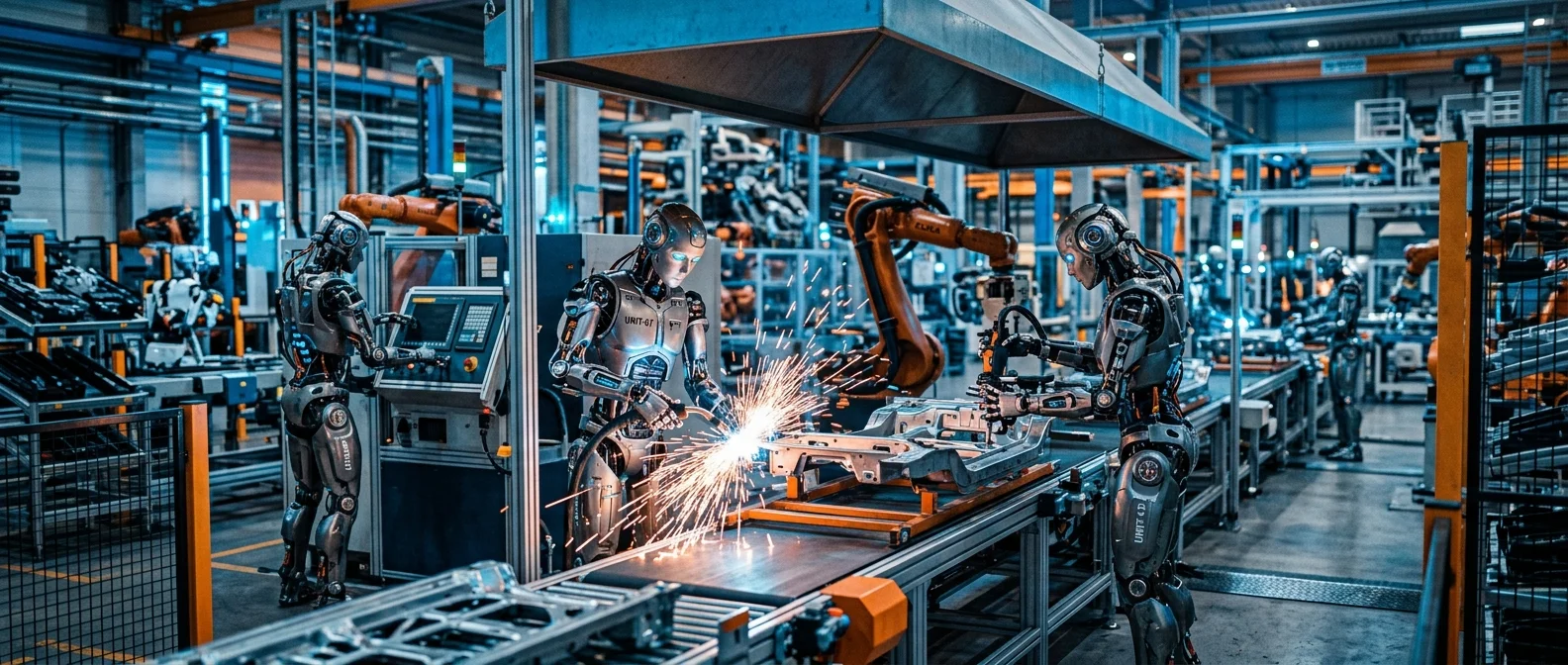
Humanoid robots are no longer science fiction. Companies like Tesla, Figure AI, and Agility Robotics are already deploying human-shaped robots in factories and warehouses. By 2030, they're expected to fundamentally reshape industrial manufacturing.
📖 Read more: Work 2040: How We'll Work in the Future
The New Generation of Humanoid Robots
The period of 2025-2026 marks a turning point in robotics. For decades, industrial robots were stationary arms on production lines — highly effective but limited to a single task. Humanoid robots bring something entirely different: a body designed for spaces built for humans, capable of adapting to multiple tasks without redesigning the factory floor.
The logic is straightforward. Factories, warehouses, and logistics centers were designed for human bodies: stairs, doors, shelves at arm height, tools with handles. A robot with a human form can enter these spaces without any infrastructure modification — that's the fundamental advantage over traditional industrial automation.
Tesla Optimus — Musk's Biggest Bet
Elon Musk unveiled Tesla Optimus (formerly Tesla Bot) in 2021, and its evolution has accelerated beyond initial projections. Optimus Gen 2, showcased in late 2024, can walk smoothly, manipulate objects with precision, and execute repetitive tasks in Tesla's own factories.
Tesla's strategy is unique: it uses its own manufacturing facilities as a testing ground. Optimus units are already being trialed on battery production lines, performing tasks traditionally done by workers — transporting components, placing battery cells, sorting parts. Musk has stated that Optimus will be Tesla's most profitable product, targeting a price below $20,000 at mass production scale.
"I think Optimus will be worth more than the rest of Tesla combined. It will completely transform the economics of labor."
— Elon Musk, Tesla Shareholder Meeting 2024📖 Read more: Working in the Metaverse: VR Offices & Digital Meetings
Figure AI — The Rise of Helix
Figure AI was founded in just 2022 and is already at the forefront. The company has secured over $750 million in funding from investors including Microsoft, NVIDIA, Jeff Bezos, and Intel. Figure 03, their latest generation, is designed as a “general purpose humanoid robot” — initially targeted at factories but now pivoting toward household applications as well.
Figure's secret weapon is Helix AI — an artificial intelligence platform that enables the robot to navigate unpredictable, ever-changing environments. Unlike traditional industrial robots that follow strictly programmed paths, Figure 03 can “understand” its surroundings and adapt in real time. This lets the robots work in unpredictable settings where traditional automation fails.
Agility Digit — First to Deploy
Agility Robotics, founded over a decade ago, currently has the most real-world deployment experience. Digit is the first humanoid robot in actual commercial production deployment — not demos or prototypes, but operational robots in real warehouses performing real work.
In February 2026, Agility announced a commercial agreement with Toyota Motor Manufacturing Canada to deploy Digit robots in automotive plants. Earlier, in December 2025, Mercado Libre — Latin America's largest digital retailer — signed a deployment agreement for Digit in its logistics centers.
Notably, Digit is assembled in Salem, Oregon, with over 80% of its nearly 6,000 parts sourced from the United States. The Arc cloud platform manages fleets of Digit robots, providing real-time monitoring and over-the-air updates. As Agility puts it: “No vaporware. No hype. Just technology that works.”
Safety First: Agility's safety-first approach focuses on augmenting human workers rather than eliminating jobs. Ten years in robotics has taught them what actually works in warehouses versus what looks good in demos.
📖 Read more: Universal Basic Income: The Solution in the AI Era?
The Global Competition
Beyond American companies, China is investing massively. Unitree has unveiled the H1 — a humanoid with impressive agility and low cost. UBTECH is developing robots for healthcare and education. The Chinese government has designated humanoid robots as a national strategic priority, targeting mass production by 2027.
Boston Dynamics (owned by Hyundai) continues advancing its fully electric Atlas. 1X Technologies in Norway is targeting humanoids for eldercare and services. Japan's robotics giants are playing catch-up. Honda killed ASIMO, and startups are racing to match American and Chinese competitors.
What Does This Mean for Workers?
The question that concerns many: will humanoid robots replace workers? The reality depends on timing and economics. In the short term (2025-2028), humanoid robots will take on the most dangerous, tedious, and physically demanding tasks — precisely those facing chronic staffing shortages.
In the US, manufacturing faces a shortage of millions of warehouse and factory workers. In Japan and South Korea, aging populations create enormous workforce gaps. Humanoid robots aren't replacing anyone — they're filling positions nobody wants or can fill. Long term, however, the picture becomes more uncertain. Once robots hit the right price point, companies will deploy them far beyond dangerous or repetitive jobs. Society must prepare with retraining programs, regulatory frameworks, and serious public dialogue.