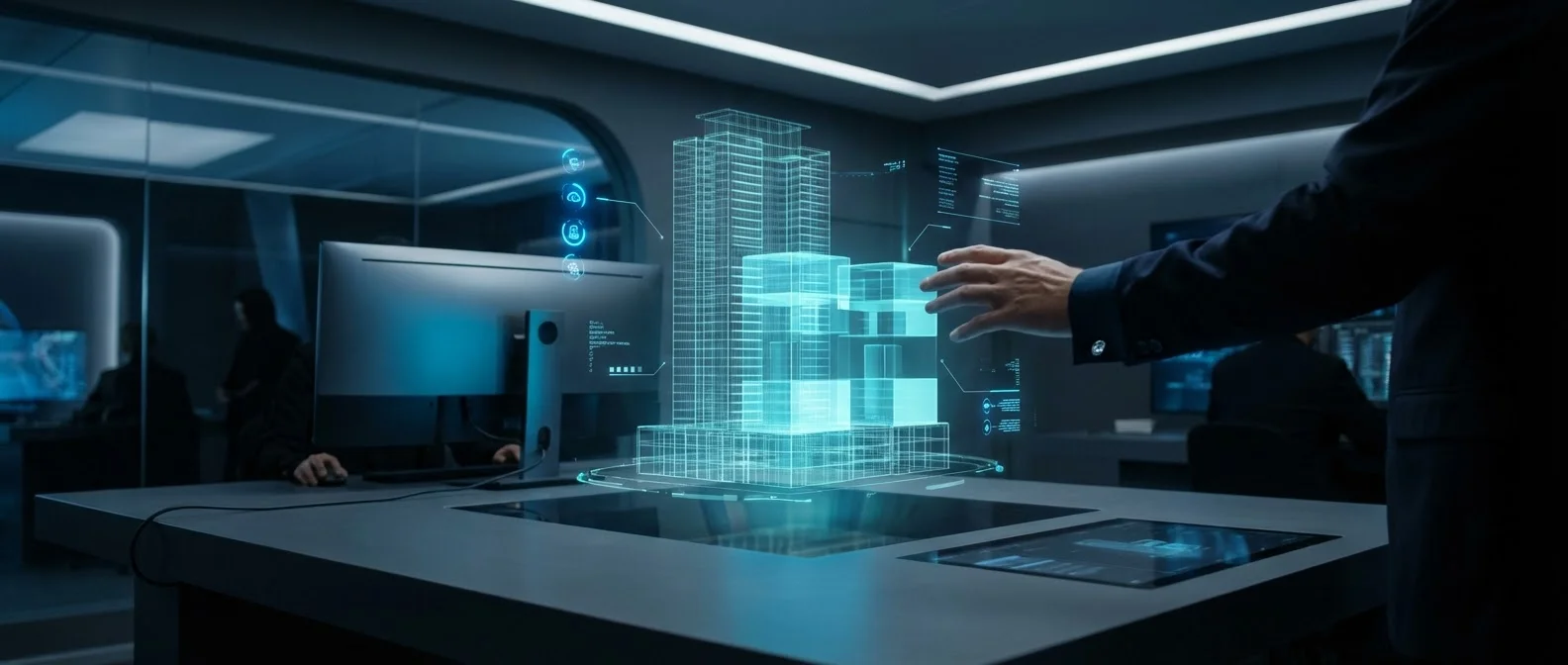
The image of Princess Leia projected in three dimensions from R2-D2 in Star Wars (1977) became one of the most recognizable scenes in cinema history. Nearly half a century later, holograms no longer belong exclusively to science fiction — they're gradually becoming reality. From telepresence and medical education to live concerts and automotive displays, holographic technology is already changing how we see, learn, and communicate.
📖 Read more: octopus-cloaking-technology
What Are Holograms?
The word “hologram” comes from the Greek words ὅλος (holos, “whole”) and γραφή (graphē, “writing”). Unlike a simple photograph, which records only the intensity of light, a hologram records both the intensity and the phase of light waves. This means it can represent an object in full three dimensions — with depth, parallax, and perspective that change as the viewer moves.
The underlying principle is interference between two light beams: a reference beam and an object beam that reflects/scatters off the subject. The interference pattern is recorded on special photosensitive material. When later illuminated with appropriate light, the pattern diffracts the rays to recreate the original light field.
History of Holography
Types of Holographic Displays
| Type | Mechanism | Advantages | Limitations |
|---|---|---|---|
| Classic laser holograms | Interference pattern on photosensitive film | Full depth & parallax | Static, require special lighting |
| Volumetric displays | Light points in 3D space (laser + particles) | Visible 360°, no glasses needed | Small size, low resolution |
| Light field displays | Multiple light directions simultaneously | Natural eye focus | Expensive computation, large data |
| MEMS piston displays | Thousands of micro-pistons reflecting light | High resolution, digital control | Cost, mechanical complexity |
| Pepper's Ghost | Reflection on semi-transparent screen | Simple, spectacular, low cost | Not a real hologram (2D) |
Modern Applications
🏥 Medical Education & Surgery
Holographic anatomy models allow medical students to study organs in real-size 3D without cadavers. Surgeons use holographic projections of CT/MRI scans during operations for more precise navigation. Microsoft deployed HoloLens in over 300 hospitals worldwide by 2024.
🎵 Entertainment & Concerts
Digital artist avatars appear in live concerts: Tupac at Coachella (2012), ABBA in London (2022), Kiss at Madison Square Garden (2023). Hatsune Miku, a virtual Vocaloid singer, tours as if she were real. While technically not true holograms (Pepper's Ghost), they pave the way for genuine holographic performances.
📖 Read more: Photonic AI Chip: 100x Faster Than NVIDIA
📞 Holographic Telepresence
Companies like PORTL develop “holographic teleportation” booths — the speaker is scanned in real time and appears as a life-size 3D image on the other end. MIT Media Lab experiments with fully holographic video calls, while Cisco introduced Webex Hologram in 2021.
🛡️ Security & Authentication
Security holograms are already used on banknotes (euros, dollars, pounds), credit cards, passports, and license plates. In India, since April 2019, high-security holographic license plates are mandatory and contain electronic vehicle data with unique identifiers.
Pioneering Companies
Looking Glass Factory
Consumer light field holographic displays — “Looking Glass Go” portable display 2024
Light Field Lab
SolidLight: large holographic panels/walls without glasses, $28M funding
PORTL
Full-size human holographic teleportation booths
Sony
Spatial Reality Display (2020): eye-tracking + micro-optical lens for individual users
Microsoft
HoloLens: mixed reality headset — holographic elements overlaid on the real world
Optware / Maxell
Holographic Versatile Disc: potential 3.9 TB storage on a 120mm disc
⚠️ Pepper's Ghost: The “Fake” Holography
Many spectacular “holographic” appearances — such as Tupac at Coachella (2012), ABBA avatars (2022), or Kiss avatars (2023) — actually use the Pepper's Ghost technique: a digital image is projected onto a semi-transparent screen at a 45° angle, creating a seemingly “floating” image. Despite the spectacle, the image remains two-dimensional — it has no depth or parallax. The term “fauxlography” is used for these pseudo-holographic technologies.
📖 Read more: Robotaxis: How We'll Get Around in 2035
Data Storage
Holographic data storage promises to become the next generation of storage media. Unlike Blu-ray discs that use only the surface, holographic media exploit the volume of the recording material. Optware and Maxell demonstrated a 120mm disc (Holographic Versatile Disc) with a potential capacity of 3.9 TB — 80 times more than a 50 GB Blu-ray. Write speeds can reach ~1 Gbps using SLMs (Spatial Light Modulators) producing 1,000 images per second at 1024×1024-bit resolution.
Touchable Holograms
One of the most impressive developments is touchable holograms. Japanese researchers pioneered this field, while Intel further developed the technology. They use focused ultrasound to create a tactile sensation in mid-air. Intel's demonstration featured an invisible piano that could be “played” without physically touching any surface — ideal for public spaces where hygiene is critical.
The Future of Holography
MIT researchers predicted that holographic displays would enter the mass market within a decade — a timeline that looks increasingly realistic. Artificial intelligence, 5G/6G networks, advanced lasers, and computational power are making previously impossible applications feasible:
- Holographic television in living rooms by 2035
- Remote surgery with holographic 3D view of the patient
- Educational holograms in schools — from chemistry molecules to planets
- Architectural visualization of buildings at full scale before construction
- Digital memorials of people through AI holographic avatars
Holography, more than 75 years after its invention, is finally on the threshold of everyday life. The question is no longer whether it will change the world — but how quickly.