The Color War in Hydrogen Production
At Shell's Texas facility, a massive plant cranks out 1,400 tons of hydrogen daily from natural gas. Right next door, carbon capture systems lock away 1.6 million tons of CO2 annually. This is blue hydrogen in action.
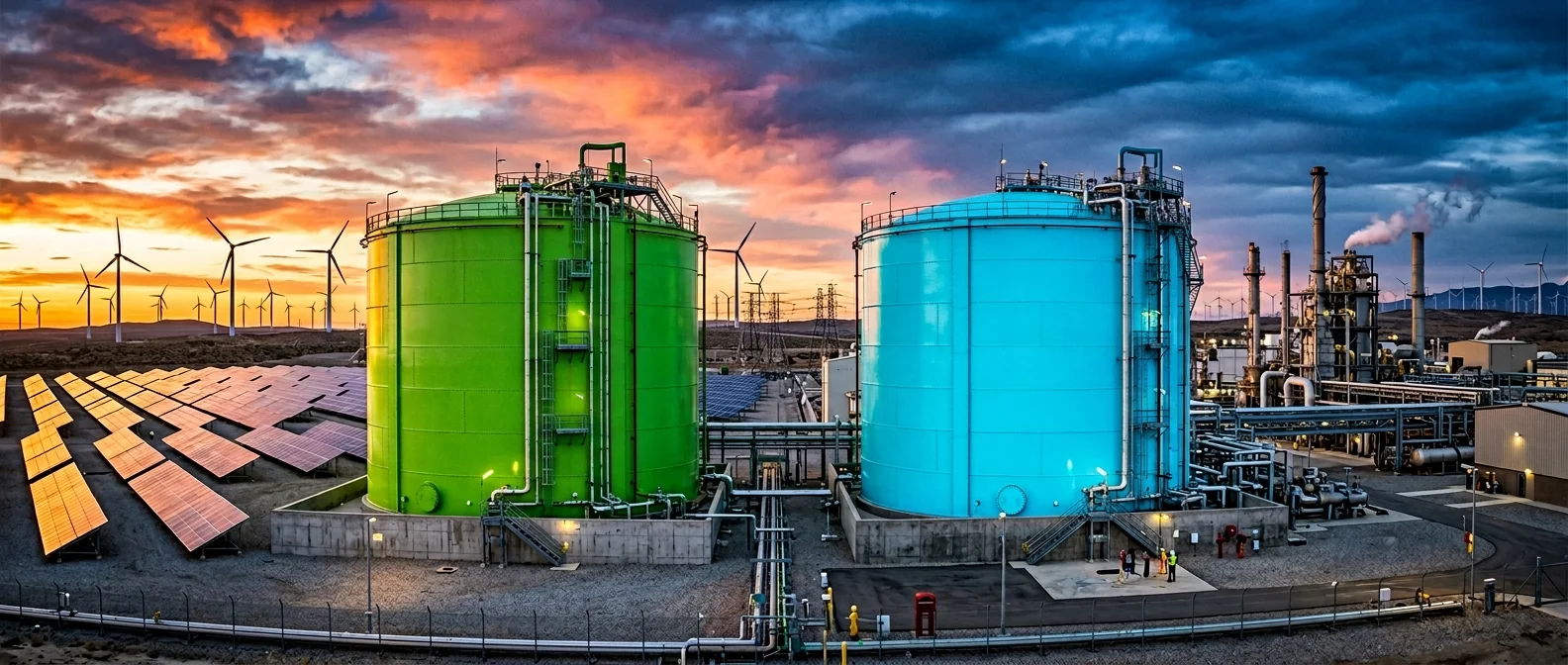
Across the Atlantic in Germany, wind farms power electrolyzers that split water into hydrogen and oxygen. Zero carbon emissions. Zero fossil fuels. This is green hydrogen. Two different philosophies, one shared mission: decarbonize the planet.
Green Hydrogen: The Clean Champion
Green hydrogen comes exclusively from renewable energy sources through electrolysis. Solar panels or wind turbines provide the juice to split water into hydrogen and oxygen. Simple in theory. Complex in practice.
According to Nature's data, green hydrogen production can cost several times more than blue. Electrolyzer technology improves rapidly, but still demands massive amounts of electricity. Every kilogram of hydrogen requires roughly 50-55 kWh of power.
Green Hydrogen Advantages
- Zero CO2 emissions
- Uses renewable sources
- Long-term sustainability
- Independence from fossil fuels
Green Hydrogen Challenges
- High production costs
- Weather dependency
- Energy storage requirements
- Limited production scale
Blue Hydrogen: The Bridge Solution
Blue hydrogen gets made from natural gas through Steam Methane Reforming (SMR), but with one crucial twist: the CO2 gets captured and stored underground instead of released into the atmosphere.
Carbon capture and storage (CCS) technology is the key. According to Nature's research, operational facilities worldwide already produce 0.7 million tons of blue hydrogen annually while capturing 10 million tons of CO2.
| Feature | Green Hydrogen | Blue Hydrogen |
|---|---|---|
| Raw material | Water + renewable energy | Natural gas + CCS |
| CO2 emissions | Zero | Low (85-95% reduction) |
| Production cost | High (several times more) | Medium (+50% vs conventional) |
| Technology maturity | Developing | Mature |
The Numbers Behind the Battle
The economics reveal a complex picture. Nature reports that production cost estimates vary by a factor of five, making it tough to hit 2030 targets. Transportation and storage costs add to the challenges.
In the US, the Inflation Reduction Act provides tax breaks that could change everything. The 45V credit offers $0.6 to $3.0 per kilogram of hydrogen, depending on lifecycle emissions. Meanwhile, the enhanced 45Q credit gives $85 per ton of CO2 stored in saline aquifers.
US Target: $1 per kg by 2030
America's Hydrogen Energy Earthshot aims to slash clean hydrogen costs to $1 per kilogram within a decade. Without tax incentives, blue hydrogen struggles to hit this target through learning-by-doing alone.
The Hidden Challenges
Both technologies face significant hurdles. Green hydrogen, while clean, can have negative environmental impacts. Nature's research points out that using renewable electricity for hydrogen production might be less efficient than directly using it to replace fossil fuels in power generation.
Blue hydrogen has its own weaknesses. Methane leaks during natural gas extraction and transport can undermine climate benefits. Plus, CCS systems aren't 100% effective - they typically capture 85-95% of emissions.
Green Hydrogen
Pros
- Fully renewable
- Zero direct emissions
- Long-term sustainability
Cons
- High costs
- Weather dependent
- Limited scale
Blue Hydrogen
Pros
- Lower costs
- Mature technology
- Large-scale production
Cons
- Fossil fuel dependency
- Methane leaks
- Partial CO2 capture
Applications and Priorities
Nature ranks hydrogen applications by competitiveness. Fuel cell cars and space heating land in the least promising categories due to rapid advances in direct electric alternatives.
Hydrogen shows real potential in industry, long-duration energy storage, and long-haul transport. Steel production, fertilizer manufacturing, and petrochemicals - which already consume 2% of global CO2 emissions - are the priorities.
High Priority
- Steel production
- Fertilizer manufacturing
- Petrochemicals
- Heavy transport
Medium Priority
- Shipping
- Energy storage
- Aviation (long-haul)
- Industrial heating
Low Priority
- Passenger cars
- Building heating
- Power generation
- Short transport
The Global Race
The US has committed $9.5 billion to clean hydrogen through the Bipartisan Infrastructure Law. In October 2023, they announced $7 billion for seven regional clean hydrogen hubs nationwide. Some hubs will use water and natural gas to produce green and blue hydrogen respectively.
America's national strategy targets 10 million tons of clean hydrogen annually by 2030, 20 million by 2040, and 50 million by 2050. By 2030, the hydrogen economy could create roughly 100,000 new jobs.
2030
10 million tons clean hydrogen annually (US)
2040
20 million tons clean hydrogen annually (US)
2050
50 million tons clean hydrogen annually (US)
Who Wins the Battle?
The answer isn't simple. Green hydrogen has the advantage of complete cleanliness, but costs remain prohibitive for mass adoption. Blue hydrogen offers a more economical bridge solution, but depends on fossil fuels and isn't fully clean.
Reality is we need both. Blue hydrogen can bridge the gap until green becomes economically viable at scale. Meanwhile, research and development investments in green hydrogen must continue to achieve long-term sustainability.
The Future of Hydrogen
The battle between green and blue hydrogen isn't zero-sum. Both technologies have roles in transitioning to a low-carbon economy. The key is strategic hydrogen development in sectors where it has the greatest competitiveness and benefits compared to alternatives.