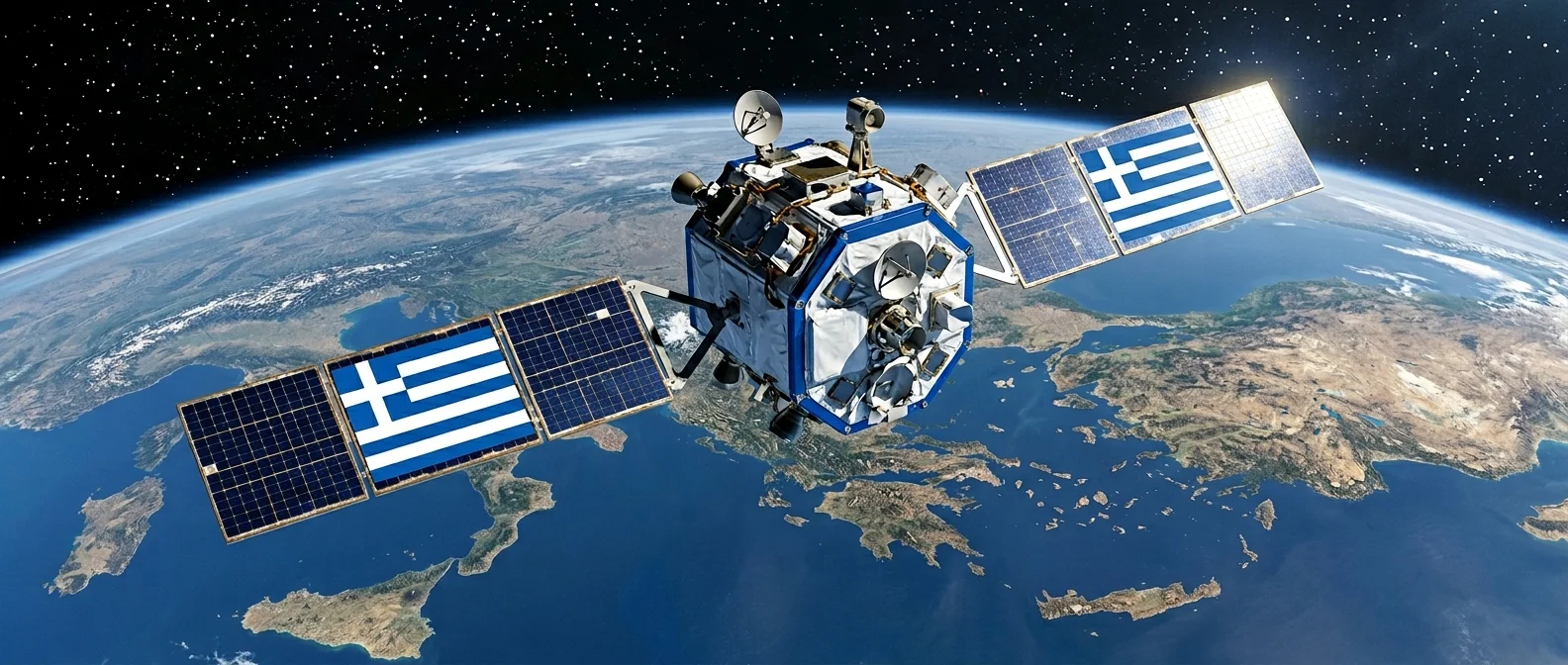
Greece may not be the first country that comes to mind when thinking about space, but the nation is quietly building a serious presence beyond Earth's atmosphere. From the Hellenic Space Centre to student-built satellites, Greece is entering the New Space era with determination and ingenuity.
📖 Read more: Interplanetary Internet: Network from Earth to Mars
The Hellenic Space Centre
The Hellenic Space Centre (HSC) was established in 2019 as Greece's official space agency, headquartered in Athens. Its creation ended decades of fragmented efforts: for the first time, Greece had a unified coordinating body for space activities, research, and industrial partnerships. The HSC oversees national space strategy, manages Greece's relationship with ESA, and supports the country's growing space ecosystem.
Greece has been a full member of the European Space Agency (ESA) since 2005, participating in programs spanning Earth observation, telecommunications, and space science. The country's annual ESA contribution has increased significantly in recent years, enabling greater participation in flagship programs like Copernicus (Earth observation) and Galileo (satellite navigation). Every euro invested in ESA generates contracts and knowledge transfer back to Greek industry.
Greek Satellites
Greece's most visible satellite presence is Hellas Sat. The Hellas Sat 4/SES-14 satellite, launched in 2018, provides satellite telecommunications across Europe, the Middle East, and South Africa. Hellas Sat, a subsidiary of OTE and partner of SES, represents one of the few Greek entities with actual orbital infrastructure.
At the small satellite level, the Aristotle University of Thessaloniki developed UPSat — the first Greek CubeSat deployed into orbit from the International Space Station in 2017. It was also the world's first fully open-source satellite — a breakthrough that made headlines in tech circles but barely registered with Greek media. All hardware designs and software were released publicly, allowing anyone in the world to build their own satellite based on UPSat's blueprints.
Today, multiple Greek teams are developing CubeSats and nanosatellites. The National Technical University of Athens, the University of Patras, the National Observatory of Athens, and several private companies participate in European small satellite programs, covering everything from Earth imaging to IoT connectivity.
UPSat — Open Source in Space: UPSat was developed by students and researchers at AUTH in collaboration with the Libre Space Foundation. All hardware and software were open source, enabling anyone worldwide to use the designs to build their own satellite. This democratization of space technology represents a distinctly Greek contribution to the global space community.
Research and Industry
Greece's space industry extends well beyond satellites. Companies like Planetek Hellas specialize in satellite data processing and Earth observation analytics. Others develop technologies for space vehicles, telecommunications payloads, and ground station equipment. The National Observatory of Athens' Institute for Space Applications participates in European space missions and tracks near-Earth asteroids and analyzes data from the James Webb telescope.
The Corallia innovation cluster for space and defense has helped dozens of Greek companies secure contracts with ESA and other European space organizations. In recent years, new space tech startups have emerged in Athens and Thessaloniki, leveraging Greek expertise in areas like remote sensing, image processing, and AI for satellite data analysis. The Greek space sector's revenue has been growing year over year, though it remains small compared to established space nations.
The New Space Opportunity
The New Space movement — the commercialization of space by private companies — has fundamentally changed the rules. A country no longer needs a NASA-sized budget to have a meaningful space presence. With CubeSats costing between €50,000 and €500,000 and rideshare launches splitting costs among multiple payloads, even universities can send experiments to orbit.
For Greece, this represents a genuine opportunity. The country possesses strong scientific talent, excellent engineering and computer science graduates, while its geographic position makes it ideal for Earth observation applications — from monitoring forest fires to maritime traffic surveillance and environmental monitoring of the Aegean Sea. These are exactly the kinds of specialized, high-value niches where smaller space nations can compete effectively.
Brain Drain or Brain Gain?
One of the biggest challenges is brain drain. Top Greek scientists work at NASA, ESA, SpaceX, and other leading space organizations — but outside Greece. The challenge is creating opportunities within the country that attract this talent back. The Hellenic Space Centre and European funding programs could serve as the catalyst.
Programs like Horizon Europe and ESA Technology Transfer already enable Greek companies and research centers to secure significant funding for space projects. The question is whether Greece can build a critical mass of space companies and research institutions that make staying — or returning — an attractive career choice for its best and brightest aerospace engineers and scientists.
The Future
Greece won't be sending astronauts to Mars anytime soon. But it can become a significant player in specific sectors: satellite data processing, nanosatellites for ecosystem observation, space-as-a-service solutions, and AI for space applications. Greek space is in its launch phase — and that's precisely what makes it exciting. The foundations are being laid now, and the trajectory points upward.