📖 Read more: Sodium Batteries: The Cheap Alternative to Lithium
Why Energy Storage Changes Everything
Solar and wind power are now cheaper than fossil fuels in many countries. The issue isn't price — it's timing. A solar installation generates electricity for only 6-8 hours a day. What happens during the other 16? Lithium batteries solve part of the problem, but they suffer from degradation. After 10-15 years their capacity drops noticeably. They also require rare earth materials — lithium, cobalt, nickel — with all the geopolitical and environmental baggage that comes with it.
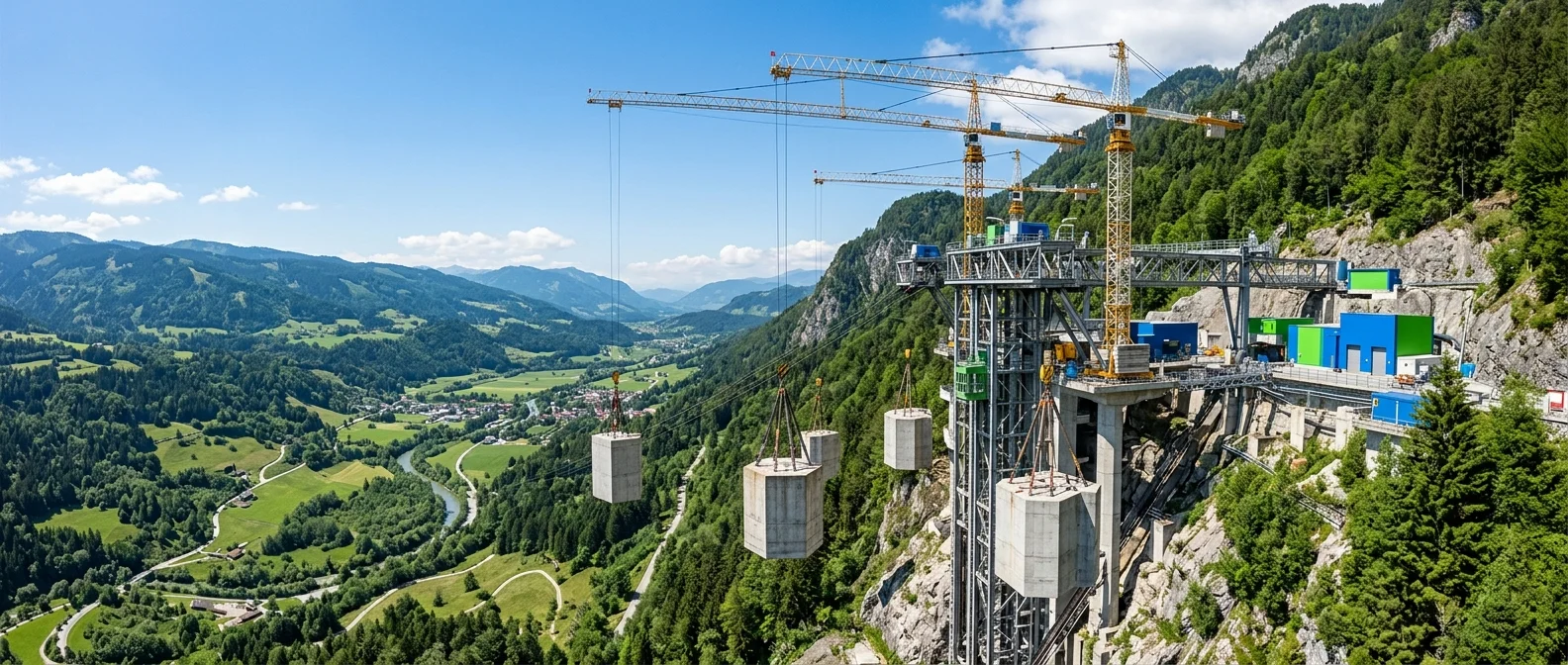
Enter a technology so simple in principle that you wonder why nobody scaled it sooner. Gravity energy storage: lift something heavy when you have surplus electricity, let it fall when you need power back. Kinetic energy converts to electrical energy through generators. Nothing chemical. Nothing that degrades. Pure physics.
Energy Vault: Towers of Concrete Blocks
Energy Vault, founded in 2017 in Switzerland (now headquartered in Westlake Village, California), brought the most well-known version of this technology to market. The concept: a tall structure with automated cranes that hoist composite blocks weighing several tons each to height. When demand rises, the blocks descend in a controlled manner and the kinetic energy generates electricity.
This didn't stay theoretical. The company is already building installations in China — in Rudong and Zhangye — and in March 2026 closed a $150 million convertible note financing. Just a few months earlier, in late 2025, it had secured an additional $135.5 million. The sector is moving fast.
The G-VAULT™ product family includes four variants: EVy™ (the base gravity system with minimal environmental footprint), EVu™ (improved unit economics with mixed-use potential), EVc™ (large-scale pumped hydro anywhere in the world), and EV0™ (pumped hydro without the downsides). Each variant decouples power and energy — you can scale one independently of the other, something batteries don't do easily.
Gravitricity: Weights Down Mine Shafts
Different approach, same principle. Gravitricity, based in Edinburgh, Scotland, instead of building towers exploits abandoned mine shafts. The idea: weights of 500 to 5,000 tons hang on steel cables inside shafts hundreds of meters deep. When there's surplus electricity, the weights get hoisted up. When power is needed, they descend in a controlled manner, spinning generators.
In April 2021, Gravitricity completed a 250 kW pilot test at Edinburgh's port, using two 25-ton weights on a 15-meter tower. The test achieved sub-second response time — faster than even lithium batteries. The company is planning full-scale installations in former mines across the UK, Finland, and South Africa, with storage capacities of 1-20 MWh per shaft.
Why mine shafts? There are thousands of abandoned mine shafts worldwide, ranging from 200 to 1,500 meters deep. Instead of digging from scratch, you use existing infrastructure. The UK alone has over 1,500 former coal mine shafts. Germany has even more. Gravitricity sees them as “gravity batteries” waiting to be activated.
Pumped Hydro: Gravity's Grandfather
Gravity-based storage isn't actually a new idea. Pumped hydro storage has been operating since the 1920s. Two water reservoirs at different elevations: pump water up when you have surplus electricity, let it flow down through turbines when you need power. Today, pumped hydro accounts for over 90% of global large-scale energy storage — roughly 160 GW of installed capacity.
But pumped hydro needs mountains, rivers, vast land areas, and decades of construction. In most countries — especially densely populated or flat regions — suitable sites simply don't exist. The new gravity systems don't need water or deep valleys. Concrete blocks or steel weights fit in a much smaller footprint.
📖 Read more: OTEC: Energy from Ocean Temperatures
Pumped Hydro vs. New Gravity Systems
- Footprint: Pumped hydro requires thousands of acres. A G-VAULT fits on an industrial lot.
- Build time: A pumped hydro dam takes 8-15 years. A gravity tower takes 12-18 months.
- Cost: Pumped hydro has lower LCOS at very large scale, but new gravity systems win on siting flexibility.
- Efficiency: Both operate in the 75-85% range. Energy Vault claims 80%+ over 35 years with zero degradation.
- Environment: Dams alter river ecosystems. Concrete blocks are made from recycled materials.
Data Centers and Emerging Markets
Something unexpected entered the picture: data centers. Energy demand for AI and cloud computing has surged, and with it the need for reliable storage. In February 2026, Energy Vault announced a partnership with Crusoe for modular data center deployment with integrated storage. The idea: instead of relying solely on the grid, you build energy independence right next to your server racks.
Data centers are driving this shift. The sector already consumes over 2% of global electricity, and every large AI model being trained draws megawatts. Companies want 24/7 renewable energy — not “green certificates” but genuinely integrated energy systems. Gravity storage, with its 35+ year lifespan and zero degradation, fits this logic perfectly.
Economics: What It Actually Costs
The key metric in energy storage isn't installation price but LCOS (Levelized Cost of Storage) — how much each stored and dispatched kWh costs across the system's entire lifetime. This is where gravity systems appear to win at longer durations.
A lithium battery costs around $150-250 per kWh installed today, but requires replacement after 10-15 years. A gravity system may cost more upfront, but operates for over 35 years without replacement or degradation. If you add up the cost of 3-4 battery lifecycles, gravity comes out cheaper. Energy Vault reports LCOS between $35 and $70 per MWh depending on duration — competitive even with pumped hydro.
Zero degradation means exactly what it says: a 35-ton concrete block doesn't lose capacity after 10,000 cycles. It doesn't need augmentation, doesn't produce thermal runaway, doesn't catch fire. That's an enormous safety advantage over lithium batteries, which require complex fire suppression and thermal management systems.
What to Expect in the Coming Years
The long-duration energy storage (LDES) market is expected to reach 50-60 GW by 2040 globally. Pumped hydro will claim a large share, but new gravity systems are entering markets where pumped hydro simply doesn't fit — literally.
Energy Vault is no longer a startup: it went public via SPAC in 2022, has deployed 1.4 GWh of storage since 2023, and its stock moves with data center demand. Gravitricity is scouting mine sites across three continents. Behind the scenes, at least a dozen other companies — Advanced Rail Energy Storage, Gravity Power, ARES North America — are working on their own variations: weights on rails, water in shafts, pistons in tubes.
Gravity won't replace lithium batteries. These two solve different problems. Batteries are ideal for fast 2-4 hour response, for homes and electric vehicles. Gravity is for 8-24 hours of grid-scale storage — situations where you need decades of reliability without buying a new system every ten years.
Someday, you might drive past a 100-meter tower with concrete blocks silently rising and falling, powering an entire city. You won't even know it's there. Maybe that's the best kind of technology.