📖 Read more: Dyson Sphere: Energy from an Entire Star
The Problem with Digital Memory
Humanity generates data at a rate exceeding hundreds of zettabytes per year — medical records, scientific measurements, satellite imagery, films, personal archives. But the media we store them on can't keep up. A hard drive lasts 3-5 years. Magnetic tape? 5-7 years. After that, you need to transfer everything to a new medium, or it's gone. Warner Bros. proactively migrates its content every three years to stay ahead of degradation.
That copying cycle costs money. A lot. And it consumes energy — from data center cooling to humidity control systems. Nobody knows how many silent films, how many scientific datasets, how many historical archives have been lost because somebody didn't migrate them in time.
Project Silica: How It Works
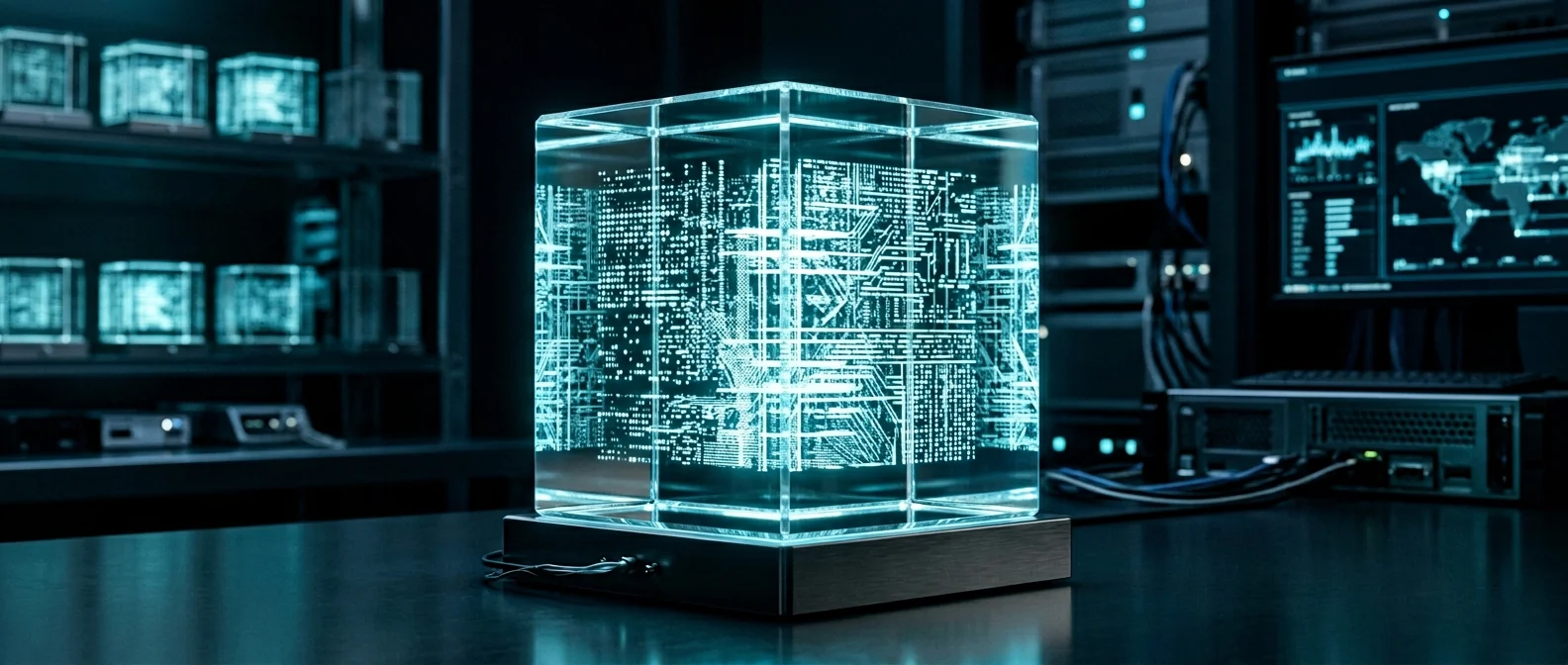
Project Silica, a Microsoft Research initiative in collaboration with the University of Southampton, uses femtosecond lasers (ultrashort light pulses, similar to those used in LASIK eye surgery) to write data inside the structure of the glass itself. The laser pulse physically alters the material, creating three-dimensional nanoscale gratings called voxels (the 3D equivalent of pixels).
Each voxel is encoded by varying the laser's intensity and orientation. The result resembles microscopic upside-down icebergs, each with different depths, sizes, and grooves. A piece of glass just 2 millimeters thick contains over 100 layers of voxels. Think of it as a multi-story data building inside a single platelet.
For reading, machine learning algorithms decode the patterns created when polarized light passes through the glass. Here's the clever part: reading uses ordinary light and microscopy, not lasers. This means it's physically impossible to accidentally erase data during reading — the reader simply doesn't have enough power to modify the glass. Built-in airgap security.
📖 Read more: Exoskeletons: Superpowers for Everyone
Superman on Glass: The Proof
In November 2019, at Microsoft Ignite, CEO Satya Nadella announced the collaboration with Warner Bros. On a glass platter measuring 75 × 75 × 2 mm — about the size of a drink coaster — the team stored the complete 1978 Superman film: 75.6 GB plus error correction codes. Writing, reading, verification — all succeeded.
Warner Bros. had been searching for years for a technology that could last centuries, without climate control, dehumidification, or data migration. The company holds one of the world's largest content libraries: from Casablanca to Friends. Today, for digitally shot films, the archival third copy gets converted back to analog film (cyan/magenta/yellow on black-and-white negatives) — an expensive process that destroys the original pixel values.
A curious full-circle detail: the oldest asset in Warner Bros.' vault is also on glass — Superman radio serials from the 1940s, recorded on glass discs. When they found players, the data was flawless decades later. It started on glass, and now it returns to glass.
Why Glass and Not DNA?
Microsoft is also working on DNA storage — encoding data in synthetic DNA molecules. The density is staggering: theoretically, the entire internet fits in a shoebox. But DNA is fragile, synthesis is expensive, reading is slow and requires biochemical processing (sequencing).
Quartz glass wins on a different axis: resilience. It's immune to electromagnetic fields (unlike tapes and hard drives), needs no climate control, doesn't decompose with moisture. And the material cost? Quartz glass is cheap — the expensive parts are the lasers and reading systems, which get amortized across millions of platters in a cloud deployment.
📖 Read more: Flying Cars: When Will We Fly?
Flooding, fire, electromagnetic pulses, solar flares: all of these destroy magnetic media. Quartz glass survives them all. The Project Silica team tested boiling, baking at 500°C, microwaving, demagnetizing, and scouring with steel wool. Zero data loss in every case.
Designed for the Cloud
Project Silica isn't meant for your home. You'll never slot a glass platelet into your computer to watch a movie. This was designed from the ground up for cold data at cloud scale: archival data with tremendous value but infrequent access needs. Medical records that must be preserved for a patient's entire life. Financial documents with regulatory obligations. Geological data. City building plans.
The team has built a robotic library prototype that manages glass platters — a shuttle transports them from shelves to reader and back. Unlike tape storage where you wait for spooling, the algorithm jumps directly to any point (x, y, z) within the glass. Random access, not sequential.
How far are we from commercial deployment? Write speed and density still need to increase. Using beam steering of the laser, the system already achieves aggregate write throughput comparable to current archival systems. But there's still a gap before reaching the petabyte-scale that Azure demands.
Someday, in a Microsoft data center, there will be shelves holding millions of glass platters — no cooling, no maintenance, no migration cycles. A digital library that will outlast the civilization that built it.