📖 Read more: 3D-Printed Houses: Housing in 24 Hours
🌊 The Problem: Why Dry Land Is No Longer Enough
Rising sea levels are no longer a theoretical scenario — they're a reality unfolding before our eyes. According to the World Economic Forum, over 410 million people live in coastal areas at immediate risk. The world's largest cities — from New York to Tokyo and London to Shanghai — face an existential question: how will they protect their residents from waters that keep on rising?
The traditional answer was dams and pumping stations. The Netherlands, with its famous Delta Works, created one of humanity's greatest engineering achievements. But what happens when even those aren't enough? The answer lies in a radically different philosophy: instead of fighting the water, we learn to live on top of it.
🏠 How Does a Floating Home Work?
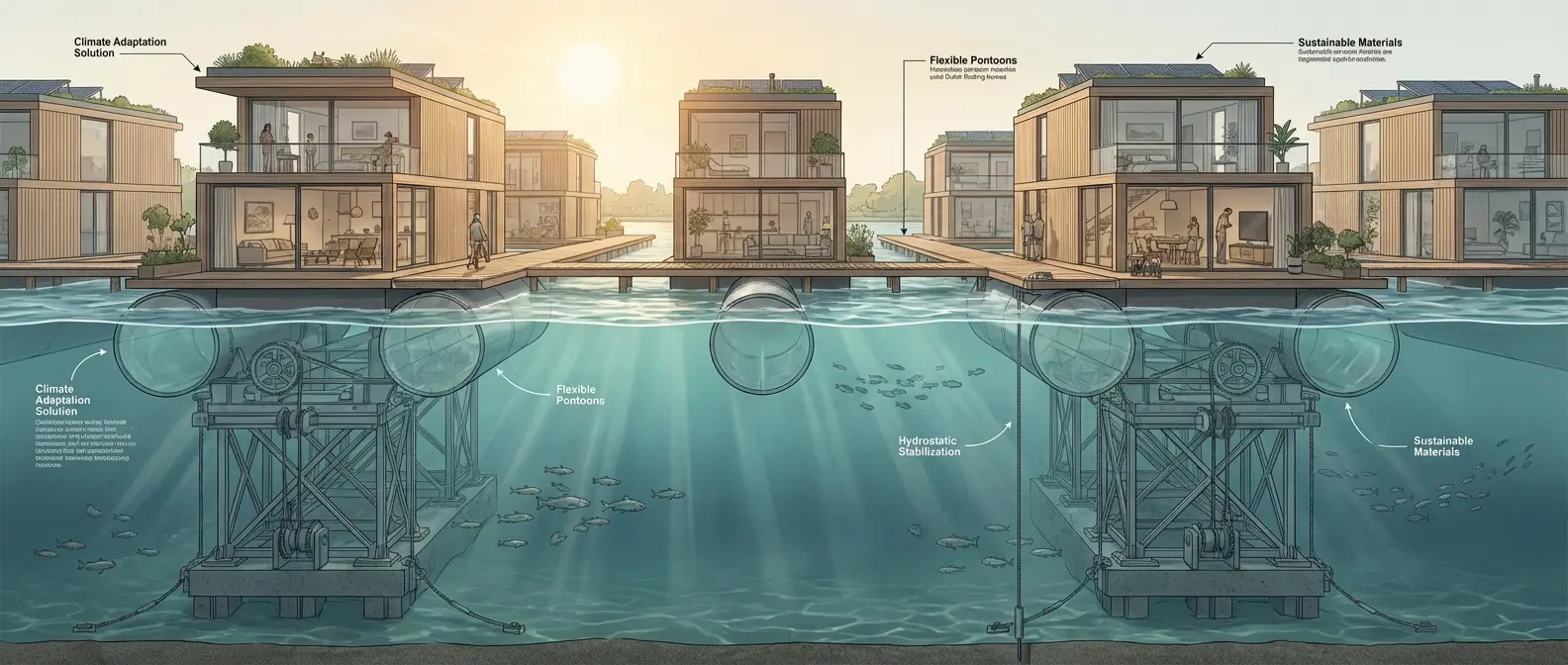
A floating home isn't just a structure that floats — it's a fully functional house that happens to sit on water. The basic principle is simple: Archimedes' principle. Beneath each dwelling lies a foundation of concrete or steel filled with air (or high-density foam), which acts like an enormous inner tube. As long as the house weighs less than the volume of water displaced by the base, the home floats.
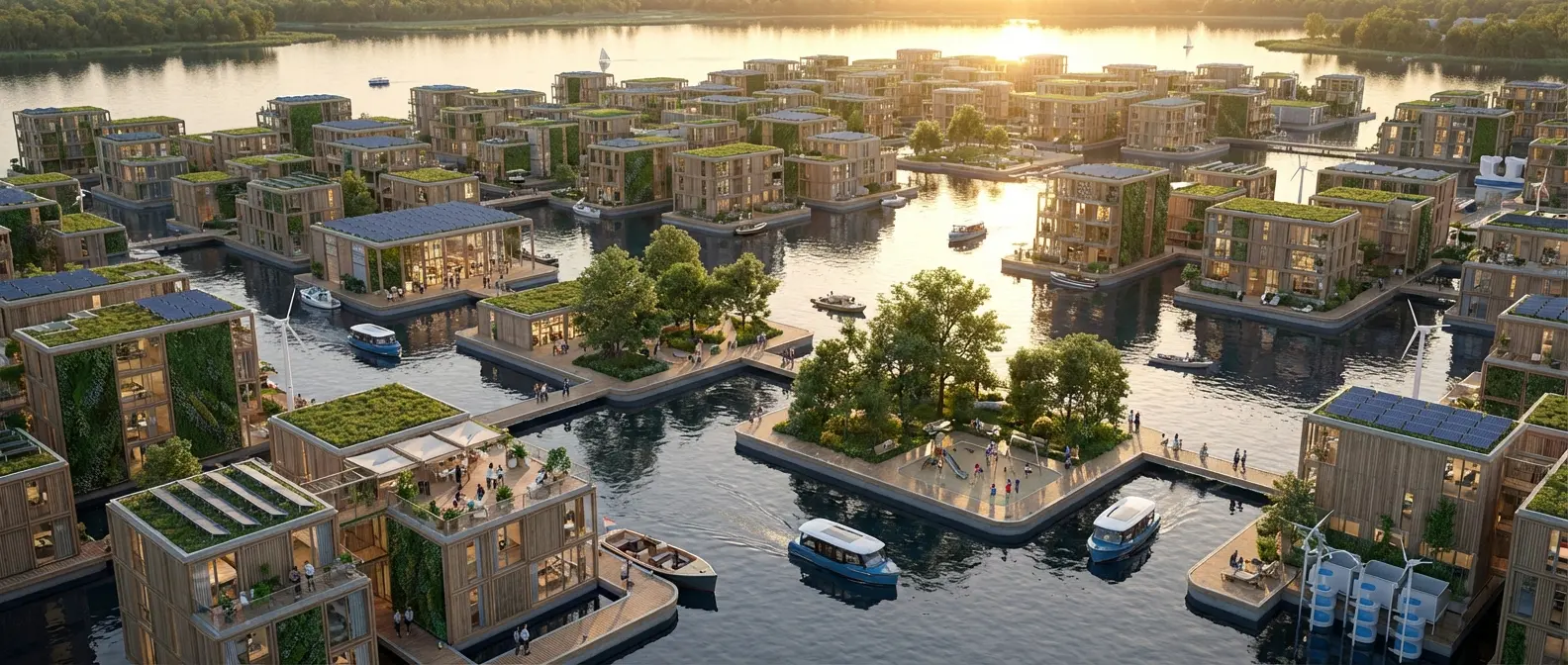
A contemporary floating residence with modern design — the future of urban living
But the technology doesn't stop there. Today's floating homes feature:
- Flexible connections: Water, electricity, and sewage are linked through bendable pipes that move with the house
- Mooring piles: Large metal piles keep the house in place while allowing it to rise and fall freely
- Inclinometers and sensors: Smart systems monitor tilt and alert residents to any issues
- Solar panels: Most residences are energy-independent thanks to photovoltaics
- Water recycling systems: Rainwater is collected and treated on-site
Did You Know?
Floating homes don't rock like boats! Their large buoyancy base and low center of gravity make them surprisingly stable. Most residents report forgetting they live on water after just a few days.
🏘️ Schoonschip: Europe's Most Sustainable Neighborhood
In Amsterdam, tucked behind the Johan van Hasseltkanaal, lies Schoonschip — literally “clean ship” in Dutch. This floating neighborhood of 46 homes and roughly 100 residents is Europe's most sustainable floating community.
The story began in 2008, when a group of architects and engineers decided to create a new form of urban living. It took 10 years of planning, bureaucracy, and construction, but in 2019 the first residents moved in.
What makes Schoonschip stand out:
📖 Read more: Climate Engineering: Can We Save the Planet?
🌍 IJburg & Waterbuurt: The Floating City of Tomorrow
If Schoonschip is the experiment, IJburg is the proof that floating cities can scale. This artificial island community in eastern Amsterdam already houses over 45,000 residents, with plans for many more.
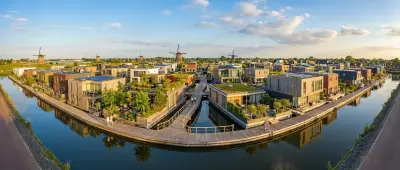
The most striking section is Waterbuurt — the “Water Neighborhood.” Here, 75 floating homes form a genuine neighborhood on the water, with “streets” that are canals and “sidewalks” that are floating platforms.
The floating neighborhood Waterbuurt — 75 homes that float on IJburg
"We don't build on water because it's trendy or interesting. We do it because we have to. The Netherlands will only exist for centuries to come if we learn to coexist with the water."
🏗️ Rotterdam: The Capital of Floating Architecture
While Amsterdam experiments with floating residences, Rotterdam is taking it a step further: entire floating neighborhoods. In 2025, the Danish architecture firm MAST, in collaboration with BIK Bouw, unveiled plans for a floating community in the disused Spoorweghaven harbor.
What the project includes:
- 100+ apartments on floating platforms
- Public spaces — plazas and parks on the water
- Commercial outlets — cafés, shops, restaurants
- Recreational marina — berths for residents' boats
- Modular design — can be expanded gradually
The choice of Rotterdam is no coincidence. As Europe's largest port city, it faces a severe housing shortage. Property prices are skyrocketing while old port facilities sit idle. Floating architecture solves both problems: it puts otherwise unused spaces to work and creates housing without destroying green areas.
⚖️ Pros vs Cons
Advantages
- Flood resilience — the house simply rises with the water
- Utilization of water surfaces
- Lower carbon footprint
- Cooler in summer, warmer in winter
- Portability — you can relocate your entire home
- A one-of-a-kind living experience
- Communities with strong social cohesion
Disadvantages
- High initial construction cost
- Weight limitations (you can't add extra floors)
- Complex bureaucratic processes
- Regular foundation maintenance required
- Insurance companies remain cautious
- Difficulty securing mortgages
- Dependence on land-based infrastructure
💶 How Much Does a Floating Home Cost?
The economics tell a different story. A floating home in the Netherlands costs on average 15–30% more than a comparable conventional house. But the picture is more nuanced:
📖 Read more: Sponge Cities: Absorbing Floods
However, residents save significant amounts in the long run:
- Zero electricity bills (solar energy)
- Reduced heating costs (heat pumps)
- Lower flood-related insurance payouts
- Higher resale value due to uniqueness
🌏 Going Global: Who's Following Suit?
The Netherlands may be the pioneer, but it's no longer alone. Floating communities are popping up everywhere:
🤔 Is It a Realistic Solution for Everyone?
Let's be honest: floating homes won't replace traditional housing. You can't build skyscrapers on water, and densely populated cities need vertical development. But for coastal areas, lakes, rivers, and even certain islands, floating architecture offers a solution that until recently seemed like science fiction.
Greece, with its 16,000 kilometers of coastline and thousands of islands, has natural advantages. Imagine floating tourist facilities that don't damage the shoreline, floating villages in sheltered bays, or even floating marine biology research centers.
"The 21st century will define our relationship with water just as much as our relationship with land. Those who adapt first will lead."
🚀 The Future Is Wet
As climate change accelerates, humanity is forced to rethink everything — from how we travel (electric hydrofoils are already here) to how we live. The Netherlands, that small country that has always “stolen” land from the sea, is showing us that the future doesn't have to be frightening.
It might just be... wet. And perhaps that's not a bad thing at all.
If you're interested in how technology is changing our lives, take a look at the electric vehicles flooding our roads, or see how artificial intelligence is impacting every sector of society.