📖 Read more: Soft Robotics: Gentle Robots with a Soft Touch
What Is an Exoskeleton?
An exoskeleton is a wearable device that augments, enables, assists, or enhances motion, posture, or physical activity through mechanical interaction with the user's body. Unlike prosthetics that replace missing body parts, exoskeletons enhance existing ones.
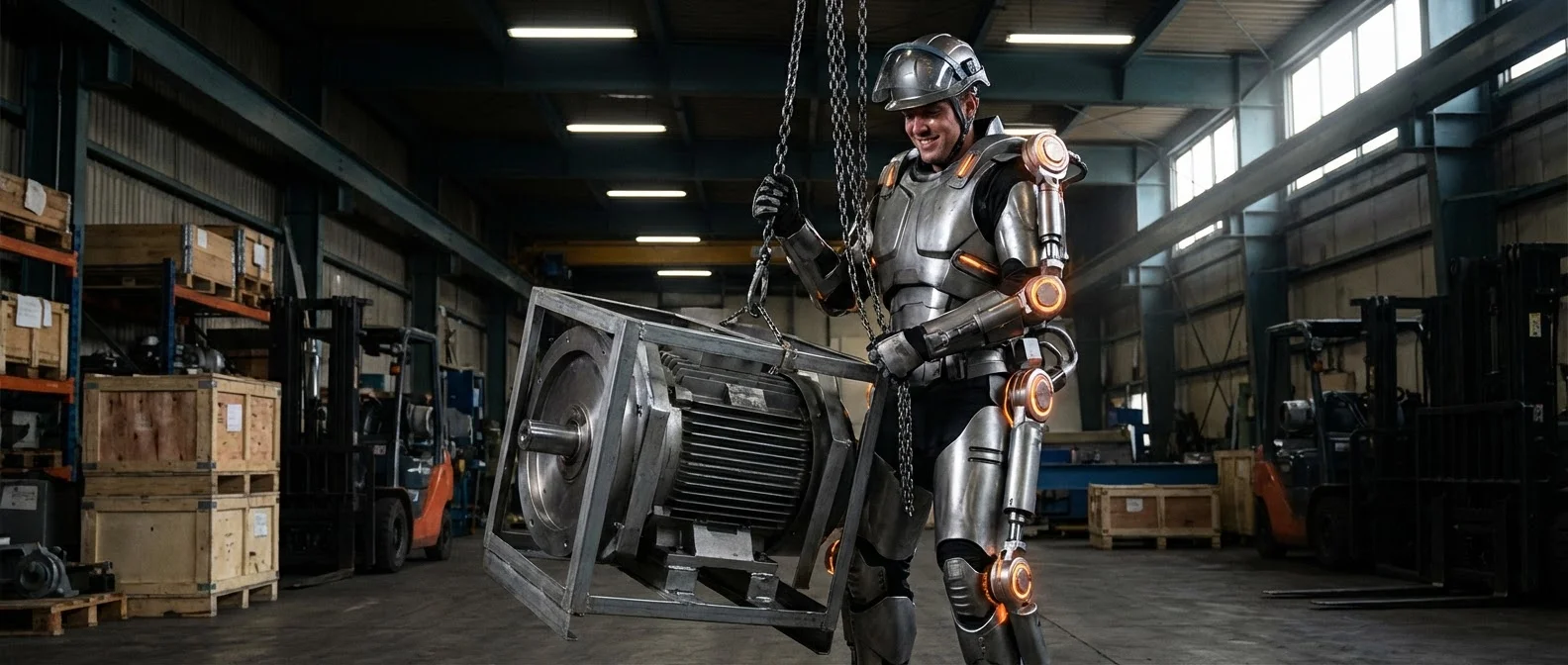
The common image of an exoskeleton — a gleaming Iron Man-style suit of armor — is far from reality. Modern exoskeletons look more like wearable tools: specialized devices designed to solve specific problems, whether it's restoring mobility after a stroke, reducing injuries in warehouses, or helping with skiing.
History: From the 19th Century to Today
The history of exoskeletons begins earlier than you might think. Around 1890, Russian engineer Nicholas Yagin built a device with bow springs between the waist and feet, designed to assist walking, running, and jumping through elastic energy storage and return. In 1917, American Leslie Kelley designed a steam-powered exosuit — a backpack-worn steam engine that transmitted power to artificial ligaments running parallel to the user's muscles.
In 1951, the U.S. Army Ballistics Research Laboratory began studying powered exoskeletons, and in 1963, researcher S. Zaroodny published the first detailed engineering challenge analyses. In the 1960s, General Electric and the U.S. Armed Forces built the Hardiman I — the most ambitious exoskeleton of its era.
🦿 Hardiman I: The Ancestor
The Hardiman I could amplify the wearer's strength by 25 times — lifting 110 kg as if it were 4.5 kg. It featured force feedback allowing the user to feel the objects being manipulated. However, it weighed 680 kg, had slow speed (0.76 m/s), and its motion was “violent and uncontrollable” when moving both legs simultaneously. It was never used in practice.
In the 1970s, Serbian professor Miomir Vukobratović in Yugoslavia developed pneumatically powered lower-limb devices for rehabilitating paralyzed patients — a pioneering medical exoskeleton application. That same decade, wearable camera stabilizers emerged, which could be considered one of the first widely adopted exoskeletons.
The 1980s brought ambitious but impractical designs — like the Pitman from Los Alamos National Laboratory, a military suit with brain-scanning sensors in the helmet. It was never built. The Lifesuit, on the other hand, went through dozens of prototypes, eventually helping people with paralysis walk in public road races.
The Modern Era: From Iron Man to Wearable Tools
In the 21st century, projects like TALOS, SARCOS, BLEEX, and HULC attempted to create full-body Iron Man-style exoskeletons. None were commercialized: too bulky, too expensive, too difficult to control. Sarcos, through a DARPA contract (2001), built the Guardian robotic exoskeletons but remained tethered to a power supply, eventually pivoting to AI software.
Instead, smaller, simpler exoskeletons designed as wearable tools found commercial success. Today, there are over 100 exoskeleton products on the market, ranging from hundreds to hundreds of thousands of dollars, from dozens of manufacturers worldwide. By the mid-2020s, hundreds of thousands of exoskeletons are in use globally, with projections for millions by the 2030s.
📖 Read more: Cryonics: Will We Wake Up in the Future?
Medical Exoskeletons: Walking Again
Medical applications represent the most impactful use of exoskeletons. Patients with stroke, spinal cord injury, cerebral palsy, or limb loss can now walk again, restore balance, hand movement, and coordination.
ReWalk, made by an Israeli company, became the first robotic exoskeleton to receive FDA approval in 2014, for paralyzed patients. Today, medical exoskeletons are used in clinics and hospitals worldwide. They can help restore balance, walking, movement, stability, and even suppress tremors.
"An exoskeleton controlled by an epidural wireless brain–machine interface in a tetraplegic patient: a proof-of-concept demonstration."
In a 2019 Grenoble study, a tetraplegic patient controlled an exoskeleton through a wireless brain-machine interface placed epidurally. It's the first proof that we can bridge the brain directly to mechanical limbs.
Occupational Exoskeletons: Fewer Injuries
Occupational exoskeletons were developed primarily to reduce workplace injuries — especially musculoskeletal disorders from overexertion or prolonged postures. In warehouses, factories, construction sites, and hospitals, workers who lift heavy loads, work overhead, or bend repetitively find relief.
There are back exoskeletons (reducing load during lifting), shoulder exoskeletons (helping with overhead work), hand exoskeletons (reducing strain when gripping tools), and even neck support devices. An 18-month study in an automotive factory confirmed that arm-support exoskeletons reduced injuries and improved worker acceptance.
Military exoskeletons are a subcategory: designed for load carriage, endurance in full body armor, and mission execution. The U.S. Army tested back exosuits in field training exercises, with positive results in reducing fatigue during lifting.
Recreational Exoskeletons: Skiing, Hiking, Running
A more recent category is recreational exoskeletons — designed for leisure activities: walking, hiking, skiing, running. They appeared in the late 2010s, primarily for skiing (reducing knee strain), and in the early 2020s for walking and running.
Research shows that ankle exoskeletons can significantly improve running energy economy — something the sports industry is watching with great interest. Some are sold directly to consumers; others are rented at ski resorts.
Types of Exoskeletons: A Classification
Exoskeletons can be classified in several ways:
📖 Read more: Digital Passport ID: One Chip for Everything
By structure: Rigid — metal or plastic frames — or soft (exosuits) — made from textiles and elastomers. Soft exosuits are lighter and less restrictive to movement but provide less force.
By function: Powered — using electric motors, hydraulics, or pneumatics — or passive — using springs or elastic materials. Passive exoskeletons don't need batteries, are cheaper and lighter, but limited in assistance profiles.
By body part: Neck, shoulders, elbows, wrists, hands, fingers, back, hips, knees, ankles, feet — or more broadly: upper body, lower body, full body.
The Big Challenges
Exoskeletons still face major hurdles:
Comfort: Physical comfort (pressure, chafing), thermal comfort (heat trapping, blocking sweat evaporation), and psychological comfort (social anxiety, noise) are critical. If an exoskeleton isn't comfortable, the user will abandon it.
Fit: Devices must accommodate many body types — heights, weights, genders. The history of safety equipment shows that many devices weren't designed for women, a problem the field is now working to solve.
Power and battery: Powered exoskeletons need batteries — which add weight, require charging, and risk thermal runaway. Bigger battery = more autonomy but more weight.
Control: Human-machine coordination remains a “grand challenge” in the field. The exoskeleton must “understand” the user's intent, respond instantly, and not interfere with natural movement.
Global Impact
Exoskeletons are reshaping industries worldwide. In aging societies like Japan, South Korea, and much of Europe, exoskeletons for elderly mobility represent a critical need. The industrial sector — from automotive to logistics — is rapidly adopting back and shoulder exoskeletons to reduce costly workplace injuries. The EU's OSHA has begun developing guidelines for occupational exoskeleton use, while the U.S. FDA continues expanding approval criteria for medical devices.
The Future: Superpowers for Everyone?
Development is accelerating rapidly. New materials (shape-memory alloys, lightweight composites), better sensors, AI-powered control, and brain-machine interfaces can bring exoskeletons closer to the ideal.
They won't be Iron Man — they'll be something better: practical, comfortable, accessible tools that help millions of people walk, work, and enjoy their lives without pain. Not Hollywood-style superpowers, but real superpowers — the ones that make a difference in everyday life.
"The vast majority of modern exoskeletons are more like wearable tools than like super suits or Hollywood exoskeletons."