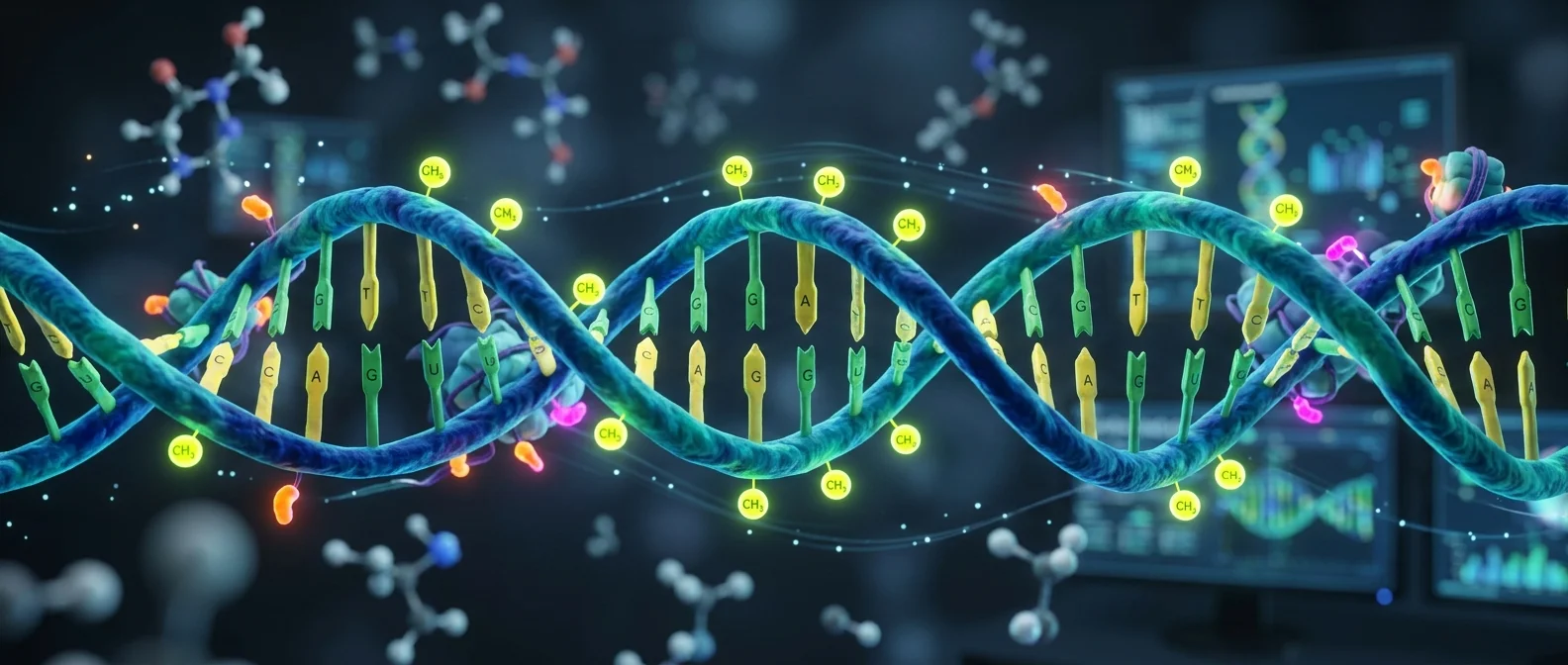
Imagine you could “switch off” a gene that causes cancer — without altering a single letter in your DNA. That's not science fiction. It's epigenomics, a field rewriting the rules of heredity and biology.
📖 Read more: Senolytic Drugs: Reversing Aging
What Is Epigenomics
Our DNA contains roughly 20,000 genes. But every cell in the body — from neurons to muscle fibers to liver cells — uses only a subset of them. What decides which genes get “switched on” and which stay “silent”? The epigenome.
The term comes from the Greek “epi” (upon) and “genome.” It refers to a collection of chemical signals — molecular “tags” — that sit on top of DNA and histone proteins without altering the genetic sequence. Think of DNA as a book with 3 billion letters. The epigenome is the bookmarks and highlights telling each cell which pages to read.
The Two Core Mechanisms
DNA Methylation
The most studied epigenetic modification. Methyl groups (CH₃) attach to cytosine bases in DNA, typically at CpG regions. When these groups cover a gene's “switch” (promoter), they silence it — halting production of the corresponding protein. Methylation explains why an eye cell produces light-sensing proteins while a muscle cell doesn't — even though both carry exactly the same DNA.
Histone Modification
DNA doesn't float freely in the nucleus. It wraps around spool-like proteins called histones. Chemical groups — acetyl, methyl, phosphate — can be added or removed from histones, changing how “tightly” or “loosely” the DNA wraps. Loose DNA = accessible genes = active. Tight DNA = closed genes = silent.
Analogy: If DNA methylation is like putting a padlock on a drawer, histone modifications are like adjusting the tightness of a screw — you can control how easily it opens without changing what's inside.
CRISPR Epigenome Editing: The Revolution
CRISPR is famous for its ability to “cut” DNA. But a newer version — dCas9 (dead Cas9) — doesn't cut anything. Instead, it carries tools to the exact location on the genome. Fused with methylation enzymes (e.g., DNMT3A) or deacetylases (e.g., KRAB), it can “silence” or “activate” a gene without altering a single letter of the DNA sequence.
The most important advantage: epigenetic modifications are reversible. If something goes wrong, you can theoretically remove the tag. This doesn't apply to the permanent DNA changes made by classic CRISPR — a distinction that could prove crucial for patient safety.
Epigenomics and Aging
In 2013, Steve Horvath (UCLA) introduced the epigenetic clock: by measuring methylation levels at 353 specific CpG sites, he could predict a person's biological age regardless of their chronological one. People with a “faster” epigenetic clock showed higher risk for aging-related diseases.
"Aging isn't just wear and tear. It's a loss of epigenetic information — cells forget what they're supposed to be."
— David Sinclair, Harvard Medical SchoolIn 2006, Shinya Yamanaka (Nobel Prize 2012) discovered that just four factors — Oct4, Sox2, Klf4, c-Myc — can “reprogram” cells, resetting them to a primitive state. Partial application of these factors (without full dedifferentiation) now forms the basis for companies like Altos Labs (founded 2022, $3 billion funding, backed by Jeff Bezos), researching “cellular rejuvenation” through epigenetic reprogramming.
Therapeutic Applications
The first approved epigenetic drugs already exist. Azacitidine (Vidaza) and decitabine — DNA methylation inhibitors — treat myelodysplastic syndromes and acute myeloid leukemia. Vorinostat (Zolinza), a histone deacetylase inhibitor, treats cutaneous T-cell lymphoma. These drugs work by restoring correct epigenetic patterns in cancer cells — “reminding” them how to stop uncontrolled growth.
In sickle cell disease, researchers are exploring the possibility of reactivating fetal hemoglobin (HbF) through epigenetic modification — an approach that could compensate for the defect without requiring gene therapy.
Environment and Inheritance
Perhaps the most disruptive discovery in epigenomics concerns inheritance. The Dutch Hunger Winter study (1944-45) revealed that children of women who were malnourished during the war showed higher rates of obesity and metabolic disorders decades later — changes that were transmitted to the third generation. The Swedish Överkalix study showed similar results: grandparents' diet affected their grandchildren's mortality rates.
Key Insight: Smoking, diet, pollution, stress — they don't just change you. They may alter genes — more precisely, their expression — for generations to come. Epigenomics turned the phrase “you are what you eat” into “your children may be what you eat.”
Challenges and the Future
Epigenomics is still in its early stages. The main challenges include:
- Targeting precision: dCas9 tools need to become more accurate — “off-target” modifications on the wrong gene can cause unpredictable damage.
- Delivery: How do you transport tools to specific body tissues? Lipid nanoparticle (LNP) technology used in COVID mRNA vaccines is a candidate solution.
- Durability: How “permanent” is an epigenetic change? Some are erased after just a few cell divisions.
- Ethics: If we can “reprogram” aging, who gets access? How does society change if age becomes adjustable?
The ENCODE (ENCyclopedia Of DNA Elements) program at NIH and the Cancer Genome Atlas (TCGA) are systematically mapping the epigenomes of normal and cancer cells. Each new discovery brings personalized medicine closer — a doctor who can “read” a patient's epigenome and intervene exactly where needed, without touching the fundamental genetic sequence.