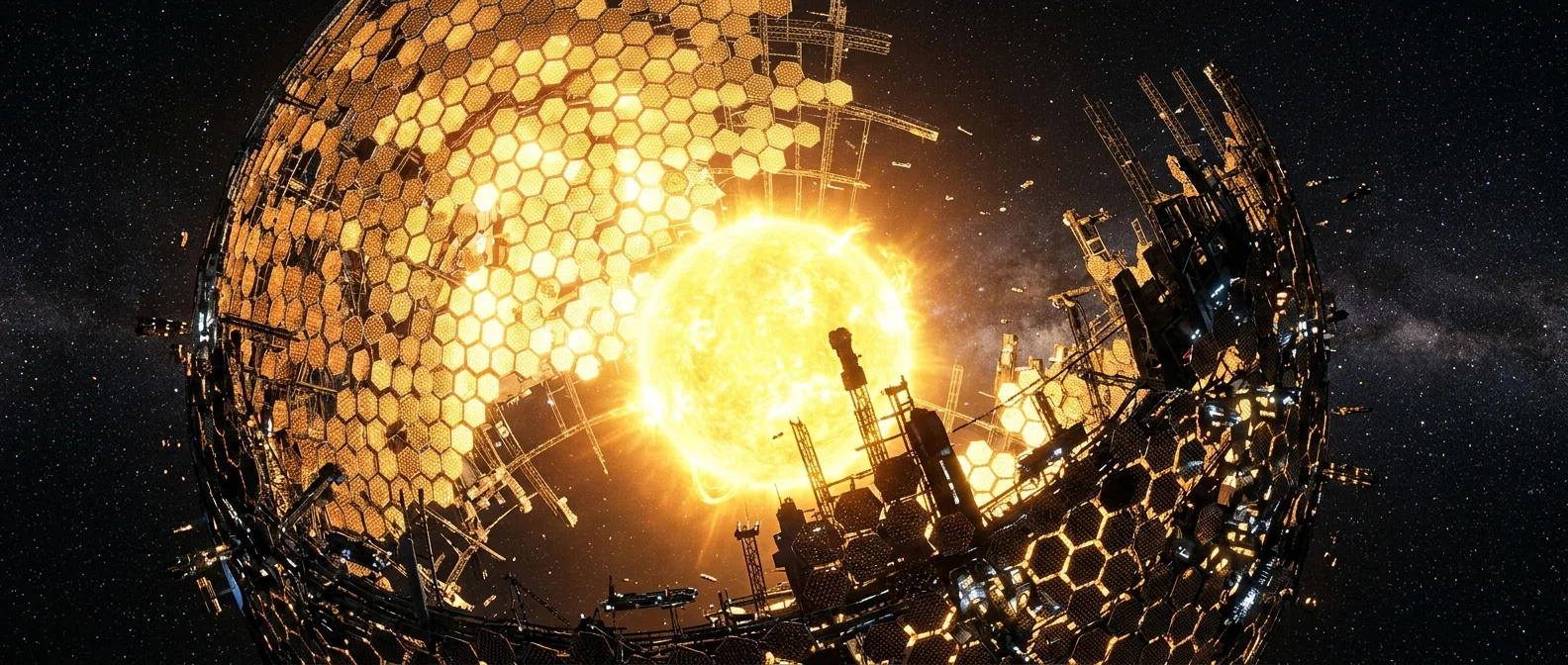
Imagine staring at the Sun — not as some distant ball warming your skin, but as a colossal energy engine wasting almost everything into the void. Every second, our star radiates 3.86 × 1026 watts. Earth captures a microscopic fraction. What if a civilization could capture all of it?
What Is a Dyson Sphere
A Dyson sphere is not a solid metal ball around a star — that image belongs squarely to science fiction. Physicist Freeman Dyson never designed one. In his 1960 paper in the journal Science, titled “Search for Artificial Stellar Sources of Infrared Radiation,” he proposed something far more realistic: a swarm of satellites orbiting a star, designed to intercept and collect its energy.
Dyson drew inspiration from Olaf Stapledon's 1937 novel Star Maker, which described “a gauze of light traps” surrounding every star in the universe. As Dyson later admitted: "I took the idea from Stapledon. Some science fiction writers have wrongly given me the credit."
Key Clarification: Dyson explicitly stated that “a solid shell or ring surrounding a star is mechanically impossible.” The form of “biosphere” he envisioned was "a loose collection or swarm of objects traveling on independent orbits around the star" — what we now call a Dyson Swarm.
Types of Dyson Megastructures
Dyson's original idea spawned numerous engineering variants. Each addresses different challenges of stability, gravity, and mechanical feasibility.
Dyson Swarm — The Practical Option
The most realistic version. Millions or billions of independent solar collectors orbit the star. If one section is damaged, the rest continues operating normally. Each unit can carry thrusters for orbital correction.
Dyson Shell — The Sci-Fi Classic
The iconic solid sphere from movies and TV shows. Mechanically impossible according to Dyson himself. Gravitational perturbations would push it into the star (the Shell Theorem means zero net gravity inside).
Dyson Ring — The Belt
A single ring orbiting the star — think Saturn's rings scaled up enormously. More mechanically feasible than a shell but captures far less energy than a full swarm. Popularized in Larry Niven's novel Ringworld (1970).
Dyson Bubble — The Static Solution
A mass of “statites” — static satellites that remain motionless, balanced between gravity and radiation pressure. Avoids the need for orbits but demands extraordinarily light materials.
How to Build a Dyson Swarm
You don't start with launches from Earth. Astronomer Stuart Armstrong from the University of Oxford proposed a bootstrapping strategy: start small, scale exponentially.
First, place a small number of solar collectors near Mercury — the planet closest to the Sun. The energy they harvest powers robotic mining of Mercury itself. New collectors are manufactured, which power even more mining. The cycle becomes exponential.
Armstrong's Strategy:
1. Deploy initial solar panels in Mercury's orbit
2. Mine Mercury using self-replicating robots (von Neumann machines)
3. Each new “generation” produces more collectors → exponential growth
4. Mercury is fully disassembled in decades, not centuries
5. Enough material for a swarm at 245 grams per square meter in Mercury's orbit
George Dvorsky has argued that self-replicating robots could overcome the industrial barrier in a relatively near-term timeframe. Dyson's original paper estimated that dismantling a Jupiter-sized planet would be necessary — but Mercury offers a more practical alternative given its proximity to the Sun.
The Kardashev Scale and the Energy Future
In 1964, Soviet astronomer Nikolai Kardashev proposed a scale for classifying civilizations based on their energy consumption:
Humanity currently sits at 0.7449 on the scale — we don't even fully utilize the energy available on our own planet. A 2023 study in Scientific Reports used machine learning to predict we'll reach Type I around the year 2371. The jump to Type II? Millennia away — unless technological progress accelerates dramatically.
A Dyson sphere is essentially the definition of Type II: a civilization harnessing the entire energy output of its star. Beyond energy, the architecture could support computational workloads — the so-called Matrioshka Brain, a galactic supercomputer powered by nested layers of Dyson spheres.
Hunting for Dyson Spheres: Project Hephaistos
If a star were “wrapped” in a Dyson swarm, how would we detect it from dozens of light-years away? The answer lies in thermodynamics.
Solar collectors absorb visible light and emit thermal energy — “waste heat” — in the infrared. A star with a Dyson swarm would show anomalous excess infrared radiation relative to its spectral type. Astronomers hunt for precisely this signature.
Project Hephaistos, led by Erik Zackrisson at Uppsala University in Sweden, analyzed data from three major databases: Gaia DR3, 2MASS, and NASA's WISE — covering 5 million stars. Using machine learning, the team identified 7 Dyson sphere candidates in May 2024.
All seven stars were M-dwarfs — red dwarfs, smaller and dimmer than the Sun. A rebuttal paper showed that at least some candidates sit very close in the sky to dusty background galaxies emitting strongly in the infrared. As Zackrisson noted: "For the cases where radio is detected, I completely agree. For the cases where no radio source has been detected, the situation is less clear-cut."
The Mystery of Tabby's Star
In October 2015, citizen scientists with Planet Hunters spotted unusual brightness dips in star KIC 8462852 — known as “Tabby's Star,” after astronomer Tabetha Boyajian. The brightness dropped by as much as 22% — far more than the ~1% a Jupiter-sized planet would cause.
"The Most Mysterious Star in Our Galaxy" — The Atlantic headline, October 2015, that sparked worldwide speculation about an alien megastructure.
Ross Andersen, The AtlanticThe alien megastructure theory collapsed. Studies from 2018 by Boyajian herself and others showed the dips were consistent with clouds of dust — possibly from an evaporating orphaned exomoon or an exocomet. Natural explanation, not alien engineers.
Challenges and Criticism
Even Dyson himself didn't take the idea entirely seriously. In a 2003 interview with Robert Wright, he called his paper “a little joke” and commented: “You get to be famous only for the things you don't think are serious.” Yet in a later interview at the University of Edinburgh in 2018, he described the underlying premise as “correct and uncontroversial.”
The engineering barriers dwarf the philosophical questions:
- Materials: Dismantling an entire planet (Mercury or larger) requires technology centuries ahead of ours
- Logistics: Billions of independent satellites need autonomous maintenance — likely self-replicating robots
- Radiation & gravity: Bit flips in electronics, orbital drift, collisions between components
- Timescale: Even with exponential growth, estimated at decades to centuries — if we begin at all
- Alternatives: Nuclear fusion, antimatter, or even shrinking energy demand could make a Dyson sphere unnecessary
Future and Significance
A Dyson sphere isn't just an engineering problem — it's a philosophical question. If a civilization could build one, would it? Or would it find more elegant ways to live with less energy?
For astronomers, the real value lies in detection. The James Webb Space Telescope (JWST) and ALMA can examine the 7 Project Hephaistos candidates with mid-infrared spectroscopy. If the excess infrared comes from dust, characteristic emission features will appear. If — theoretically — it's a Dyson swarm, the emission would be pure continuum radiation.
The idea has stayed alive for over 65 years. Even if we never find one, the search pushes the boundaries of our technological imagination — and reminds us that the sky, in Dyson's own words, "is crawling with infrared sources which look just the way a Type II civilization might look."